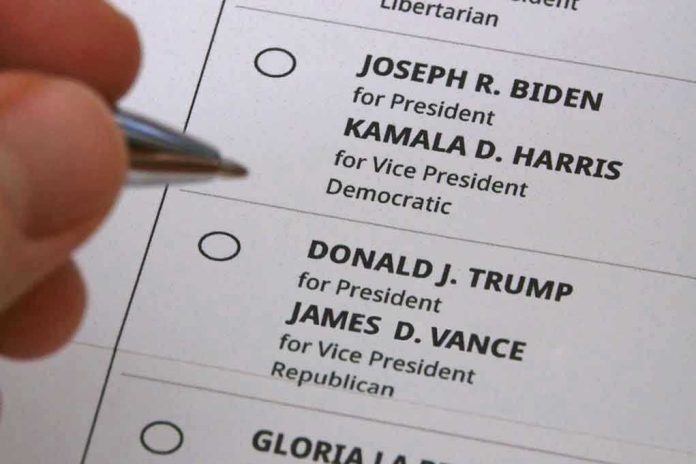
When two candidates with the same surname appear on the same ballot, the risk is not an abstract civics-class hypothetical; it is a mechanical stress test of election design, legal authority, and post-election remedies—especially under ranked-choice voting, where first-choice tallies can cascade into the final outcome.
The Short Version
- The Justice Department filed a federal lawsuit seeking to block Alaska from certifying its U.S. Senate race if Senator Dan Sullivan loses and reassigning votes cast for “Daniel J. Sullivan” would change the result.
- DOJ’s theory centers on likely voter confusion created by two Sullivans on the ballot and frames the requested relief under federal statutory obligations to protect election integrity.
- The remedy is conditional: delay certification only if the “namesake” votes could be outcome-determinative after tabulation under Alaska’s ranked-choice system.
- Alaska already distinguished the candidates on the ballot, and state courts previously allowed Daniel J. Sullivan to remain on it, setting up a federal-state clash over certification authority.
What DOJ Is Asking For, And Why It Matters
The government’s complaint takes an unusually targeted approach: it does not seek to halt Alaska’s election or to remove a candidate after ballots are printed; it seeks to pause certification only if a specific contingency materializes. If Senator Dan Sullivan loses, and if votes cast for the separate candidate named Daniel J. Sullivan—whose name and purported party identification could plausibly confuse some voters—would have flipped the outcome had they been counted for the incumbent, DOJ asks the court to bar certification and require an investigation into voter intent. The department ties this request to federal law protecting election integrity, arguing that certifying a result marred by name-driven confusion would violate national standards for fair federal elections.
This conditional structure matters. It narrows the intervention to the decisive margin rather than every instance of potential confusion. In practical terms, DOJ is saying: only if the “namesake” vote is big enough to plausibly change the winner should the state delay certification and sort out intent before the result is finalized.
How Confusion Could Operate Under Ranked-Choice Voting
Alaska uses ranked-choice voting for general elections: voters rank candidates; if no one secures a majority of first-choice votes, the last-place candidate is eliminated and ballots transfer to the next-ranked choice, repeating until a candidate crosses 50 percent. Name confusion typically shows up in first-choice tallies—where an inattentive or uncertain voter may tap or fill the oval next to the wrong “Sullivan.” In a close race, even a small first-round misallocation can echo through subsequent elimination rounds, altering who survives to the final allocation and by what margin.
In that ecosystem, DOJ’s focus is not a generalized fear of muddled ballots; it posits a clear causal chain: if Daniel J. Sullivan’s first-choice pile is materially composed of voters intending to support the incumbent, ranked-choice arithmetic could be distorted. The complaint’s logic is straightforward: isolate whether those votes were decisive, and if so, hold certification to examine intent before locking in an outcome the state cannot later unwind.
Ballot Design, State Process, And The Pre-Election Rulings
Alaska officials took steps to differentiate the two candidates on the ballot—distinguishing the incumbent and using middle initials—after litigation over whether the “namesake” could appear in the first place. State courts permitted Daniel J. Sullivan to remain, leaving Alaska to mitigate the risk through labels and layout rather than disqualification. Those design choices matter, but they do not fully eliminate the possibility of confusion: in live voting, recognition shortcuts, ballot scanning habits, and party heuristics often dominate.
Against that backdrop, DOJ’s request is not to relitigate ballot access, but to limit certification if, and only if, the evidence shows the namesake vote could have determined the winner. That places federal and state authorities on parallel tracks: Alaska exercised its pre-election authority to craft a lawful ballot and let voters decide; DOJ seeks post-vote review if the specific harm the state tried to mitigate nonetheless proves decisive.
The Legal Theory DOJ Is Advancing
Rather than couching its action in broad rhetoric, the department anchors its claim to federal statutory obligations that govern the integrity of federal elections—arguing that proceeding to certification where mistaken-identity voting likely altered the outcome would violate those obligations. The essential assertion is remedial: federal courts can require states to pause certification long enough to determine whether the federally protected electoral process was compromised by a unique, identifiable defect—here, twin names that could mislead reasonable voters seeking the incumbent.
Framed this way, the lawsuit is not about second-guessing policy choices Alaska already made, but about the federal role in preventing certification of a result that, on a defined evidentiary showing, would not reflect voter intent. The conditional posture is key; DOJ is not seeking to supervise Alaska’s count in real time, only to cabin the finality of certification to ensure the winner’s legitimacy under federal standards.
What Evidence Would Actually Set The Trigger
The government’s standard, as described in reporting, requires two showings: first, that the incumbent does not win under the certified tabulation; second, that reallocating votes cast for Daniel J. Sullivan to Senator Sullivan would change that outcome. That implies a mechanical analysis of the ranked-choice record: ballot-level or cast-vote-record review, identification of ballots ranking both Sullivans in patterns suggestive of mistaken identity, and sensitivity testing to see whether reassignments within reasonable parameters flip the result.
Courts have the tools to structure this inquiry. Judges routinely order production of anonymized cast-vote records, direct parties to submit expert simulations under competing assumptions, and take limited evidence—surveys, affidavits, or statistical signatures—aimed at distinguishing confusion from genuine support. The point is not to “divine” each voter’s state of mind, but to test whether a plausible, quantifiable confusion effect was outcome-determinative, which is the only circumstance that would justify delaying certification under DOJ’s own requested terms.
🗳️ Trump says he personally ordered the Justice Department lawsuit that could stop Alaska from certifying its Senate race if Sen. Dan Sullivan loses. The reason is a second Dan Sullivan on the ballot. https://t.co/UGbWtoY4Gf
— Thomas Jones (@Thomas_JonesX) October 23, 2026
Why This Case Is Structurally Unusual
American election litigation has often addressed similar-name candidates, but the fight typically occurs pre-election and focuses on ballot access or design. Alaska’s dispute departs from that pattern by making post-election certification the fulcrum: do not finalize the winner if a namesake effect likely changed who won. That moves the controversy from preventative design to remedial legitimacy. It also reflects a broader national trend of pairing a specific ballot theory with a targeted injunction to pause certification until defined questions are resolved.
Implications For Future Contests
Two practical lessons emerge. First, jurisdictions using ranked-choice voting should treat name-collision risk as a design-level hazard—alongside typography, order effects, and instructions—and formalize protocols before ballots are printed. Distinct labeling (incumbent status, middle initials, party), educational inserts, and sample-ballot saturation are low-cost mitigations. Second, where a name collision survives into the general election, election administrators should plan for a structured post-tabulation audit capable of quantifying confusion signatures rapidly, so the legal system has evidence equal to the stakes.
Sources:
cbsnews.com, cnbc.com, cnn.com, abcnews.com, upi.com, commondreams.org