
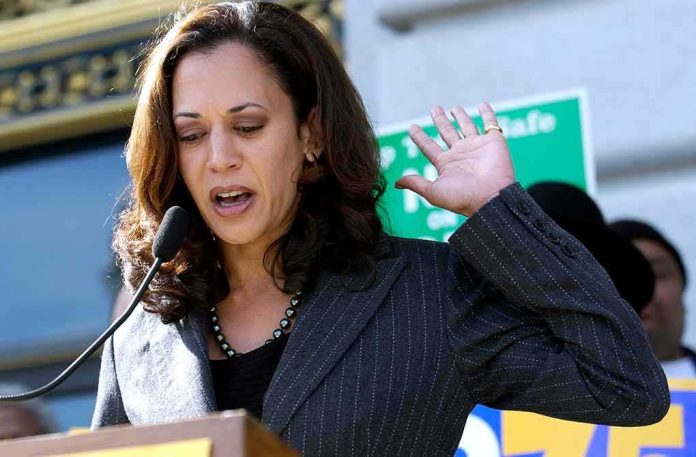
Campaign moments do not happen in a vacuum; they land inside a media environment that amplifies the punchy and the awkward while often obscuring the full scene, which is why understanding what actually occurred at Kamala Harris’s Columbus, Mississippi rally—and what we can and cannot responsibly infer from it—matters beyond one evening’s sound bite.
At a Glance
- Kamala Harris headlined a campaign rally in Columbus, Mississippi, on October 22, 2026, supporting Democratic Senate candidate Scott Colom; the stop was part of a broader late-campaign swing.
- The event was publicly promoted and then relocated from a university venue to Columbus High School after logistical issues; the rally proceeded as scheduled.
- Claims that Harris mangled a motivational quote and drew “crickets” from the crowd circulated afterward, but independent reporting documents the rally—not the specific line or the audience reaction.
- This episode fits a recurring pattern in campaign media wherein clipped moments outrun fuller records; context and primary recordings determine whether a viral framing holds up.
What happened in Columbus: the documented facts
On October 22, 2026, Kamala Harris traveled to Mississippi for campaign stops that included a rally in Columbus on behalf of Scott Colom, the Democratic challenger in the state’s U.S. Senate race. Local and national outlets previewed and covered the visit, identifying Columbus High School as the final venue after an initial plan to host the event at Mississippi University for Women fell through for logistical reasons. The rally’s purpose was clear: energize Democrats, mobilize persuadable voters, and give Colom a late-stage boost against the Republican incumbent, Cindy Hyde-Smith.
Colom’s team publicly promoted the event days in advance, calling for a high-energy community rally and positioning Harris as a top-of-ticket surrogate who could lend attention and momentum. The schedule placed Columbus alongside other late-campaign stops, consistent with how national figures barnstorm competitive or strategically important states in the final stretch.
The viral claim versus the record
After the rally, a story frame circulated that Harris butchered a motivational quote on stage and, after asking to “repeat that,” drew silence—“crickets”—from the audience. Here is what the documentary record supports. First, the rally happened on the date and at the place reported; second, it was indeed promoted as a political event likely to generate clips and commentary; third, contemporaneous coverage confirms Harris’s Mississippi swing that day. What the record does not independently establish is the precise wording attributed to Harris or the audience’s characterized response. The available reporting anchors the rally itself, not the disputed line or crowd reaction.
That gap is not unusual. In modern campaigns, a short, emotionally framed clip often races ahead of fuller footage or transcripts. Researchers label this dynamic a “cheap fake” or context collapse: not deepfakes, but selective editing or interpretation that reassigns meaning without fabricating pixels. In such cases, authoritative judgment rests on primary audio and the immediate setting—what was said, in sequence, and how the room responded—rather than on captions or partisan gloss.
Why campaign acoustics and venue changes complicate reaction claims
Audience response is a function of acoustics, stagecraft, and expectations as much as rhetoric. High school gyms behave differently than purpose-built arenas: sound dissipates, microphone dynamics can exaggerate pauses, and a call-and-response line that works in a union hall may hang in the air in a larger, colder room. Columbus High School became the venue only after the university declined to host the event for logistical reasons; any last-minute shift means revised staging, altered crowd flow, and potential changes in press sight-lines and audio pickup. Those details matter when a single beat of silence is used to stand in for the room’s energy.
None of that excuses a poorly delivered line if one occurred. It does explain why responsible assessments prefer complete recordings over clipped moments—and why venue and production context belong in any fair reading of a purportedly awkward exchange. The mechanism is straightforward: room size and mic gain affect perceived crowd volume; camera placement affects how many audience mics capture response; and a beat for applause, if mistimed, can read as dead air even when pockets of the crowd react.
How this stop fit Harris’s broader late-campaign push
Mississippi was not an isolated cameo. Harris was making a strategic late-campaign push across multiple states to bolster Democratic candidates and shape the closing argument of the midterm cycle. National coverage framed these visits as part of a concentrated tour to galvanize turnout, especially where margins are historically tight or where statewide infrastructures need reinforcement from national figures. In that context, the Columbus rally served two functions: signal national investment in the race and create local content—photos, short videos, and quotes—for field organizers to circulate in the final sprint.
Colom’s campaign positioned the event as a momentum-builder aimed at volunteers and persuadables alike. The logic is familiar: a high-profile surrogate can reset narrative attention, draw press that might otherwise ignore a down-ballot contest, and give local candidates a larger stage. The tradeoff is equally familiar: every syllable is recorded, clipped, and judged in the performative court of social media, where snappy derision often outperforms nuanced context.
"These people in Washington are trying to make you feel powerless and alone. You have Scott Colom, and he will fight for you. The people of Mississippi have a choice. Don't let anybody tell you who you are, you tell them who you are." – Kamala Harris pic.twitter.com/h2Fyd75xNU
— Fabi 🪷 (@kamala_things) October 23, 2026
The media pattern: why context beats captions
Episodes like Columbus recur every cycle. A line stumbles or a cadence lands flat; a clip circulates with a knowing caption; the insinuation becomes the story. What changes the analysis is not the spin but the evidence—authoritative video, contemporaneous transcripts, and corroborated accounts. In the absence of those, sober observers default to what is firmly established: the rally happened as part of a documented campaign itinerary; the venue shifted; the candidate delivered remarks in a gym built for basketball, not broadcast; and the rest requires primary material to adjudicate.
There is a reason these distinctions matter beyond one candidate. The informational economy of campaigns rewards the rapid, the clipped, and the confidently framed. Yet accountability in political coverage—whether praising a stemwinder or lampooning a stumble—depends on reconciling the viral with the verifiable. That means weighting contemporaneous local reporting for the who-what-where-when, and expecting claims about the how—delivery, quotes, crowd dynamics—to rest on primary recordings rather than captions alone.
What to watch for when the next clip drops
When the next campaign moment trends, a simple checklist protects your judgment: Was the event itself documented by independent outlets? Does a complete video exist, and does the circulating segment preserve its sequence? Are there matching accounts from people in the room with no obvious incentive to embellish? If the claim hinges on a quotation, can it be matched to an authoritative text? Applied to Columbus, the first answers are yes; the others await primary materials. Until then, the durable facts are the itinerary, the venue, and the campaign purpose; the rest is a claim that lives or dies by the tape.
Sources:
drooid.social, newsweek.com, wtva.com, x.com, supertalk.fm, magnoliatribune.com, apnews.com