Political rhetoric routinely turns private life into a stage, and few lines show that more clearly than President Trump’s rally claim that men tell him he “saved” their marriages because their 401(k)s are up and their wives now see them as financial geniuses.
At a Glance
- At a Corinth, Mississippi rally, President Trump said men tell him their wives “finally” love them and view them as savvy investors because their retirement accounts are up.
- He repeated a specific anecdote about a New York police officer whose wife allegedly changed her view of his financial ability after recent gains.
- The remarks tethered personal relationship dynamics to investment performance, with Trump citing 401(k) gains such as “60%, 65%, 58%.”
- Research consistently finds money is a durable source of marital conflict; improved financial security can ease strain even if it does not directly determine affection.
What Trump Said And Why It Resonated
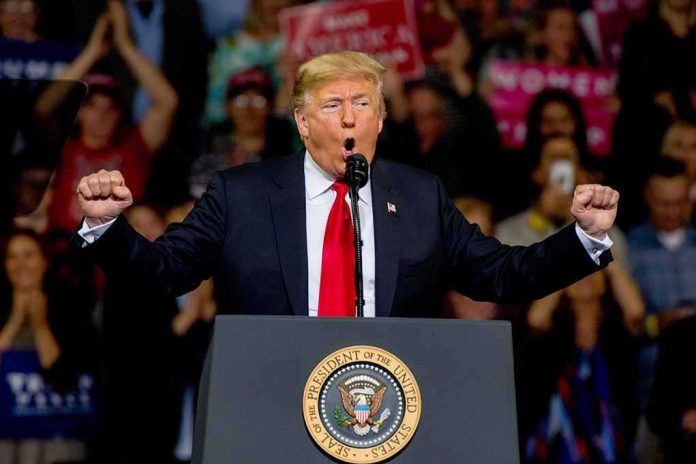
At a Monday-night rally in Corinth, Mississippi, President Trump told supporters that men have been approaching him with a striking message: their wives “finally love” them because their retirement accounts have appreciated. He urged attendees to check their 401(k)s and offered specific figures—“60%, 65%, 58%,” including “up 64%”—as shorthand for the wins he argues households are seeing. Trump also relayed a recurring anecdote about a New York police officer whose wife reportedly shifted from doubting his financial competence to calling him a “genius” based on recent portfolio performance. The comments were framed as direct, first-person reports to the president at events and in conversations, not as third-party summaries or policy briefs.
The rhetorical construction matters. By putting intimate validation—spousal love—on the same ledger as portfolio returns, Trump turns the abstractions of market performance into something visceral and legible. It is a timeworn technique of retail politics: translate macroeconomic talking points into household stories, then cast the politician as the catalyst connecting the two. The line lands because the emotional circuitry is familiar. In many marriages, financial standing operates like a background hum; when it rises or falls, spouses feel it quickly.
Money As A Marital Fault Line: What The Research Shows
There is a robust literature showing that money disputes are a distinctive and persistent category of marital conflict. In a diary study that tracked 748 conflicts among 100 couples, disagreements about finances represented roughly a fifth of the total and were more resistant to resolution than other topics; they lingered, reappeared, and were experienced as more consequential to the relationship’s health. Complementary work finds financial disagreements correlate with divorce risk even after controlling for income, assets, and debt—that is, the argument patterns about money matter above and beyond the balance sheet itself.
Why money fights behave this way is also well documented. Some disputes are directly about economic pressure—insufficient income or high debt—while others express deeper issues: mismatched risk tolerances, control, trust, or identity-bound views of what money signifies in a marriage. Nationally representative data show that financial strain and communication problems jointly predict conflict; they are not mutually exclusive explanations but often travel together. Personality and role perceptions compound this; “tightwad–spender” pairings and gendered expectations about who should manage or earn can reliably forecast friction between partners.
How Finances Influence Affection—And What They Don’t Do
Do stronger household finances “save” marriages? The evidence supports a tighter, more modest claim: improved financial security reduces stressors that otherwise feed recurring conflict. When bills are paid without anxiety and retirement balances feel credible rather than aspirational, couples often argue less and communicate better. That relative calm can enlarge the margin for generosity—how quickly spouses give each other the benefit of the doubt, how willing they are to attribute competence rather than carelessness. Those shifts, in turn, feel like renewed affection. The mechanism is not mysterious; it is stress relief reorganizing the daily emotional economy.
But money does not rewrite a couple’s relational script on its own. Financial relief can loosen the knot; it rarely teaches new communication habits or resolves control battles by itself. Clinical and survey research alike show that when conflicts are proxies for deeper trust or identity disputes, an improved bank balance helps but does not cure. In other words, a rising 401(k) can change the temperature of the room; it is not, by itself, marital therapy.
Why Trump’s Framing Works In Political Communication
Trump’s anecdote compresses a macroeconomic claim (“your retirement accounts are up”) into a domestic payoff (“your spouse loves you more”). The move is effective because it collapses abstraction into status and intimacy—the axes on which people assess whether life is improving. Status dynamics are especially salient in couples where financial identity is contested. If one spouse is regarded as imprudent or risk-averse, a run of investment gains functions as reputational vindication, shifting a familiar argument from “you never manage money well” to “perhaps you were right this time.” That is a potent narrative hook in a rally hall, where politics competes with entertainment for attention.
There is also a campaign craft element: rather than citing GDP prints or market indices, the line invites people to perform a personal audit—open the retirement portal, check the chart, and connect the dots to the present leadership. Whether listeners ascribe causality to policy or to broader market cycles, the test is immediate and identity-affirming. The policeman anecdote adds texture; a named profession with cultural resonance stands in for many households without turning the speech into an econometrics lecture.
Numbers, Benchmarks, And The Limits Of Anecdote
Trump’s use of round-number gains—“60%, 65%, 58%”—is classic stump-speech shorthand. In practice, 401(k) returns vary widely based on contribution rates, fund mix, fee drag, sequence of returns, and the period chosen. Two neighbors with identical salaries can see very different performance if one is in a target-date fund and the other is concentrated in equities. That heterogeneity makes a single percentage both memorable and inexact. Politically, the imprecision is an asset; it invites favorable recall. Analytically, it reminds us that the relevant question inside a marriage is not the median benchmark but the couple’s felt financial trajectory—did their account cross a psychological threshold that recoded a spouse’s perception of competence?
On the relational side, the research record gives Trump’s framing a plausible substrate: money conflicts are common, persistent, and tied to relationship quality; when finances improve, couples often feel better together. What the literature does not do is endorse a direct, universal conversion rate between account gains and affection. In other words, the story is directionally credible for some couples some of the time, not a law of marital physics.
Bottom Line: A Savvy Political Metaphor Built On A Real Marital Dynamic
Trump’s claim that men tell him their wives “finally” love them because of fatter retirement balances is, at core, a political metaphor built on a sturdy social fact: money is a durable driver of marital strain, and its relief can feel like restored admiration. The Corinth rally anecdotes—especially the New York officer story—package that truth into a punchline that doubles as a case for performance. As a matter of household psychology, the line scans. As a matter of political communication, it’s engineered to be unforgettable. One caveat is obvious and sufficient: the remarks are reported anecdotes rather than audited life outcomes.