

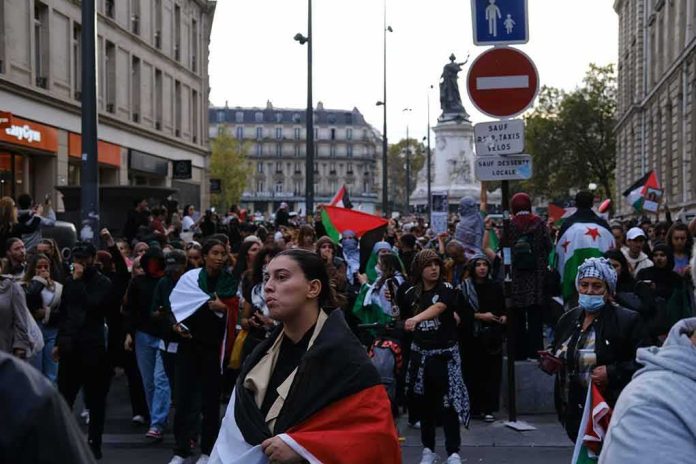
When large, messy street uprisings become raw material for national politics elsewhere, the argument is rarely about the streets themselves; it is about what story those images are made to tell. The France riots were quickly conscripted into America’s immigration debate, but the evidentiary record about what actually drove the unrest does not match the rhetoric that followed.
The Short Version
- President Trump publicly attributed French unrest to “out of control mass migration” and Islam, and folded it into U.S. campaign messaging.
- Independent reporting described a student-led movement over school conditions and public services that broadened to living-cost grievances, not an immigration revolt.
- No credible investigative or official record surfaced linking the protests’ organization or demands to immigration or Islamist groups.
- The episode shows how dramatic unrest is repurposed as proof for preexisting positions, even when the initiating causes are different.
What Trump claimed and how it was used politically
President Trump’s position was explicit and repeated: he said France’s unrest was “out of control mass migration,” insisted “this isn’t about schools,” and framed the episode as Islam “wanting to take over a once great Country.” He then leveraged that framing on the trail, warning that scenes from France previewed what Democrats “want to do to America.” The scale of the French disturbances made the warning vivid; reporting tallied hundreds of thousands of demonstrators, school blockades, and widespread disorder that supplied the necessary imagery for a civilizational cautionary tale. But the images and the stated cause are separate questions. Trump did not furnish documentary or official evidence linking the mobilization to immigration or Islamist networks, and none was cited alongside his assertions.
Campaign allies echoed the message, treating France as a parable for U.S. border and cultural policy. As political communication, the move is familiar: translate a distant crisis into domestic risk, then present one’s platform as the prophylactic. As an explanation of France, it asks for substantiation the public record does not provide.
What happened in France according to the strongest available reporting
Independent coverage converges on a different origin story. Students and pupils mobilized around deteriorating school conditions: teacher shortages, overcrowded classrooms, and dilapidated facilities. Trade unions, including the CGT, joined with demands centered on wages, pensions, prices, and the protection of public services. The coalition broadened further as living-cost pressures and service quality became part of a nationwide grievance set; violence and opportunistic looting accompanied some marches, as often happens when participation swells and policing falters. Across these accounts, the documented demands are educational resources and social-welfare performance, not immigration or religion.
This does not sanitize the disorder; cities saw clashes, arson, and property damage on a significant scale. But scale is not a cause. In the material that has been reported, neither organizers’ statements, nor police briefings, nor government announcements identify migration or Islamist agendas as the drivers of mobilization. The French government’s initial tangible response was technocratic and targeted at schools—pledging thousands of additional supply teachers—which is consistent with the protesters’ stated complaints rather than an immigration lens.
How protests evolve: mechanism, escalation, and misattribution
Episodes like this usually follow a recognizable arc. A narrow, concrete grievance—here, the condition and staffing of schools—activates a constituency with high direct exposure to the problem. As the grievance resonates, adjacent groups with related frustrations join, broadening the issue frame to cost of living, state capacity, and fairness in public services. With mass and complexity comes a higher risk of opportunistic violence and counter-mobilization. That escalation does not erase the initiating cause; it layers new tensions on top of it. Analysts who study movement dynamics caution against post hoc monocausal explanations, especially cultural ones, that retrofit a sprawling event to a single identity-based driver in the absence of specific evidence.
Two corollaries matter for readers sorting cause from narrative. First, the presence of people with immigrant backgrounds among participants in a large urban protest does not imply the protest is about immigration; big-city coalitions reflect their demography. Second, policymakers should privilege falsifiable indicators—organizer demands, arrest records with affiliations, seized communications, and court filings—over rhetorical inference. In the French case, those indicators, as publicly reported, point to schools and public services.
Where the arguments genuinely diverge
The core disagreement is not about whether France experienced severe unrest; it did. It is about attribution. On one side, the assertion is that mass migration and Islam are the engines of French disorder and, by analogy, a harbinger for the United States if Democrats prevail. On the other, detailed reporting and on-record union and student claims place the engine in under-resourced education and the cost of living. The first claim is rhetorically potent but under-evidenced in the available record; the second is mundane but well-attested. When sources conflict, deference should go to the account that specifies mechanisms, documents demands, and is testable against the state’s policy response. Here, that is the education-and-services account.
To be clear, the immigration analogy could be tested. Investigators could examine arrest cohorts’ demographic and associational data under French privacy law, map any involvement by religious or ideological networks, and analyze whether protest communications carried migration-related content. Absent such evidence, the immigration thesis is a political claim in search of a record, not a record in search of an explanation.
Trump, Vance Pin France Unrest on Immigration
Read the full story: https://t.co/wlpwvqEZAL
Trump and Vance blamed immigration for French unrest rooted in education and living-cost grievances, using it to campaign against Democrats.#France #protests #immigration #Trump #Vance… pic.twitter.com/p7uMPZcgtJ
— wondernews.now (@wondernews_now) October 19, 2026
Why this matters for U.S. readers
Major unrest abroad is often drafted into America’s domestic argument about borders, belonging, and order. That is natural politics. But translating foreign crises into U.S. risk assessments without matching mechanism to evidence produces brittle policy. If school infrastructure failure and service austerity are what actually lit the fuse in France, then the relevant U.S. lesson is about investment, governance, and social trust—how states maintain legitimacy when everyday systems fray. If, someday, strong evidence were to show organized immigration-linked networks driving violence, that would counsel different remedies. Good analysis keeps those pathways distinct.
Bottom line
France’s upheaval supplied searing images. President Trump’s claims supplied a sweeping immigration narrative. The strongest reporting supplies a different, more prosaic cause: a student-led revolt over schools, amplified by the cost of living and public-service strain. In politics, images travel faster than mechanisms. Responsible judgment insists they not outrun the evidence.
Sources:
facebook.com, afp.com, politico.com, firstpost.com, straitstimes.com, internazionale.it, timesofisrael.com, bignewsnetwork.com