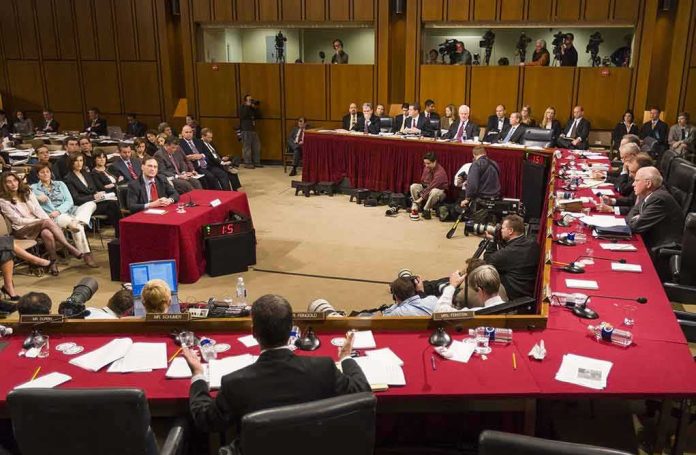
The line between legitimate accountability and political intimidation is drawn not by who holds power, but by the target and purpose of the sanction; Senator Elissa Slotkin’s “deterrence” remarks sit precisely on that fault line, which is why they ignited more than a news-cycle flap — they exposed a contest over the rules of democratic governance itself.
The Short Version
- Slotkin publicly described a desire to deter graduates from joining a future Trump administration by pursuing “signature cases” against those who “enabled” it.
- Her subsequent defense narrows the target to illegal conduct and corruption, while denying any threat of prosecution based on affiliation or employment alone.
- The evidence confirms she sought a deterrent effect; it does not show a concrete program, charging theory, or actual chilling of applicants.
- This fight reprises a durable American tension: accountability that deters future wrongdoing versus tactics that risk weaponizing law to police political participation.
What Slotkin Said — And What That Means
At a University of Chicago event, Slotkin said she wanted young graduates to think twice about working for the Trump administration because it “might be buying myself a ton of problems,” adding, “I want that deterrence message sent.” Multiple accounts also reported that she referenced pursuing “signature cases” involving “the people who enabled him.” The wording is not an aside; it conveys an objective to shape behavior prospectively through the prospect of legal scrutiny, and it extends beyond President Trump personally to those around him. That is why critics emphasize intimidation rather than mere post hoc accountability: the stated purpose was to change future choices by would-be staff through fear of consequences, not simply to punish past crimes if and when they are proven.
Two caveats matter. First, nothing in the available record shows Slotkin specifying an offense or advancing a concrete investigative plan — no bill text, committee authorizations, subpoenas, or charging memos surfaced in tandem with the remarks. Second, the clip that drove the controversy was brief, and the full transcript is not supplied here; short-form circulation is tailor-made to amplify the hardest-edged reading in polarized environments. Still, on the narrow evidentiary question — did she advocate a deterrent effect targeting would-be Trump personnel — the answer is yes, in her own words.
Slotkin’s Counter-Case: Deterrence Against Illegality, Not Partisanship
Slotkin later argued the point of her comments was corruption: accountability for unlawful conduct, not punishment for affiliation or employment itself. She said she “never mentioned prosecution for staffers or prospective staffers,” and framed her message as a civic analogue to the military’s duty to refuse illegal orders — if you are asked to break the law, you are obligated to say no and can be held responsible if you don’t. She further contended that misappropriating taxpayer funds or steering public money to enrich the president or his family warrants consequences for everyone involved, not just the principal — a stance that, in isolation, tracks ordinary legal doctrine about accomplice liability and misuse of office.
This defense narrows the aperture meaningfully: it preserves the deterrence idea while conditioning it on unlawful conduct. That matters because the constitutional harm in politicized enforcement is not that wrongdoing gets punished, but that the prospect of punishment is tied to who you worked for rather than what you did. The difficulty for Slotkin is rhetorical rather than legal: her original formulation spoke in the grammar of behavioral deterrence aimed at would-be staff, not in the grammar of elements, evidence, and prosecutorial discretion. The counter-argument therefore clarifies the intent but does not erase the earlier emphasis on discouraging participation as such.
Where The Real Disagreement Lies
Both sides claim the rule of law. The dispute is over instrument and aim. One reading treats “signature cases” as a classic accountability strategy: high-credibility prosecutions focused on provable crimes whose public consequences deter future illegality. The other reading hears a political precommitment: select cases not only to redress past wrongdoing but to make government service under a disfavored president feel personally risky, thereby thinning the talent pipeline. The first is a familiar practice — deterrence is one of criminal law’s core purposes. The second, if operationalized by targeting affiliation rather than conduct, would erode bedrock norms against viewpoint discrimination and chill lawful participation — the very danger critics highlight.
On the record available, the evidence supports that Slotkin invoked deterrence toward potential Trump staff in general terms while later insisting the trigger is illegality, not affiliation. There is no documentary proof of an implemented program, no identified targets or statutes, and no measured chilling effect on applicants — useful facts for cutting through apocalyptic claims on either side. Conversely, there is also no reason to pretend the deterrence language did not mean what it sounded like in the moment; it did, and it understandably sparked a debate about lines that should not be crossed.
How We Got Here: A Long Arc of Politicization Anxiety
Fights over prosecutorial independence are not a Trump-era novelty. The post-Watergate generation consciously built norms to insulate the Department of Justice from direct presidential direction precisely because earlier periods saw overt political management of prosecutions. Those norms are periodically stressed whenever politics and prosecution intersect, which is often; as federal authority and criminal law’s breadth have grown, so have opportunities for perceived or real politicization. In parallel, modern administrations aggressively curate personnel. Research and contemporary analyses have described an elevated emphasis on loyalty in Trump-era staffing — a dynamic that, fairly or not, intensifies suspicions about whether accountability efforts are substantive housecleaning or partisan score-settling.
Overlay that history atop a digital media environment that rewards clipped provocation over transcript context, and you have the perfect accelerant: a 26-second video becomes a referendum on weaponization, corruption, and the bounds of dissent. The platform incentives make careful line-drawing — punish crimes, never associations — sound like equivocation, when it is actually the constitutional center of gravity.
Senator bashes MAGA's 'manufactured outrage' over potential criminal probes: 'How toxic'
Sen. Elissa Slotkin (D-MI) has been facing personal and increasingly threatening attacks from Republicans, following her remarks at the University of Chicago that she hopes Democratic… pic.twitter.com/kbJ5fiwB9U
— Roshan Rinaldi (@Roshan_Rinaldi) October 19, 2026
What Responsible Accountability Looks Like
The way out is not rhetorical, it is procedural. If lawmakers or committees believe crimes occurred, they should articulate elements, cite statutes, preserve evidence, and build cases that would stand up in court irrespective of the defendant’s political loyalties. If they cannot do that, they should not speak in terms of deterrence aimed at prospective employees; the right kind of deterrence is a byproduct of neutral, law-bound enforcement, not a freestanding political objective. Conversely, political allies should resist converting any mention of accountability into proof of persecution. The public can hold two thoughts at once: prosecutions must not be partisan, and illegal acts carried out for political leaders are still crimes. That is not hair-splitting; it is the rule of law in practice.
Sources:
twitchy.com, slotkin.senate.gov, cnn.com, dailysignal.com, huffpost.com, demokratis.co.id, dailywire.com, brookings.edu, journals.uchicago.edu, academic.oup.com