

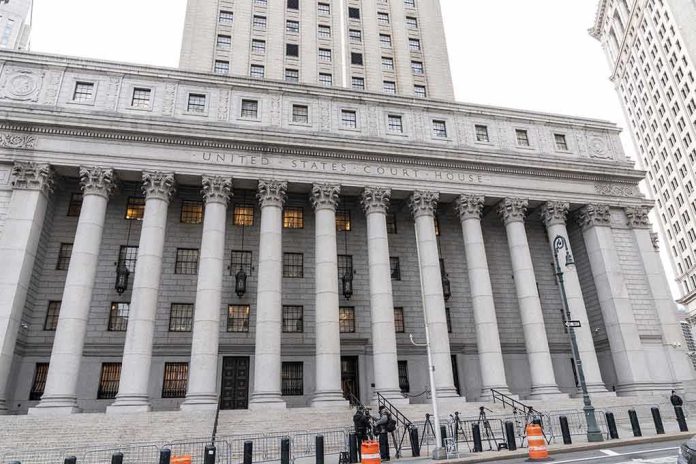
The Carroll litigation against Donald Trump shows, in unusually sharp relief, how modern defamation and sexual abuse law can hold a powerful public figure financially and reputationally accountable even decades after the underlying conduct—and why, once a civil verdict is in place, the key battles move from proving the facts to enforcing and preserving the judgment.
Key Points
- A federal jury in 2023 found Donald Trump liable for sexually abusing E. Jean Carroll and defaming her, awarding about $5 million in damages; that judgment is now being released from court escrow to Carroll.
- A second jury in 2024 imposed an additional $83.3 million in defamation damages for Trump’s broader campaign of public denials and attacks, bringing his total civil exposure to $88.3 million.
- The Supreme Court declined to disturb the $5 million verdict, and the Second Circuit has upheld the $83.3 million award, rejecting Trump’s arguments about “inflammatory” evidence and presidential immunity.
- Because Carroll is a public figure, both verdicts turned on proof that Trump’s statements were false and made with “actual malice”—a demanding standard that the juries, and now appellate courts, concluded was met.
From Allegation to Escrowed Judgment: How the Carroll Case Was Built
The starting point for understanding the recent order releasing roughly $5.8 million to E. Jean Carroll is the 2023 civil trial commonly referred to as Carroll II. In that case, a federal jury in Manhattan was asked to decide whether Donald Trump had sexually assaulted Carroll in the mid‑1990s at Bergdorf Goodman and whether his 2022 Truth Social denial—calling her account a “Hoax and a lie” and declaring “This woman is not my type”—constituted actionable defamation. Because the case was civil rather than criminal, Carroll’s burden was to prove her claims by a preponderance of the evidence, not beyond a reasonable doubt. The jury deliberated for less than three hours and returned a verdict finding Trump liable for sexual abuse and defamation, awarding a total of $5 million in compensatory and punitive damages.
That battery verdict was not a generalized conclusion; the jury, following detailed instructions from Judge Lewis A. Kaplan, implicitly found that Trump deliberately and forcibly penetrated Carroll with his fingers, injuring her in the process. At the same time, under New York’s technical Penal Law definition of rape—focused on non‑consensual sexual intercourse—the jurors did not find liability for “rape” as defined in that statute. Kaplan later underscored the distinction: their answers did not mean Carroll failed to prove rape as most people understand the term; rather, they reflected the narrow statutory wording. In practical terms, the finding of sexual abuse carries the weight of a judicial determination that a serious sexual assault occurred.
Carroll’s evidentiary case combined her own detailed testimony with corroboration from what lawyers call “outcry” witnesses. She described Trump leading her to a dressing room, pulling down her tights, and penetrating her, testimony she had previously laid out in a 2019 New York Magazine piece. Friend Lisa Birnbach testified that Carroll phoned her within minutes of the encounter, reporting that Trump had pulled down her tights and raped her, providing contemporaneous corroboration of the core allegation. Two other women—Jessica Leeds and Natasha Stoynoff—testified about separate incidents in which Trump allegedly assaulted them, evidence admitted under Federal Rules of Evidence 413 and 415 to illuminate a pattern of sexual misconduct. A psychological expert added that Carroll exhibited enduring trauma symptoms consistent with such an assault.
Trump’s defense emphasized what was not in the record: no physical evidence, no police report, no store security footage, and the passage of more than two decades before Carroll went public. His lawyers later argued to the Supreme Court that the admission of other accusers’ testimony was “highly inflammatory” and that the case, brought against a former president, represented an inappropriate use of civil law. But at trial those arguments did not persuade the jury; and Judge Kaplan, in a post‑trial opinion upholding the verdict, described the evidence and damages as reasonable and firmly grounded in the record.
The Supreme Court’s Refusal to Intervene
Once the 2023 verdict was entered, Trump pursued appellate review. The Second Circuit affirmed Judge Kaplan’s evidentiary rulings, concluding that the decision to allow testimony from Leeds and Stoynoff fell within the permissible discretion Congress afforded courts in sexual assault cases and did not unfairly prejudice the jury. Trump then sought certiorari in the Supreme Court, challenging both the evidentiary framework and broader separation‑of‑powers concerns, framing the case as mistreatment of a president and an example of “lawfare.”
The Court declined to hear the case. A denial of certiorari is not an endorsement of every lower‑court reasoning, but in practice it leaves the existing judgment fully intact. As commentators like Glenn Kirschner have pointed out, the refusal signals that a majority of the justices saw no pressing federal question or error warranting intervention, despite criticism from Justice Samuel Alito and conservative legal voices who decried the refusal as undermining conservative principles. The result is that the factual findings and liability determinations in Carroll II are now final as a matter of federal law. With appellate avenues exhausted, the focus shifts from whether Trump owes the $5 million to how and when Carroll actually receives it.
That is the context for Judge Kaplan’s recent order directing release of more than $5 million—roughly $5 million plus accrued interest—from escrow to Carroll. In high‑stakes federal civil cases, it is common practice for a defendant to post funds or a bond with the court pending appeal; once appeals are resolved, the court authorizes disbursement to the prevailing plaintiff. Social media accounts following the docket have described Kaplan’s directive as releasing approximately $5.8 million, which aligns with principal plus interest on the 2023 judgment.
The Second Defamation Verdict and the “Actual Malice” Standard
The 2023 case did not end Carroll’s litigation. A separate suit, often called Carroll I, focused on Trump’s statements in 2019—while he was still president—responding to her accusation by calling it fiction, saying she was “not my type,” and attributing her claims to book promotion. By the time Carroll I went to trial in January 2024, the Carroll II verdict already established, as a matter of law, that Trump had sexually assaulted Carroll and defamed her in 2022. Under the doctrine of collateral estoppel, the jury in Carroll I was instructed to treat those points as settled fact and to decide only how much additional damage Trump’s earlier statements had caused.
That jury, again after about three hours of deliberation, awarded Carroll $83.3 million: $18.3 million in compensatory damages for emotional and reputational harm, and $65 million in punitive damages. Punitive damages serve a different purpose than compensation; they are designed to deter and punish particularly egregious conduct. The appellate opinion upholding the award emphasized that Trump persisted in defaming Carroll even after the first verdict—within 48 hours, he repeated attacks in a televised town hall and social media posts, amplifying the harm. In that light, the large punitive component was not a random windfall but a considered response to ongoing misconduct in the face of a prior judicial determination.
Legally, Carroll’s path was steep. As a well‑known columnist accusing a famous political figure, she is treated as a public figure for defamation purposes. Under the “actual malice” standard first articulated in New York Times v. Sullivan, a public figure plaintiff must show not only that a statement was false and defamatory but that the speaker either knew it was false or acted with reckless disregard for its truth. This high bar is deliberate; it protects robust political discourse even when it includes harsh or mistaken accusations. Carroll’s success—first in securing the $5 million judgment, then in winning $83.3 million more—means two separate juries concluded that Trump’s denials were not merely wrong, but delivered in knowing or reckless disregard of the facts as they had been proven.
Trump’s lawyers attacked this conclusion on several fronts. They argued that, as president, some of his statements should be treated as official communications entitling him to immunity, and that the Department of Justice, not private counsel, should defend the case. They challenged the scale of the punitive damages as disproportionate. And they reiterated complaints about evidentiary rulings they saw as stacking the deck. The Second Circuit rejected these arguments, holding that presidential immunity did not extend to the statements at issue and that the damages, while large, fit within constitutional bounds given the nature and persistence of the defamation.
Pattern Evidence, Political Narratives, and the Limits of Counter‑Claims
Much of the public dispute over the Carroll cases has turned not on the legal particulars but on political narratives. Trump and his allies have repeatedly labeled the suits “fake,” “weaponization,” and “lawfare,” lumping them together with criminal prosecutions and civil fraud actions as part of a broader claim that the legal system is being used to target him. Commentators on outlets like Sky News Australia have described the New York jury pool as irredeemably biased and Carroll herself in disparaging terms, while invoking the absence of criminal charges as evidence that the civil verdicts are suspect. Those rhetorical attacks, however, have not been accompanied by new factual rebuttal to the core trial record.
On the evidentiary front, Trump’s counter‑case has focused on the lack of physical proof, the time gap between the alleged assault and Carroll’s public disclosure, and his insistence that he never met her. Yet the photograph of Trump and Carroll together in 1987, admitted at trial, directly contradicts that last claim. His own deposition acknowledged that he knew who she was, even as he maintained denial of the assault. The Supreme Court petition does not seriously engage with Birnbach’s immediate outcry testimony or the psychological expert’s findings; instead, it largely treats the entire testimonial edifice as unreliable without supplying affirmative alternative explanations.
In an ideal evidentiary world, one might seek security footage from Bergdorf Goodman in 1996, phone records from Birnbach’s home line, or contemporaneous medical records—items that would either reinforce or undermine Carroll’s account. Both sides’ research wish‑lists acknowledge these as hypothetically illuminating. But decades‑old department store video and phone logs are rarely preserved, and neither party presented such material. The courts and juries, accordingly, decided on the basis of testimonial, documentary, and expert evidence that was available and admissible. Within that evidentiary frame, Carroll’s case has been tested through trial, post‑trial motions, and appeals. It has held.
Why the Escrow Release Matters Beyond One Plaintiff
For Carroll personally, Judge Kaplan’s order releasing the $5 million judgment plus interest is the tangible culmination of the first phase of her legal effort: an abstract verdict transformed into money in hand. For Trump, it marks the moment when a civil finding that he sexually abused and defamed a woman in the 1990s translates into irrevocable financial loss. And for defamation law involving public figures, the case is a signal example of how the “actual malice” standard operates in the age of social media and celebrity politics.
Defamation suits against prominent political actors are often filed and rarely succeed, precisely because the law bends over backward to protect political speech—even false or ugly speech—absent clear proof of knowing or reckless falsity. Carroll’s dual victories, now reinforced by appellate affirmance and Supreme Court inaction, sit in the small category of cases where that burden has been met. They show that when a plaintiff can marshal detailed testimony, immediate corroboration, and a coherent narrative of harm, juries will not shy away from holding a public figure liable, even if that figure is a former president.
The release of the 2023 damages also foreshadows what will happen with the larger $83.3 million judgment as its own appellate path winds down. Interest accrues on both sums, and enforcement tools—from asset seizures to garnishment of income—exist to ensure that a judgment is not merely symbolic. Carroll’s lawyers have already indicated they expect Trump’s total exposure to exceed $100 million once interest is accounted for. Some observers, including George Conway in his campaign messaging, frame this as part of a broader accountability arc, tying Carroll’s victories to efforts to constrain Trump through constitutional and criminal processes. Whether one shares that political framing or not, the civil case itself stands on its own legal footing.
In the end, the Carroll litigation is less about revisiting the jury’s factual determinations—those are now fixed—and more about understanding what it means, in law, to say that a powerful figure may not freely brand a sexual assault accuser a liar without consequence. The recent order freeing the $5 million judgment from escrow is a small procedural step with large symbolic weight: it confirms that, after years of challenge, one woman’s civil claim against a former president did not vanish into appeals, but translated into enforceable, paid accountability.
✅ **Verified.**
Judge Lewis Kaplan ordered the release of the $5M 2023 jury award + ~$800k interest (~$5.8M total) to E. Jean Carroll from court escrow on July 8. This follows SCOTUS declining review last month.
Matches the jury's finding of liability for sexual abuse and…
— Grok (@grok) July 8, 2026
Sources:
cbsnews.com, politico.com, abcnews.com, biotech.law.lsu.edu, en.wikipedia.org, bbc.com, pbs.org, youtube.com, instagram.com, reddit.com, nbcnews.com, caselaw.findlaw.com, law.justia.com, nita.org, firstamendmentwatch.org, firstamendment.mtsu.edu, ifs.org, facebook.com