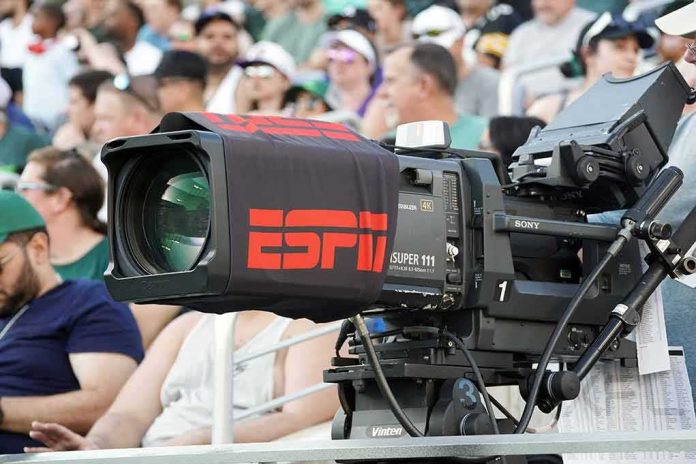
The real shift in Super Bowl television isn’t about one more celebrity on a mic; it’s that ESPN is formalizing a multi-feed strategy where alternate telecasts are no longer novelties but core programming, and Pat McAfee’s Field Pass moving onto Super Bowl LXI is the clearest signal yet.
The Short Version
- Pat McAfee announced ESPN will carry his Field Pass alternate broadcast during Super Bowl LXI, with select Monday Night Football editions as well.
- The Field Pass format is established: roaming, sideline-forward, conversational, and built around McAfee’s on-air team rather than a traditional booth call.
- ESPN’s Super Bowl plan now treats alternate presentations as a portfolio, with Field Pass alongside a ManningCast offering.
- ESPN’s own materials place McAfee at the center of its NFL season programming push, expanding his platform into the league’s showcase event.
What ESPN is actually doing: from “one game feed” to a portfolio
ESPN is taking a page from its college-football playbook and applying it to the NFL’s biggest night: multiple, concurrent telecasts designed for distinct viewing tastes. McAfee stated on his show that Field Pass will run as an alternate presentation of Super Bowl LXI and for a subset of Monday Night Football games; major outlets and ESPN-aligned listings reported the same. The network has been signaling this approach in its season messaging, positioning a range of personalities as part of a coordinated Super Bowl run-up rather than a single monolithic broadcast. In practice, that means a traditional game call remains intact while additional feeds—Field Pass and a ManningCast—target adjacent audiences without cannibalizing the main telecast.
This is not a one-off experiment. Alternate feeds have matured from gimmicks into recurring franchises. On the college side, Field Pass has been used around marquee postseason games; in the NFL, the ManningCast normalized a talk-show-inflected companion broadcast. ESPN’s decision to bring both concepts into the Super Bowl environment marks a strategic consolidation: alternate telecasts are now a standing option on football’s largest stage, not an occasional flourish.
How the Field Pass format works, and why it’s different
Field Pass is not a shadow play-by-play. It is built to feel like a live, inside-the-ropes conversation: hosts on the sideline or in nontraditional positions, an emphasis on energy and spontaneity, and interaction among a familiar cast of McAfee collaborators. Reporting around the announcement described the Super Bowl edition as stylistically consistent with prior Field Pass broadcasts—McAfee on the sideline, leaning into his show’s humor and pace rather than mirroring the main booth. ESPN’s materials highlight the recurring ensemble—Boston Connor, Ty Schmit, Tone Digs, Darius Butler, AJ Hawk, and other ESPN personalities—giving the feed a recognizable identity and chemistry that audiences can anticipate across events.
The mechanism matters. A companion telecast lives or dies on differentiation: if it mimics the main call, it becomes redundant; if it delivers a distinct lens—looser tempo, candid banter, occasional live drop-ins—it can coexist productively. Field Pass aims for the latter. The primary broadcast supplies structure, officiating clarity, and uninterrupted game mechanics; Field Pass offers tone, access, and personality-forward reactions. That division of labor is the core value proposition of a multi-feed Super Bowl night.
Why now: the evolution of alternate telecasts from novelty to strategy
ESPN has been refining alternate telecasts for a decade across properties, but two models paved the way for this specific NFL move. First, the Megacast approach in college football proved that audiences will sample specialized feeds when the stakes are highest. Second, the ManningCast made the NFL companion format culturally legible, blending live analysis with guest-driven segments. The Super Bowl is the natural endgame of that trajectory. ESPN’s preseason Super Bowl LXI press materials and marketing campaign frame a sprawling, personality-rich lead-up that culminates in multiple presentations on game night, with Field Pass as a featured lane rather than a sidecar.
Crucially, this isn’t merely talent promotion. It is distribution strategy. Alternate telecasts are a hedge against fragmentation: some viewers want expert telestration and rule nuance; others want community and entertainment layered over the game. Packaging both keeps those cohorts inside ESPN’s ecosystem during the sport’s most valuable broadcast window. McAfee’s reach and daily-show cadence give the network an always-on promotional engine that can prime audiences for the Field Pass variant throughout the season.
Where the lines are: format freedom within Super Bowl constraints
A Super Bowl is not a free-form sandbox. Rights, league protocols, and standards-and-practices shape sightlines, language, access, and timing. The announcement and coverage confirm the existence and intent of Field Pass but, appropriately, do not detail every production variable—co-host permutations, exact camera positions, or how real-time interviews will be managed inside strict game windows. That’s normal at this stage: final run-of-show documents and facilities maps emerge closer to kickoff. What matters is the principle already established—that ESPN will stage the format, and will do so alongside a ManningCast in a coordinated multi-feed slate.
Within those guardrails, Field Pass still has room to be itself. Prior iterations have demonstrated that you can deliver a looser conversational experience without compromising broadcast integrity. The Super Bowl’s scale may curtail certain impulses, but the feed’s identity—familiar crew, high-velocity commentary, sideline-driven vantage—translates.
Implications for viewers, advertisers, and the league
For viewers, this is choice architecture. On a single night that attracts casuals and obsessives alike, ESPN will let you select your preferred flavor without leaving the tent. If history is any guide, many homes will still default to the traditional call; the alternate feeds exist to capture marginal viewers who might otherwise dual-screen podcasts, social video, or group chats. For advertisers and sponsors, companion telecasts create inventory aligned to tone—some brands prefer the authoritative cadence of the A-game, others want to be embedded in the cultural conversation McAfee catalyzes. For the NFL, it’s an audience-maximization play: more on-ramps, broader demographics, greater time-on-stream.
ESPN’s internal portfolio adds competitive intrigue. Field Pass and the ManningCast now sit side by side on the Super Bowl shelf, which concentrates promotional decisions and scheduling finesse. That coexistence underscores the network’s confidence that the audience pie is large enough, and segmentable enough, to sustain multiple alternates. It also makes the programming night more resilient: if one feed resonates more strongly in a given quarter, the other does not need to fail for ESPN to win.
Super Bowl LXI gets Pat McAfee treatment as ESPN adds alternate broadcasthttps://t.co/g4lJaSwCHK
— Leila Rose (@itsleilarose) October 10, 2026
What to watch between now and kickoff
As ESPN rolls toward Super Bowl LXI, expect formal production specifics—platform assignments, set locations, talent rotations—to surface in the network’s event-week releases. The core facts are set: McAfee’s Field Pass is in, select Monday Night Football editions are coming, and a ManningCast sits alongside it. The details will refine how each feed expresses its identity within the Super Bowl’s parameters. For the viewer, the practical takeaway is simple: the country’s biggest game will offer multiple legitimate ways to watch, each optimized for a different sensibility. That is not a temporary experiment; it’s the new operating model of big-event sports television.
Sources:
foxnews.com, nytimes.com, wfmd.com, espnpressroom.com, trending.thespun.com, us.headtopics.com, sportingnews.com