

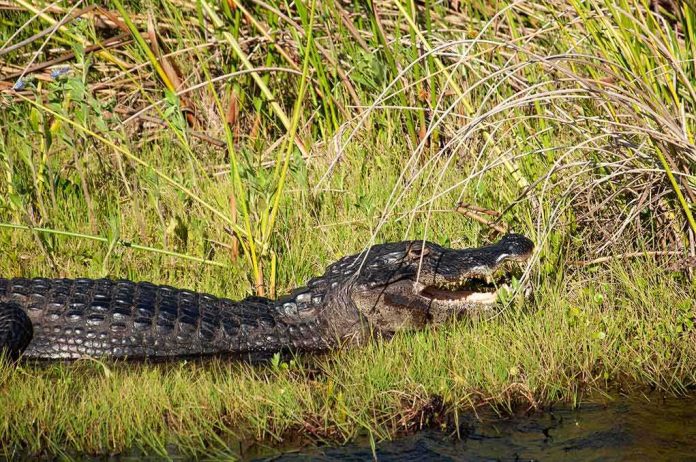
An alligator that evades capture for four years isn’t surviving by luck; it’s surviving by behavior, and the capture of South Carolina’s “Snaggletooth” is as much a lesson in reptile wariness as it is a fish story with a scale that reads 844 pounds.
Key Points
- An 844-pound, roughly 14-foot alligator nicknamed Snaggletooth was hauled from Lake Moultrie, South Carolina, on the night of Sept. 28, ending a pursuit that its guides say lasted four to five years.
- Renegade Bowfishing’s Cole Poplin and William Ard guided the hunt for tag holder Chris Webb and his father, who made the catch; reporting places the animal as the second-largest alligator ever taken in the state.
- The alligator was identified across years of sightings by a distinctive broken set of front teeth — the trait behind its name.
- South Carolina’s harvest rules require hunters to file a report with measured, not estimated, carcass length and weight, which explains why the public record on a catch like this takes shape gradually rather than instantly.
- The catch lands inside a record 2025 season — 467 alligators harvested statewide, the highest total since at least 2013 — underscoring how unusual an animal of this size remains even in a recovering, well-managed population.
What happened at Lake Moultrie
Around 11 p.m. on Sept. 28, a four-man team pulled an alligator measuring roughly 14 feet and weighing 844 pounds from Lake Moultrie in Berkeley County, about an hour northwest of Charleston. The team — Cole Poplin and William Ard of Renegade Bowfishing, working for tag holder Chris Webb and his father — had spent years tracking the animal they’d nicknamed Snaggletooth for its jagged, broken front teeth, a marking distinctive enough to let them identify the same alligator across repeated, unsuccessful encounters. The Post and Courier, the regional paper of record for the Charleston area, reported the catch as the second-largest alligator ever confirmed taken in South Carolina, a characterization repeated by national outlets covering the story in the days after.
Poplin, speaking to NewsNation, described the animal in terms meant to convey scale to people who’ve never stood next to a reptile that size: as heavy as a grand piano, or two adult grizzly bears, and roughly as long as a car or two king-size beds laid end to end. He’s a Lowcountry native who has guided alligator hunts professionally for roughly five years, and in a separate catch earlier in the same season his team landed a 770-pound alligator from the same lake — itself large enough to draw public disbelief, with some viewers assuming the photos were digitally altered.
How a hunt like this actually works
Capturing an alligator this size is not a matter of a single clean shot. Guides like Poplin and Ard spend hundreds of hours scouting — reading sign, watching known travel corridors, and tracking an animal’s pattern of movement across a 60,000-acre reservoir where a single alligator can vanish for months at a stretch. Once an alligator is hooked or snared, the physical fight begins: standard winches rated for alligators over 600 pounds are the usual tool for hauling a carcass into a boat, but on this catch the winch reportedly stalled and began smoking partway through, a detail that speaks to just how far outside normal parameters an 844-pound animal falls. Alligators are also fiercely territorial, which is precisely why the same individual can be sighted repeatedly over years without ever being caught — it rarely leaves its home range, but it also rarely stays still long enough to be approached.
Four years in pursuit of one animal
What separates this catch from an ordinary tag-fill is the duration of the chase. Poplin has described tracking this particular alligator since around 2020, with only six or seven confirmed sightings across hundreds of attempts over four to five years. That kind of multi-year pursuit of a single identifiable animal is rare in public alligator hunting, where most hunters fill a tag within a season or two and move on. The persistence paid off because the alligator’s broken teeth made it recognizable every time it did surface, turning an otherwise generic “big gator” sighting into confirmation that this was the same animal the team had been chasing since Poplin was a younger guide building his reputation in the Lowcountry.
How South Carolina records and ranks a catch of this size
South Carolina does not keep a simple, single public leaderboard the way some record-keeping bodies do; instead, size claims emerge from the state’s harvest-reporting system. The public alligator harvest form instructs successful hunters to report carcass length in feet and inches and explicitly tells them not to list an estimated weight — only a weight measured on a scale. The state’s hunting guide defines total length as the distance from the tip of the nose to the end of the tail. Renegade’s own account noted the carcass was measured three times at the dock at 14 feet, then measured again roughly 11 hours later, after the animal had been iced and transported and re-straightened, at 13 feet 8 inches — a reminder that alligator carcasses can shift slightly in measured length depending on handling, which is exactly why the state’s reporting process calls for measured figures rather than field estimates.
Why the size matters against the backdrop of a recovering species
Context makes the catch more remarkable, not less. American alligators were hunted to scarcity across the Southeast by the mid-20th century before federal and state protections allowed populations to rebound; South Carolina didn’t reopen a limited public hunting season until 1995, nearly three decades after the species had been pushed toward collapse. The state’s most recent public seasons have harvested several hundred alligators a year — 467 in the 2025 season alone, the highest total since at least 2013 — but the average size of harvested animals runs closer to nine feet. An alligator stretching into the 13-to-14-foot range, let alone one approaching 850 pounds, sits so far outside that average that guides reasonably spend years, not weekends, hunting for one.
What the catch signals going forward
Snaggletooth’s capture will likely be cited for years as a benchmark in South Car