

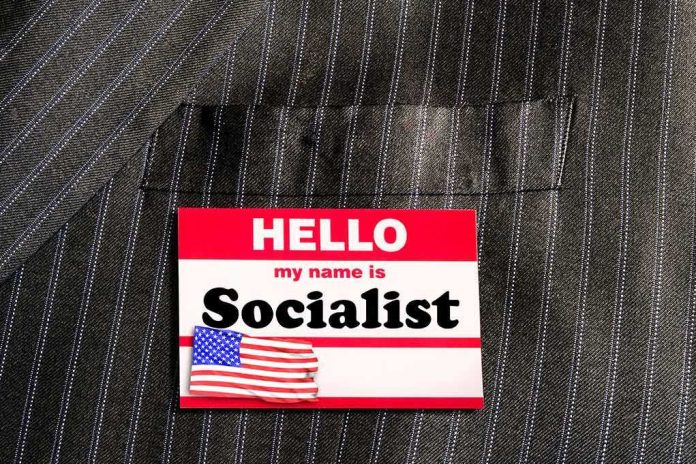
Campaigns win advantages not just with policies but with labels; in Michigan’s Senate race, Mike Rogers’s bid to define Abdul El-Sayed as “the DSA’s candidate” illustrates how modern politics translates complex ideological nuance into a simple, high-salience identity cue—one that sticks even when the underlying record is more mixed.
The Short Version
- El-Sayed appeared at multiple Democratic Socialists of America events, including a headlined fundraiser, but was not formally endorsed by the DSA and rejects the socialist label.
- Policy overlap—Medicare for All, eliminating ICE—gives Rogers material to argue a big-government contrast, though it does not establish a plan to abolish private enterprise.
- Rogers and allied groups have coordinated on a DSA/socialism frame, amplifying its salience beyond the documentary record.
- Political repetition matters: repeated cues can shape voter belief and memory independent of precise program details.
What the record shows—and what it doesn’t
The documented facts sustain two claims at once. First, El-Sayed engaged with the DSA as a speaker and participant; reporting tallies six DSA-linked appearances between 2017 and 2020 and a headlined 2019 fundraiser. Those are concrete ties of interaction. Second, the DSA did not endorse El-Sayed in the Senate race, and he has said repeatedly he is “not technically or practically DSA” and “simply not a socialist.” Both points are on the record. Framed precisely, then, the evidence supports association—events, audiences, overlapping ideas—without proving organizational affiliation or ideological control.
Rogers’s case leans on that association plus a substantive policy divide. El-Sayed backs Medicare for All and has argued for eliminating ICE, positions frequently championed by the American political left and consonant with parts of the DSA platform. In debates and coverage, those contrasts helped Rogers present himself as a conventional conservative alternative and El-Sayed as aligned with a big-government approach. That is a plausible ideological framing. But categorical claims that El-Sayed “doesn’t believe in the free-enterprise system” reach beyond the published record, which includes explicit self-description as a capitalist who favors regulation.
How the “socialist” label gained traction
Labels persist because they are easy to repeat, emotionally legible, and strategically reinforced. Rogers used the DSA frame early and often, calling El-Sayed the “Democratic Socialists of America darling,” then watched as party committees, super PACs, and advocacy groups adopted the same shorthand. This is not incidental; coordinated repetition compresses ideological complexity into a usable memory trace. Political science has documented that repeated claims—even when contested—can harden perceptions, particularly among partisans predisposed to hear them sympathetically. In a national survey experiment, increased repetitions of false claims raised belief among Republicans while lowering it among Democrats, a partisan asymmetry that maps onto today’s media consumption patterns.
Once a label becomes a campaign’s central organizing device, downstream effects multiply. Media stories summarize debates through the frame. Voter contact scripts and digital ads echo it. Poll questions begin to register perception rather than policy literacy, turning reception into “evidence” for further messaging. Breitbart highlighted unfavorable views of the DSA among Michigan voters; that sentiment makes the label electorally useful even if it remains analytically imprecise for describing one candidate’s full platform.
Policy substance beneath the rhetoric
Does El-Sayed’s program collapse private enterprise? The record does not show that. He has offered a regulated-capitalism account—markets as efficient allocators when protected by guardrails—and, critically for the healthcare fight, has said families could keep private insurance under his Medicare for All formulation. That is a nontrivial distinction; some single-payer models centralize financing while retaining private delivery and supplemental coverage, whereas others seek to displace private insurance entirely. In Michigan’s debate coverage and interviews, El-Sayed’s position sat closer to the former than to wholesale abolition of private insurance. That weakens the claim that his agenda equals socialism in the classic sense of public ownership of the means of production.
On law enforcement and civil liberties, the fault line is also sharper in rhetoric than in codebook categories. Eliminating ICE, a position El-Sayed has associated with broader immigration reform, is routinely cast by opponents as a proxy for anarchic border policy. Supporters frame it as restructuring federal enforcement and ending practices they argue are abusive or duplicative. Likewise, his opposition to pervasive surveillance technologies—Flock cameras foremost—was grounded in consent and constitutional safeguards rather than in any generalized hostility to policing. Ideologues will map these to their priors; the documentary trail maps them to regulatory choices, not systemic demolition.
Where the campaigns truly disagree
The durable disagreement is over the size and role of the state in providing security, healthcare, and economic rules of the road. Rogers advances a limited-government, market-first orientation; El-Sayed favors a more assertive public role in financing healthcare, regulating corporate conduct, and constraining surveillance. Reuters accurately summarized the stakes: a contrast between a common-sense conservative message and a big-government progressive alternative. That is an intelligible, high-information divide voters can adjudicate on its merits without importing maximalist definitions of socialism that the candidate denies and the record does not establish.
That said, ambiguity in campaign vernacular makes the fight over labels inevitable. “Democratic socialism,” “progressive,” and “regulated capitalism” are not synonyms, and party coalitions are messy. Candidates borrow audiences and share stages with ideological neighbors; opponents compress those proximities into identity brands. The DSA’s own platform spans universal programs and public-ownership arguments; overlap with the first does not entail endorsement of the second. Treating it otherwise is politics, not logic.
How to read the race without getting played by the label
Three filters help. First, separate event association from organizational endorsement: the former is frequent in big-tent coalitions; the latter is testable and, in this case, absent. Second, distinguish public provision and regulation from public ownership; a state-financed benefit or a market rule is not the same as socializing an industry. Third, privilege operative design details over slogans: whether private insurance remains, whether providers stay private, whether immigration enforcement is restructured or abandoned—these are the levers that change lives and budgets. When evaluated through those lenses, Rogers’s frame captures a real left–right policy contrast but outruns the evidence when it implies El-Sayed rejects free enterprise or seeks wholesale socialism.
Sources:
facebook.com, cnn.com, breitbart.com, cbsaustin.com, washingtonexaminer.com, dw.com, yahoo.com, wcvb.com, ocregister.com, foxnews.com