Electronic warfare has moved from a supporting act to the opening note of modern deterrence, and NATO just demonstrated that shift where it matters most: along the edge of Russia’s Kaliningrad air defenses, with America’s newest jamming and signals-disruption aircraft at the center of the package.
At a Glance
- NATO assembled a complex air package near Kaliningrad that included the U.S. Air Force’s EA-37B Compass Call, a next-generation electronic warfare jet.
- The EA-37B orbited west of Kaliningrad for roughly two hours, integrated with AWACS, fighters, ISR, and tankers to stress-test high-end coordination and spectrum operations.
- Polish and NATO officials framed the mission as planned training and interoperability; its composition also served clear deterrence messaging in a sensitive theater.
- This deployment reflects a broader trend: spectrum dominance and multi-platform data fusion are now foundational to credible deterrence on NATO’s northeastern flank.
What Actually Happened: A High-End Air Package With a New Centerpiece
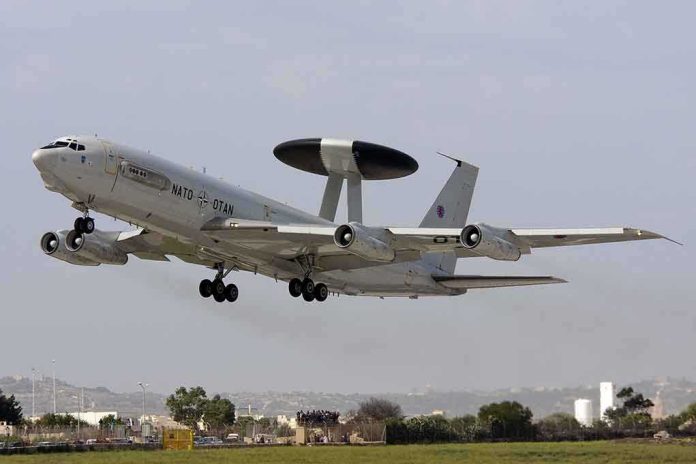
On 18 August, NATO fielded a dense, U.S.-led air package over northeastern Poland and the Baltic approaches abutting Russia’s Kaliningrad exclave. The formation featured U.S. and Norwegian fighters, a NATO E-3A Sentry airborne early warning and control aircraft, aerial refueling tankers, and, notably, the EA-37B Compass Call electronic warfare jet. The EA-37B staged to Poland and flew deliberate orbits west of Kaliningrad for about two hours, synchronized with the rest of the stack to create a coherent picture of the battlespace and to practice how allied aircraft fight—together—in the electromagnetic spectrum as much as in the air.
Polish commanders and NATO channels characterized the activity as planned training unrelated to a specific Russian sortie, underscoring routine readiness rather than crisis response. That description is accurate, and it coexists with the obvious strategic signaling: choosing Kaliningrad’s periphery concentrates attention on one of Europe’s most militarized patches of terrain and the fulcrum of Russia’s anti-access umbrella in the Baltic.
Why the EA-37B Matters: From Platform to Posture
The EA-37B Compass Call represents the U.S. Air Force’s current generation of stand-off electromagnetic attack and electronic support. Built on a modern business-jet airframe to gain altitude, speed, and endurance advantages over legacy platforms, it is designed to detect, identify, and disrupt adversary communications, datalinks, and certain radars—precisely the connective tissue of command and control that turns sensors and missiles into an integrated air defense. In practice, that means compressing an opponent’s decision cycle, fraying coordination, and creating exploitable seams for strikers and ISR aircraft. When paired with AWACS, stealth and non-stealth fighters, and theater ISR like ARTEMIS, the jet extends beyond “jamming” into dynamic spectrum warfare: sensing, deciding, and imposing costs in real time.
In the Baltic context, that capability is not abstract. Kaliningrad hosts layered Russian air defenses and strike systems intended to complicate NATO air operations. Bringing EA-37B into the neighborhood—without crossing borders—lets allies practice the choreography they would need on day one of any serious contingency: fusing data from E-3A, maintaining fuel through tankers, managing emissions control, and conditionally degrading hostile networks that hold the airspace at risk.
How NATO Uses Exercises as Deterrence in Practice
NATO deterrence near Kaliningrad relies on repetition, integration, and credible enablers. Exercises are the delivery vehicle: they normalize complex multi-nation air operations on short timelines; they validate tanker bridges and command-and-control chains; and, crucially, they make spectrum playbooks muscle memory. The alliance has used similar packages—fighters bracketed by AWACS and ISR—across the Baltic for years. What makes this episode noteworthy is the inclusion of the EA-37B, which signals that electromagnetic warfare is not a niche specialty but a routine, planned element of high-end airpower. Polish and NATO statements framed the operation as standard training, which it was; that public line does not diminish the strategic message when the training stack includes rare, top-tier EW assets.
Open-source flight tracking and specialized reporting reconstructed the package’s architecture and timing. Those sources converged on the same essentials: a U.S.-overseen mission set, orbits in Polish and Baltic airspace, and a Compass Call sortie aligned with the larger airborne formation. The combination of AWACS, EA-37B, fighters, and tankers is not incidental; it is the canonical deterrence stack for contested airspace on NATO’s northeastern flank.
Kaliningrad’s Strategic Logic: Heavily Armed, Geographically Exposed
Kaliningrad is Russia’s unsinkable magazine at the Baltic’s center—S-400s, coastal defense missiles, strike systems, and a vital naval anchor—but it is also a geographic cul-de-sac, separated from mainland Russia and bordered by NATO members. That paradox shapes both sides’ playbooks. For Moscow, the enclave is a shield and a signal. For NATO, it is a problem set best addressed before a crisis: mapping the electromagnetic environment, rehearsing airborne command and refueling, and practicing how to degrade command-and-control nodes and sensor networks should deterrence fail. The August package fit that mold exactly, with allies employing a mix of surveillance, refueling, and electronic attack to build familiarity with the local spectrum and with each other.
This is the broader pattern: regularized, multinational sorties that advertise allied ability to appear quickly, persist for hours, and manage the spectrum as deliberately as airspace. The EA-37B’s participation sharpened that message because it embodies the shift from platform-centric jamming to integrated electromagnetic maneuver—responsive, data-driven, and tied to a larger kill web.
🇺🇸🇳🇴🇷🇺🚨 NATO reportedly increases air activity near Kaliningrad
According to multiple reports, NATO deployed around 25 aircraft near Russia’s Kaliningrad exclave on August 18. The activity reportedly included US and Norwegian fighter jets, an AWACS early-warning aircraft, an… pic.twitter.com/luOV1TrQ6P— The Political Inspector | TPI (@PnPPolitics) August 21, 2026
What This Means Going Forward
Three durable implications follow. First, spectrum operations are now table stakes for credible deterrence in Europe. Expect the EA-37B to reappear alongside AWACS, F-35s, and ISR assets in future Baltic and Arctic evolutions; repetition is how alliances inoculate against surprise. Second, the line between training and strategic messaging will remain intentionally thin. Public affairs will keep describing these events as routine interoperability drills—even as their composition, timing, and pacing communicate resolve to any professional observing the air picture. Third, the data harvested from such missions compounds. Every orbit, every refueling track, every emissions snapshot makes the next package smarter, faster, harder to counter—an advantage that is difficult to quantify publicly but decisive in planning circles.
Sources:
19fortyfive.com, migflug.com, twz.com, militarnyi.com, en.sedaily.com, x.com, armyrecognition.com