

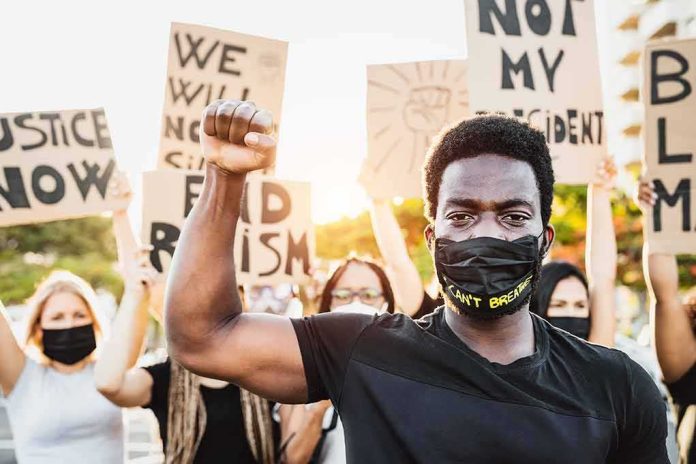
When party leadership and an insurgent faction collide, the fight is rarely about a single chant or a single room; it is a struggle over who gets to define the party’s coalition and priorities, with identity arguments often serving as proxies for a deeper contest about power, policy, and legitimacy.
At a Glance
- Hakeem Jeffries publicly highlighted the lack of racial diversity he saw in a victory-party crowd that jeered him; the observation became shorthand for a broader representational dispute.
- The confrontation was organized, not incidental: a coordinated chant—“You’re next!”—at a Bushwick event underscored an explicit bid to challenge party leadership.
- The activist faction had clear organizational links to DSA-aligned campaigns and newly elected lawmakers, signaling durable, not episodic, pressure on leadership.
- Progressive actors framed their opposition on policy—affordability, healthcare, housing, Israel—arguing their wins constitute a working-class mandate rather than a demographic statement.
What the clash is actually about: representativeness versus agenda control
Jeffries’ remark—“almost zero diversity”—about the Claire Valdez victory-party crowd is a vivid artifact of a longstanding intra-party narrative: leaders question whether insurgents represent the party’s broad base; insurgents counter that they represent its conscience and future. The setting matters. Gothamist reported a collective chant—“You’re next!”—when Jeffries’ image appeared at a Bushwick event for Valdez and other democratic-socialist candidates, signaling an organized, not incidental, challenge to the top of the caucus. CNN identified Valdez as a DSA member and situated the exchange within Jeffries’ wider effort to manage both President Trump’s agenda and left-flank critics, making clear this was about control of the House Democratic agenda, not only tone or style.
Yet the insurgents’ case does not live or die on the racial composition of one room. In interviews and statements, Valdez and DSA-aligned figures ground their opposition in policy: affordability, healthcare, housing, voting rights, and U.S. weapons transfers. That is the terrain on which they want the leadership fight adjudicated; they claim their election wins demonstrate voters’ appetite for that program.
How the episode fits a durable pattern of factional competition
Political science has long described parties as coalitions of factions—durable networks of electeds, activists, and allied groups vying to steer both platform and power. In this framework, ideological factions primarily seek to control policy positions; hierarchical factions focus on organizational authority—committee gavels, leadership posts, and procedural leverage. The Jeffries–DSA tension maps cleanly onto that distinction. The DSA-aligned bloc is pressing claims on policy content—Medicare for All, social housing, voting rights, and foreign policy—while also probing the boundaries of leadership authority through visible, symbolic challenges like the Bushwick chant and public hedging on a Jeffries speakership vote.
Leaders, for their part, often question insurgents’ representativeness as a means of disciplining the coalition. Jeffries’ diversity critique functions in that register: it suggests that the activists challenging him stand apart from the multiracial electorate that delivered Democratic victories. Historically, such representational claims can be a powerful internal argument, but they persuade most when paired with voter and precinct data—evidence that transcends a single event’s optics. Absent that, they can read as rhetorical jiu-jitsu: deflect ideology with identity.
What the evidence establishes—and what it doesn’t
The strongest facts are concrete. Jeffries publicly characterized the Bushwick crowd as lacking diversity; CNN carried the quote, and right-leaning outlets amplified it. Gothamist documented the “You’re next!” chant, locating it within a coordinated event featuring Valdez and other democratic-socialists. Multiple outlets also reported that Valdez, a DSA member, withheld an immediate commitment to support Jeffries for speaker, even as she predicted eventual party unity. Taken together, these facts show an activist faction with real organizational footing and at least some representation among incoming lawmakers applying pressure on the would-be Democratic leader.
What the record does not show is demographic proof beyond that night. No attendance rosters, coded photographic audits, or membership data appear in the reporting—only observations and descriptors. That leaves two claims unproven: that the DSA as a whole “lacks diversity,” and that the Bushwick attendees constitute a reliable microcosm of the broader activist coalition. Those are bigger, testable propositions; the available accounts don’t attempt that test.
The insurgent case is about policy, not headcounts
Valdez and DSA-aligned voices insist the argument is substantive: abolish ICE, Medicare for All, permanent affordable social housing; evaluate leadership on voting rights, healthcare, affordability, and weapons shipments. In separate reporting, Valdez ties progressive and socialist victories to an economic-populist, working-class agenda, asserting those wins are the relevant proof of representativeness. For that camp, a room’s demographic look on primary night is not the metric; the ballot box is. That posture is strategically shrewd: it shifts the debate from identity snapshots to policy deliverables, where insurgents believe momentum and message are aligned.
It also intersects with Jeffries’ persistent friction with DSA-aligned actors noted in New York political reporting—an institutional relationship defined less by personal pique than by divergent theories of how Democrats should wield power in a closely divided House and under a Republican presidency.
LA’s DSA Rep.-Elect Says She Won’t Back Hakeem Jeffries for House Speaker https://t.co/Zti4Z38usY via @truthout
— theprophet359 (@theprophet359) November 9, 2026
Consequences for governing: leverage, limits, and the data that would actually settle this
Leadership fights inside large coalitions hinge on leverage: numbers in the chamber, caucus rules, and the willingness to impose costs. DSA-aligned gains give progressives more visible voices, but not necessarily veto power—especially if leadership can assemble cross-faction majorities on procedural votes. Conversely, even a small bloc can extract concessions when margins are thin and unity is fragile. That dynamic makes symbolism functional: a chant is not policy, but it can signal resolve to defect at the right moment, raising the price of ignoring a faction’s priorities.
What would move this debate from rhetoric to resolution is evidence that scales. To validate or rebut the representational critique, compare crowd impressions with precinct-level vote returns and district demographics; pair that with transparent surveys of Black and lower-income voters on the precise policy planks in contention. To assess whether insurgents are over- or under-claiming a mandate, match the policy wish list to post-election opinion and turnout patterns. And to clarify whether this is primarily an identity clash or a programmatic one, lay Jeffries’ legislative record alongside DSA-aligned platforms and trace points of convergence and veto.
The bottom line
Jeffries’ observation about a “not very diverse” jeering crowd is documented; so is the activists’ organized challenge and their policy-centered case for leverage. The first is a snapshot, not a census. The second is a strategy, not yet a governing outcome. As with most durable intra-party struggles, the winner will be the faction that can translate its claim of representativeness—whether rooted in identity, geography, or class—into measurable agenda control. That translation happens through votes, rules, committees, and coalitions. Not through the optics of one raucous room.
Sources:
townhall.com, edition.cnn.com, tollbit.gothamist.com, thehill.com, politico.com, newsweek.com