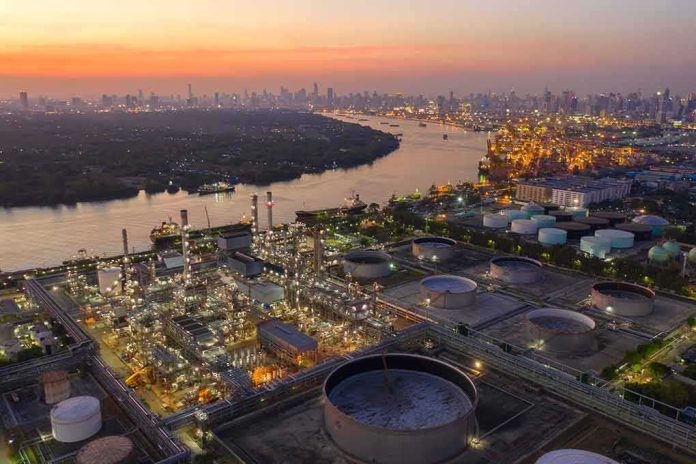
Striking a refinery is never just a spectacular fire; it is an attack on a system of throughput, inventories, and logistics whose resilience—or brittleness—decides whether flames translate into real pressure on an adversary’s war economy.
At a Glance
- Kirishi (KINEF), described as Russia’s second-largest refinery, caught fire after a drone attack linked publicly to Ukraine; regional authorities confirmed UAV impacts in the Kirishi industrial zone and said the blaze was contained.
- Open-source visuals placed the fire within the refinery complex, near primary crude-processing units—equipment whose impairment matters far more than an outbuilding.
- Fuel-sale caps appeared across multiple Russian regions during the same period, though a direct causal chain from this single strike is unproven.
- Ukraine also claimed a strike on the Morozov plant near St. Petersburg, alleging damage to three workshops tied to Iskander-M solid-fuel production; independent verification remains limited.
What the evidence establishes—and what it does not
The core facts are not in serious dispute: a large fire broke out at the Kirishi refinery following a mass drone attack, and the Leningrad regional governor acknowledged confirmed UAV impacts in the city’s industrial zone; he later said the fire was contained. Multiple outlets described Kirishi as Russia’s second-largest refinery, underscoring why any hit on core processing units draws immediate attention. Visuals reviewed by independent and Ukrainian outlets geolocated the fire inside the complex, with OSINT accounts pointing to the vicinity of ELOU-AVT primary distillation units—the heart of a refinery’s crude-to-product conversion. Those specifics matter because damage to primary distillation forces run cuts or shutdowns; damage to peripheral structures usually does not.
What remains unclear is duration and scale. Neither regional statements nor early reporting establish a sustained throughput loss, repair timeline, or quantified market effect from Kirishi alone. Russia framed the incident as contained, restored heat service in the locality, and did not claim a prolonged refinery outage. In parallel, fuel-sale rationing appeared across several regions, but officials attributed caps to precaution and panic buying as much as to production loss—a plausible blend in a system absorbing repeated shocks. In short, the strike is established; its long-run operational impact at this specific site is not.
Why Kirishi matters: mechanism and stakes
Refining is a chain. Crude enters via pipelines or rail; primary distillation separates it into fractions; downstream units—reformers, hydrocrackers, desulfurization trains—transform those fractions into marketable gasoline, diesel, jet, and petrochemical feedstocks. Primary distillation (ELOU-AVT in Russian nomenclature) is the gateway. If a distillation column, furnace, or associated heat-exchanger bank is down, the entire refinery’s achievable run rate can collapse, even if storage tanks and offsites are intact. That is why OSINT emphasis on fires near ELOU-AVT units is consequential: a short-lived blaze on a tank berm is one thing; thermal exposure to column internals or charge heaters is quite another. Reportage around Kirishi references ELOU-AVT-2 and possibly -6, which—if truly impaired—would force operators either to idle units or divert crude elsewhere, bottlenecking product output until repairs or workarounds are in place.
Russia’s fuel system can route around single-site losses in the short term via regional swaps, rail movements, and altered crude allocations. The risk emerges from accumulation: repeated hits increase turnarounds, maintenance backlogs, spare-parts scarcity under sanctions, and operator caution that keeps utilization below nameplate. That cumulative dynamic, not any single dramatic fire, explains the multi-month degradation documented by energy analysts during prior waves of strikes.
The broader campaign against Russian refining
Kirishi fits a pattern. Since 2023, Ukraine has repeatedly targeted refineries, fuel terminals, and related logistics deep inside Russia. Each attack has three simultaneous purposes: degrade military fuel elasticity, raise civilian and political costs through scarcity or queues, and message strategic reach. The effectiveness comes less from knocking out a single behemoth than from creating system-wide friction—lost runs, forced maintenance, and risk premia on storage and distribution. The International Energy Agency has reported that Russian refinery throughput fell to about 3.8 million barrels per day at a mid-2026 trough—roughly 30% below the prior year—illustrating how a campaign of many strikes can depress national processing even if individual plants periodically resume operations.
Market consequences follow mechanics. When refining capacity tightens, diesel and gasoline output fall faster than crude production because crude can still be pumped but not as easily upgraded to finished products. Analysts and market reporting through 2026 chronicled reduced diesel and gasoline production, export bans, and episodic rationing—textbook symptoms of constrained runs and stressed distribution. That history is why a credible hit on a large, complex site like Kirishi commands attention even before precise damage metrics surface.
Competing narratives and the evidence threshold
Russian regional authorities emphasized control and continuity: fire contained, heating restored, purchase caps characterized as temporary and aimed at preventing panic buying. Those statements do not contradict the strike; they aim to narrow its perceived effect. On the other hand, Ukrainian and OSINT sources highlighted fires near core units and framed Kirishi’s stature to imply strategic gain. An expert reading weighs specific, verifiable elements most heavily: governor-acknowledged UAV impacts and confirmed refinery fire; geolocated visuals within the complex; the absence—so far—of engineering-grade outage data. The result is a clear finding of impact but an open file on magnitude and duration.
The same evidentiary discipline applies to Ukraine’s claim against the Morozov plant, tied to solid-fuel charges for Iskander-M missiles. Kyiv’s General Staff said three production workshops were damaged—an assertion with high strategic salience if true. Yet independent confirmation in publicly available sources remains limited; without satellite analysis or corroborating industrial data, the prudent stance is to treat the claim as plausible but unverified.
Russian state controlled oil giant Rosneft has rationed gasoline and diesel sales across Russia following an intense wave of Ukrainian drone and missile strikes targeting domestic oil refineries. The sudden return to fuel rationing comes less than two weeks after previous… pic.twitter.com/bmY7sKuX4f
— Canadian Pollution (@canadapollution) November 9, 2026
How to read fuel rationing during strike cycles
Sale caps, when they appear, are a signal, not a diagnosis. They can reflect real shortfalls from lost refinery runs, precautionary inventory management to avoid dry-outs at critical nodes, or demand surges as motorists top off after alarming headlines. Russia’s own officials have acknowledged that refinery strikes have stressed markets and affected prices while asserting that national fuel production overall has not stopped—positions that can simultaneously be true. In a system under chronic attack, rationing toggles on and off as local managers balance stocks, deliveries, and psychology. Tying any given cap directly to the Kirishi event alone overstates what the evidence supports.
What would prove sustained impact—and why it matters
Three classes of evidence would turn the Kirishi strike from a vivid incident into a documented capacity loss. First, remote sensing: multi-week thermal infrared signatures and visible-light imagery showing reduced flaring and fewer hot units, or captured repairs on key columns and furnaces. Second, operational breadcrumbs: railcar and pipeline flow data indicating diverted crude, reduced product loadings, and abnormal tank levels. Third, administrative footprints: maintenance tenders, insurance claims, or energy-ministry statistics reflecting prolonged run cuts. In prior strike waves, exactly these signals underpinned confident assessments of national throughput declines; the same standard should govern Kirishi.
Bottom line
The Kirishi fire demonstrates reach and finds a soft spot: primary distillation is where small drones and modest warheads can punch above their weight. The immediate effect is established; the scale of lasting damage is not. Read the incident as one move in a cumulative campaign whose potency is measured in aggregate run cuts, rationing cycles, and price responses over months—not in any single night’s flames. If subsequent data show that Kirishi’s core units ran at reduced rates or remained offline, the strike will graduate from symbolism to sustained pressure. Until then, it is a credible hit on a critical node in a system already showing the strains of repeated blows.
Sources:
youtube.com, kyivpost.com, kyivindependent.com, pravda.com.ua, spotmedia.ro, news.az, aljazeera.com, reuters.com