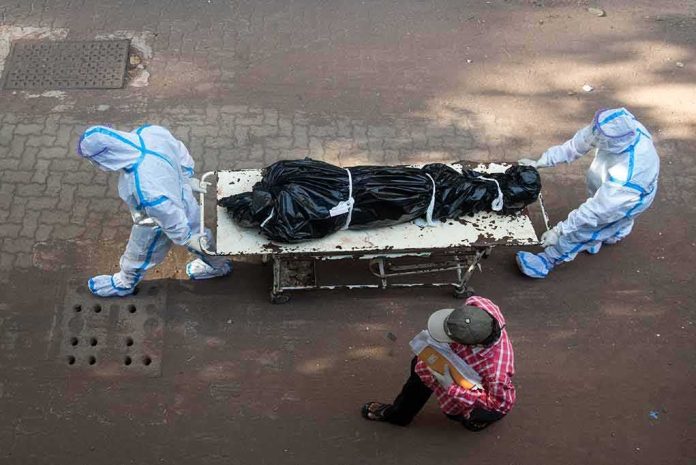
The important story is not only that a teenage gunman killed his grandparents and then attacked a Thai school; it is that, within hours, the event became a fully fledged public tragedy in which families had already begun reclaiming bodies while the official picture was still being assembled.
Key Points
- The core account is consistent across major reporting: a 14-year-old student allegedly killed his grandparents, went to his school, and died by apparent suicide after the attack.
- Authorities and news outlets agree that the school victims were educators, while the early casualty breakdown varied as the story developed.
- The public record is strong on the broad sequence of events but weaker on the forensic details that would lock down the exact timeline, victim roster, and weapon trace.
- What happened in the aftermath matters: the reclaiming of bodies, the grief rituals, and the fast hardening of breaking-news summaries are part of how mass-casualty events become history.
The event entered public view as a tragedy already moving toward closure
Thailand’s deadly school shooting followed a grim but familiar crisis pattern: a rapid police narrative, a burst of live coverage, and a near-immediate public need to account for the dead. Reuters reported that the suspect was a teenage Thai student who killed his grandparents before killing at least five people at a school outside Bangkok and then killing himself, while BBC coverage and other outlets repeated the same essential sequence. The broad facts held steady even as the precise count and victim categories shifted in early reports.
That distinction matters. In mass-casualty events, the first draft of the record is often accurate in structure but unstable in detail. Here, the structure is plain: family home first, school second, self-inflicted death at the scene. The unstable detail lies in the early accounting of who died where and in what category, which is exactly where breaking-news coverage is most vulnerable to error.
How the attack is described in the public record
The strongest common thread in the supplied reporting is the alleged sequence. Reuters said police identified the shooter as a 14-year-old student who killed his grandparents before opening fire at school, and the Washington Post described the same sequence in similar terms. Reuters also reported that the gun belonged to the suspect’s grandfather and that officers found additional ammunition at the scene, a detail repeated in BBC coverage. Those facts give the story its internal logic: access, proximity, and familiarity with the weapon are all part of the mechanism of the attack.
The death toll is less tidy than the core narrative. Reuters and BBC reported at least seven dead including the shooter, his grandparents, and school staff; AP/ABC-style reporting in the supplied material described at least seven killed as well, but one account categorized school victims differently, describing students among the dead. That is not a trivial discrepancy. It is the difference between a cleanly sketched public memory and the messier reality that investigators and hospital systems must later reconcile.
What families did after the shooting reveals the second phase of the event
The Reuters video package attached to the story centered on relatives claiming the bodies of victims, which is more than a scene of mourning; it is the administrative and emotional handoff that follows a mass killing once the immediate emergency has ended. In Thailand, as in most countries, that stage requires identification, confirmation, and release procedures before funerals can begin. The public sees grief, but behind it sits the machinery of death certification, body release, and local authority coordination. That process is why body collection becomes news in the first place: it signals that the event has moved from active crisis to settled fatality.
This aftermath also explains why the story persists after the initial burst of violence. A school shooting is not finished when the gunfire stops. It continues through victim identification, funeral arrangements, and the slow replacement of rumor with records. Families claiming bodies marks the point at which the abstract casualty count becomes a roster of individual lives, and that is the moment when the social meaning of the event becomes fully real.
Where the record is solid and where it is still thin
The public record is strongest on the basic sequence and weakest on the evidentiary foundation beneath it. The supplied material does not include a formal police incident report, autopsy results, or a ballistic reconstruction, so the suicide finding and the exact order of deaths remain dependent on police attribution repeated by media. That is normal in fast-moving breaking news, but it is not the same as a completed forensic case file. For a historical account, the difference matters because the first version of the story can be directionally right and still miss crucial particulars.
The same is true of the victim roster. Reuters said those killed at the school were teachers and staff, while another early report in the supplied material described students among the dead. The most defensible reading is that the core tragedy is undisputed, but the granular accounting was still settling. That is not a sign that the event was unclear in essence; it is a sign that crisis reporting outran formal documentation, as it so often does.
Families in Thailand have begun funerals for victims of a school shooting that killed nine people and injured dozens. The attack has renewed concerns over gun violence.
Al Jazeera’s Camille Nedelec reports. pic.twitter.com/n7HU0HJjbc
— Al Jazeera English (@AJEnglish) August 8, 2026
Why this event resonated beyond Thailand
Thailand already has a painful recent template for school violence, and the supplied material explicitly situates this attack against earlier shootings in the country. That context gave the event immediate national weight. It also sharpened the policy dimension, because once a school shooting is framed as part of a broader pattern, the public conversation turns quickly toward guns, access, and institutional security rather than toward the smaller but crucial factual questions that investigators still need to answer.
That policy turn is understandable, but it can flatten the evidentiary story. The most important lesson from the available reporting is not speculative motive; no official motive is given in the supplied material. It is that a credible, cross-outlet account can still leave important details unresolved, especially when the suspect is a minor and the first authoritative statements come through police briefings rather than publicly released documents.
What to watch if the case record is ever opened fully
The decisive documents would be straightforward: the Thai police incident file, forensic-medical reports, ballistic testing, death certificates, and any CCTV or witness statements that reconstruct movement inside the school. Those materials would answer the questions that remain open in the public record: whether the reported victim categories were corrected later, how precisely the weapon was traced, and how investigators determined the suspect’s final moments. Until then, the event stands on a sturdy but still mediated evidentiary base.
That is the right way to read it. The broad narrative is established; the tragedy is real; the aftermath is already visible in the claims on the bodies. What remains unfinished is not the fact of the violence, but the archival completeness of the account that history will ultimately inherit.
Sources:
youtube.com, bbc.com, theguardian.com, en.wikipedia.org, reuters.com, cnn.com, time.com