

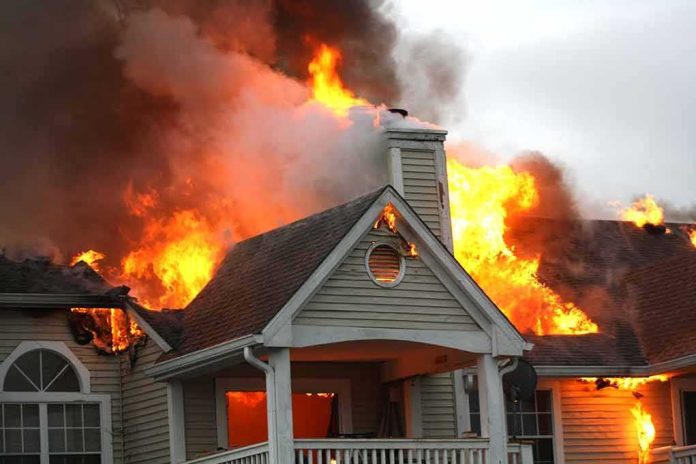
When a fire leaves eight people dead in a single home—six of them children—and some of those bodies bear gunshot wounds, the central task for investigators is not only to determine what happened inside that house, but to do it carefully enough that the public can trust every word that follows.
Key Points
- Eight family members—two adults and six children aged roughly 5 to 15—were found dead inside a Grand Haven Township, Michigan home after a house fire.
- Deputies and fire crews describe the deaths and the blaze as “suspicious”; at least some victims had gunshot wounds.
- Arson specialists from Michigan State Police are assisting local investigators in determining whether the fire was intentionally set.
- Authorities have floated murder-suicide as one theory but emphasized that cause of death and event sequence remain unconfirmed pending autopsies and forensic work.
A deadly fire, a family of eight, and a “complicated” crime scene
The known facts are stark. Late on a Friday morning in Grand Haven Township, a largely residential area near Michigan’s Lake Michigan shoreline, firefighters responding to a report of smoke entered a single-family home on Riverside Trail and found eight people dead inside. According to Ottawa County Sheriff’s Office Captain Jacob Sparks, the victims were members of one family: two adults in their 40s and six children between about 5 and 15 years old. No one who lived in the home was found alive, and authorities have said they are not currently looking for additional victims.
What transformed this from a tragic house fire into a major criminal investigation was what responders saw when they examined the bodies. At an evening news briefing, Sparks confirmed that at least some of the victims had gunshot wounds. He declined to specify how many, or which individuals, had been shot—a detail investigators often withhold until autopsy work is complete—but called the overall scene “complicated” and “complex.” That combination of fire damage and gunshot trauma immediately raised the possibility of homicide, suicide, or both, and pushed the case into the category law enforcement uniformly calls “suspicious deaths.”
From house fire to major-crime investigation: how the response unfolded
The timeline on the day of the incident illustrates how an ordinary fire call can evolve into a multi-agency forensic operation. Neighbors first reported smelling smoke sometime between 8:30 and 9:00 a.m., prompting an initial response by local fire crews to the Riverside Trail area. On that first visit, firefighters reportedly did not find an active fire and left the scene, a pattern that can occur when smoke is faint, the source obscured, or the problem appears minor.
By late morning, around 11:40 a.m., calls escalated: responders were dispatched again, this time to visible white smoke coming from the home itself in the 14900 block of Riverside Trail. When crews entered to battle what was then a confirmed fire, they discovered the bodies of the eight family members. Deputies from the Ottawa County Sheriff’s Office joined firefighters inside the house, and very quickly, the response shifted. Instead of treating the location purely as a fire scene, authorities locked it down as a potential crime scene and began coordinating with Michigan State Police arson investigators.
Gunshot wounds, “suspicious” fire, and the arson question
Two evidentiary threads are driving the investigation: the gunshot wounds and the fire itself. Sparks has said publicly that some victims clearly had gunshot injuries, visible even before autopsies. That fact alone places the case in the realm of violent death, but it does not, by itself, distinguish between homicide, suicide, or a mix of both. Autopsy reports are needed to determine whether bullets, smoke inhalation, burns, or some combination of these caused each person’s death.
On the fire side, investigators quickly signaled that they were not treating the blaze as accidental. Sparks described the fire as “suspicious” and said there was reason to believe it had been intentionally set inside the home. Arson-detection dogs were brought in to search for accelerants, and specialists from Michigan State Police remained on scene examining burn patterns, origin points, and any surviving physical evidence. Even so, Sparks was explicit about the limits of their certainty, noting that while he believed the fire started internally, he did not yet have that “for a 100%” confirmation.
That cautious phrasing reflects standard practice in fatal-fire investigations. Fire destroys and obscures evidence; it can erase fingerprints, warp metal, and collapse structural elements that would otherwise help reconstruct a sequence of events. Confirming arson typically requires laboratory analysis of debris samples, comparison of burn patterns with known accelerant behavior, and exclusion of electrical or accidental sources. Until that work is complete, experienced investigators avoid definitive public statements.
Murder-suicide as a working theory—and why investigators refuse to rush it
The presence of gunshot wounds, the lack of an apparent external suspect, and the fact that every known resident of the home was found dead have led authorities to acknowledge murder-suicide as one working theory. Sparks has said that investigators are not currently searching for an outside suspect and that it appears all individuals involved were inside the residence at the time and are now deceased. That pattern—entire household dead, no sign of intrusion or escape—often pushes detectives to consider whether one member killed others and then himself or herself.
Yet Sparks has been emphatic about avoiding premature conclusions. He told reporters, “It’s too early for me to say that it’s a murder-suicide,” stressing that it remains “one theory that we have and we’re still looking to see if we can verify that.” In practice, “verification” in a case like this would involve several converging lines of evidence: ballistics tying bullets and casings to a single firearm, gunshot residue on the suspected shooter, wound trajectories consistent with self-infliction, and absence of indications that another person entered or left the home around the time of the fire.
The need for restraint is not merely rhetorical. Violence-prevention and forensic literature treat homicide-suicide as a specific subtype of fatal violence, often linked to intimate-partner conflict, family annihilation, or severe mental health crises. It is relatively rare, and misclassifying a complex scene as murder-suicide without sufficient evidence can obscure other causes—such as a third-party offender or an accident compounded by a panicked response. In Grand Haven Township, investigators appear intent on avoiding that trap.
The role of autopsies, ballistics, and fire science in clarifying what happened
For now, the most important work is happening away from cameras. Autopsies of the eight victims were scheduled promptly, with authorities expecting initial results the day after the fire. Those examinations will determine not just cause of death but also timing—whether, for example, a child died from a gunshot before the fire started, or from smoke inhalation after being trapped by the blaze. Toxicology may look for intoxicants or medications in the adults that could shed light on their mental state or capacity at the time.
Ballistics testing will match bullets and shell casings to any firearms recovered at the scene, identify the number of shots fired, and map trajectories through the rooms and bodies. Combined with crime-scene documentation—body positions, bloodstain patterns, and the distribution of damage—this allows investigators to reconstruct a sequence: who was likely shot first, where they were standing, whether they moved after being wounded, and whether one person could plausibly have fired all the shots.
On the fire side, accelerant testing of debris, wiring analysis, and origin-and-cause reports will ultimately decide whether the blaze was incendiary. If investigators find a clear point of origin with pour-patterns consistent with gasoline, for instance, and no accidental source nearby, the arson theory strengthens considerably. If the evidence instead points to an overloaded outlet, a space heater, or a cooking accident, the narrative shifts; gunshot wounds might then represent a separate event unconnected to the fire’s ignition.
Media narratives, public grief, and the danger of filling gaps too fast
Part of what makes this case so emotionally and socially charged is the age and number of the victims. Six dead children and two dead adults almost guarantee intense coverage and a flood of speculation. Early reporting from national and local outlets has consistently emphasized three elements: the “suspicious” designation, the gunshot wounds, and the possibility of murder-suicide. Those are factual, but they are also partial; by definition, they precede the deeper forensic findings.
In high-profile fatal-fire cases, that pattern recurs. Preliminary clues—gunshots, hints of accelerant, lack of external suspects—are broadcast as the frame through which the public understands the event. If autopsy and lab results later complicate that picture, they often receive less attention than the initial, more dramatic narrative. Investigators in Ottawa County seem aware of this dynamic, which helps explain their deliberate, sometimes repetitive insistence that it is “too early” to declare a definitive cause, that they are “hesitant to ever jump to any conclusions,” and that multiple theories remain under review.
At the same time, limited disclosure creates its own problems. When authorities withhold names pending next-of-kin notification, decline to specify how many victims were shot, and avoid describing injuries in detail, they protect both the investigation and the families—but they also leave an information vacuum. In that vacuum, social media posts, neighborhood rumor, and commentary from distant observers can gain traction faster than carefully vetted facts. For a small community like Grand Haven Township, the result is a collective grief compounded by uncertainty.
8 family members found dead after suspicious house fire
Two adults and 6 children were found inside the home on Riverside Trail. Ottawa County sheriff's deputies are calling the deaths suspicious as some victims were shot. GRAND HAVEN TWP, Mich. https://t.co/uJKrTz120b— wake1up (@n2oneness) July 25, 2026
What this case illustrates about modern fatal-fire investigations
Stepping back from the specifics, the Grand Haven Township tragedy encapsulates how modern investigators handle the intersection of fire, firearms, and multiple fatalities. They treat the scene first as a potential crime scene, even when the initiating call is for smoke or flames. They bring in specialized arson units early, understanding how quickly fire can erase critical evidence. They delay definitive public statements until autopsies, ballistics, and fire-origin analyses converge on a coherent picture, even when public pressure demands immediate answers.
For the families of the victims and the wider community, that pace can feel painfully slow. But in a context where eight people are dead and the mechanisms of their deaths overlap and interact, speed is not the primary virtue; accuracy is. Whether this case ultimately proves to be murder-suicide, a broader homicide, or a tragic confluence of violence and accidental fire, the careful evidentiary work now underway will determine more than just the wording of a press release. It will shape death certificates, insurance claims, possible criminal charges, and the historical record of how one Michigan family’s life ended in a house on Riverside Trail.
Sources:
washingtontimes.com, nytimes.com, youtube.com, cnn.com, nbcchicago.com, facebook.com, mlive.com, freep.com