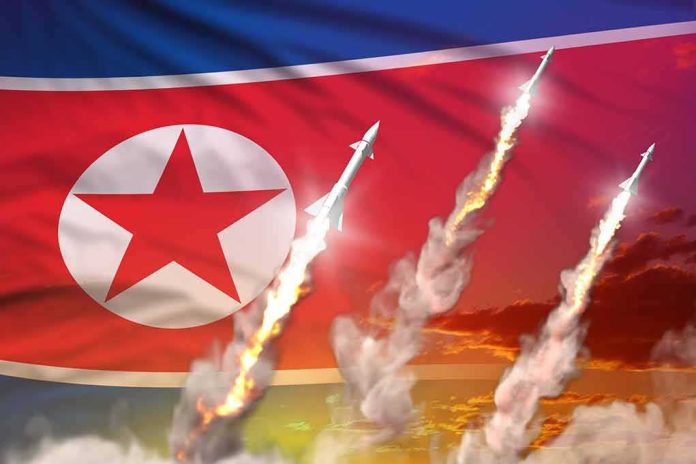
North Korea’s nuclear and missile programs are not merely persisting under pressure; they are diversifying, hardening, and moving toward a force that is more survivable and operationally flexible across ranges—progress that changes the risk calculus for the United States, South Korea, and Japan.
At a Glance
- CRS assessments: Pyongyang is expanding its arsenal and fielding more varied, survivable delivery systems despite sanctions and diplomacy.
- Testing tempo and diversity: Launch activity since 2022 includes frequent short-range barrages, novel hypersonic-claim systems, ICBM-class shots, and space-launch vehicles using ballistic technology.
- Toward a usable deterrent: External assessments judge DPRK warheads as miniaturized for missiles and increasingly mated to road-mobile and sea-based platforms.
- Arsenal size remains estimate-dependent; the modernization trend does not. Open sources vary on warhead totals, but converge on continued growth in fissile material and delivery options.
What the evidence shows: growth in capability, pace, and survivability
U.S. Congressional Research Service (CRS) reporting is unequivocal on trajectory: North Korea continues to advance both nuclear weapons and missile programs notwithstanding UN Security Council sanctions and rounds of high-level diplomacy. The pattern is visible in the test record as much as in doctrine and declarations. Japan’s Diplomatic Bluebook tallies 11 missile-related events (at least 22 launches) in 2024, spanning short-range salvos, ICBM-class shots, and launches using ballistic-missile technology ostensibly for satellites; 2025 maintained activity with multiple additional events by midyear. The cumulative effect is not just more launches—it is a broader menu of delivery systems, exercised routinely enough to burn in procedures and complicate interception.
CRS also captures the scope of ambition. Internal directives called for ramping warhead stockpiles and expanding weapon-grade material production; external intelligence assessments have warned that the intercontinental component, while still numerically limited, could grow substantially in the coming decade. Against that strategic picture sits a critical enabling detail: allied defense assessments judge that North Korea has achieved the level of miniaturization necessary to mount nuclear payloads on ballistic missiles, enabling “tactical” (theater) nuclear options as well as strategic ones.
How the force is built: delivery systems, basing, and doctrine
Three strands of development define North Korea’s approach. First, diversification: the arsenal spans short-range ballistic missiles (SRBMs) tailored to defeat terminal missile defenses through depressed trajectories and maneuver, medium- and intermediate-range systems that can reach U.S. bases in Japan and Guam, and ICBM-class missiles intended to hold the U.S. homeland at risk. Second, survivability: road-mobile launchers, dispersed operating sites, and a nascent sea-based arm—submarine-launched ballistic missiles (SLBMs) and tests from submersible platforms—complicate preemption and boost crisis endurance. Third, doctrine: official statements have moved from declaratory deterrence to explicit integration of preemptive nuclear use into warfighting plans, with “tactical nuclear” framing designed to break allied coalitions by threatening limited, theater-level nuclear strikes early in a conflict.
Testing supports all three. Repeated SRBM launches—often in salvos and at varying azimuths—rehearse saturation and ambiguity. ICBM-class tests demonstrate range and staging reliability sufficient to command a planning response even as analysts debate reentry vehicle performance. Space-launch campaigns using ballistic technology hone propulsion, guidance, and staging under a veneer of civilian utility. The throughline: a maturing, exercised missile complex whose breadth puts pressure on layered defenses and crisis decision time.
Arsenal size versus modernization: what we know, what is estimated
Two distinct questions tend to be conflated in public debate. The first—whether North Korea is modernizing and enlarging its nuclear forces—is well evidenced by official declarations, observed testing, and repeated updates from CRS and allied defense ministries. The second—how many assembled warheads the DPRK possesses today—remains an estimate because the program is opaque and access to production nodes is denied. Open-source ranges typically put the stockpile on the order of a few dozen to low double digits of dozens, constrained by fissile material and engineering cadence. Some nongovernmental analyses place the assembled number around 45 with wider uncertainty bands; others estimate sufficient fissile material for more devices than currently assembled. The precise count matters for force planning, but the strategic hinge is trend: continued production of plutonium and highly enriched uranium and the integration of warheads onto varied, survivable delivery systems.
The intelligence community’s long-range outlook reflects that distinction. One public assessment in 2025 judged North Korea to have “10 or fewer” intercontinental ballistic missiles at that time, with potential growth to dozens by the mid-2030s if current trajectories persist—an estimate about launchers and missiles, not necessarily mated, deployed warheads. That growth vector, layered atop road mobility and potential sea-basing, is what shifts deterrence dynamics over the next decade.
Why sanctions and diplomacy have not halted the program
Sanctions have raised costs and narrowed legal channels, but they have not reversed the program’s direction of travel. The reasons are structural. The regime treats nuclear capability as regime-survival insurance and a coercive tool to shape its external environment; it has proved willing to absorb economic pain to protect that core program. Enforcement gaps—especially along the China and Russia vectors—blunt impact, while the dual-use nature of many components complicates interdiction. Scholarly and policy analyses converge on a sober verdict: UN measures have contained and monitored aspects of the program more effectively than they have compelled abandonment. The result is not impunity—North Korea pays an economic price—but strategic persistence.
Diplomacy has delivered pauses and partial constraints when incentives and verification were aligned, but the record shows that incomplete coverage and hedging behaviors—particularly the diversification into uranium enrichment while plutonium pathways were negotiated—left avenues for continued progress. The recent cycle has featured overt rejection of talks premised on near-term denuclearization, with domestic law codifying expansive nuclear-use authorities. Absent a negotiating frame that addresses both regime-security guarantees and phased rollback with verifiable stops, the default is continued modernization.
Implications for allied strategy and stability
A more diversified and survivable DPRK nuclear force stresses every rung of allied planning—deterrence, defense, and crisis management. For South Korea and Japan, the growth of accurate, nuclear-capable SRBMs and MRBMs compresses decision timelines and burdens missile defense architectures designed around ballistic, not maneuvering, threats. For the United States, even a small, credible ICBM presence complicates escalation control by injecting homeland risk into any peninsula crisis. Extended deterrence—assurances that U.S. nuclear and conventional power backstops allies—must therefore be demonstrated not just declaratorily but through posture: rotational assets, integrated air and missile defenses, resilient command and control, and exercise patterns that practice cross-domain responses under missile attack.
At the same time, channels to manage escalation—hotlines, deconfliction, and crisis protocols—grow more, not less, important as nuclear thresholds are lowered in doctrine. The practical agenda is dual: harden against coercion through capability and alliance integration while preserving off-ramps and verifiable arms-control footholds should political conditions shift. Nothing in the modernization trend forecloses diplomacy; it does, however, raise the price of delay.
What to watch next
Four indicators matter. First, evidence of serial production and dispersal of newer SRBM families—an operational, not merely developmental, milestone. Second, maturation of sea-based options beyond test articles to patrol patterns and basing facilities that signal survivable second-strike intent. Third, movement in fissile-material throughput at known sites or suspected covert facilities, which tracks the ceiling on warhead assembly. Fourth, doctrinal codifications that either entrench—or, less likely, constrain—preemptive nuclear-use authorities. Collectively, these will tell us whether North Korea is settling into a stable minimum-deterrent posture or edging toward a more ambitious, theater-dominant nuclear strategy.
Sources:
defensedaily.com, congress.gov, mofa.go.jp, ncnk.org, firstpost.com, yris.yira.org, isis-online.org, armscontrol.org