
What looks like a T-shirt controversy is, in fact, a stress test of how modern concerts balance artistic speech, private control of stages, and a polarized audience primed to read a two-word slogan as either conscience or trespass.
At a Glance
- Zach Bryan wore a “Free Palestine” shirt onstage at Gillette Stadium; multiple outlets documented the onstage display.
- The act landed in a venue already politicized by Robert Kraft’s recent justification for excluding Macklemore over what Kraft called hate speech.
- There is no on-record explanation from Bryan; the shirt’s meaning is inferred from context and timing.
- The core friction is not only about Israel–Palestine; it’s about who sets expressive boundaries inside privately run mega-venues.
What happened, and why it resonated beyond one night
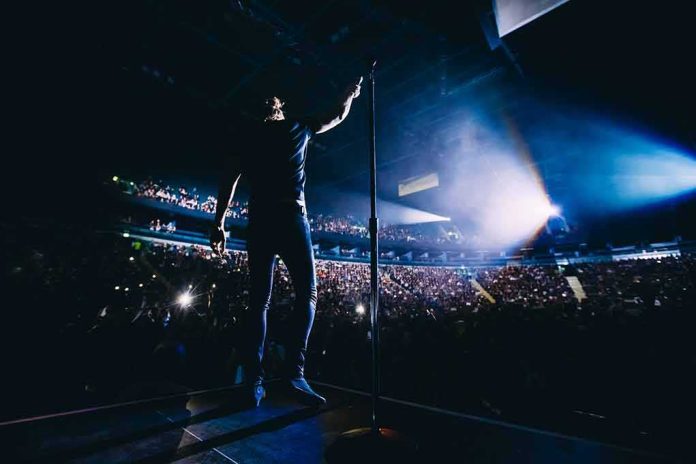
The facts are straightforward and well-corroborated: during the first of two Gillette Stadium shows, country star Zach Bryan performed in a black T-shirt that read “Free Palestine,” with “An appeal to heaven” and a pine tree emblem below; several bandmates wore similar or thematic apparel. The shirt appeared onstage during the concert, not in a press line or ad buy, which matters because clothing choices at shows function as part of the performance itself. Newsrooms from CBS and CNN to the Boston Globe ran contemporaneous accounts, and none contradict the core description of what audiences saw that night. The meaning, journalists uniformly concluded, was political rather than fashion-random, given the text and timing at a venue whose recent controversies made the message unmistakably legible to the crowd and the press.
That timing is the lever. Weeks earlier, Gillette’s owner, Robert Kraft, publicly defended a decision to exclude Macklemore from Ed Sheeran’s tour stops at the stadium, arguing that Macklemore’s participation would cross a line the venue draws against platforming hate speech—citing the rapper’s onstage material in New Jersey and what Kraft characterized as a broader record of offensive rhetoric and imagery. Macklemore rejected the framing, saying that criticizing Israel and saying “Free Palestine” should not be conflated with antisemitism. Whether one reads Bryan’s shirt as humanitarian solidarity or provocation, the placement—on Kraft’s stage—guaranteed it would be read inside that dispute.
How artist speech and venue power actually work
To understand why this moment keeps reproducing across genres and cities, separate two regimes that often get blurred. First, the First Amendment sharply limits government suppression of speech; when a venue is publicly owned or a government actor is entangled in content-based decisions, constitutional constraints and forum doctrine come into play. Second, most stadiums are private businesses. Private owners can condition access to their platforms by contract, enforce conduct codes, and manage reputation risk—so long as they don’t run afoul of specific laws (for instance, civil rights statutes) or their own agreements. In practice, the speech question in a concert hall is usually contractual, not constitutional; it turns on what the artist, promoter, and venue agreed to, and how consistently the venue enforces those terms across viewpoints.
That distinction explains the pattern: artists increasingly treat the stage as a civic pulpit, while venue operators treat the same stage as a brand-sensitive asset. The friction is structural, not merely ideological. It appears whenever a brief, symbolic gesture—an image on a screen, a spoken line, a shirt—collides with an owner’s risk calculus about sponsors, security, and community relations. The more polarized the issue, the shorter the fuse. And because the economics of stadium touring concentrate leverage—limited routing options, enormous sunk costs—owners and promoters can exert extraordinary control, even absent formal censorship. The result is a modern test of how much expressive latitude a performer can practically exercise inside a private, high-stakes environment.
What the evidence supports—and what it doesn’t
The onstage act is not in serious factual dispute: Bryan wore the shirt; multiple outlets and video clips documented it. There is, however, no on-record statement from Bryan explaining his intent; interpreting motive is necessarily inferential. What anchors the interpretation isn’t guesswork but context: the message text itself and a venue freshly associated with a ban justified as anti–hate speech policy. Taken together, the inference that the shirt functioned as political expression—conscious of place and moment—is stronger than alternative readings. Coverage also noted that some band members wore aligned messages, suggesting coordination rather than a one-off whim.
The counter-argument in play is not a factual denial of the shirt but a boundary claim: Kraft’s position that the stadium will not platform hate speech, and that the prior Macklemore materials, taken in context, would have crossed that line. That’s a values and categorization dispute. Macklemore answered directly that pro-Palestinian advocacy is not antisemitism. In Bryan’s case, no party has alleged his shirt violated a policy or prompted sanction; there is no record here, yet, of enforcement action. So the weight of the evidence supports a simple conclusion: this was protected artistic expression in the colloquial sense—an artist using the stage to say something—within a private venue that retains the contractual authority to set and enforce limits, should it choose to invoke them.
Why concerts are now flashpoints for politics by design
Live music has long been a venue for protest, but the stadium era amplifies both voice and vulnerability. A single arena night now represents millions in gross and a global social footprint; a two-second clip can define an artist’s public identity for months. That scale invites artists who want reach for cause-driven speech—and owners who see brand risk in precisely that reach. This is why ostensibly neutral rules (“no political statements”) rarely stay neutral in practice. The line between “political” and “humanitarian” is blurry, and enforcement almost always lands on issues with immediate reputational cost. The Israel–Palestine conflict, supercharged by diaspora sensitivities, donor politics, and real-time war reporting, guarantees that even minimalist signals—two words on cotton—become litmus tests.
For audiences, this dynamic reframes the ticketed show as a negotiated space. Fans don’t merely consume songs; they watch the meta-story: what the artist dares to say, how the building responds, and which outlets frame the gesture as courage, demagoguery, or brand play. Multiply that by social media’s incentive structure—short clips, instant outrage—and the afterlife of the act often eclipses the setlist. In that ecosystem, silence from principals (artist camp, venue management) doesn’t cool things down; it cedes interpretation to commentators whose business model rewards certainty.
Zach Bryan Breaks Attendance Record At Robert Kraft's Gillette Stadium Wearing 'Free Palestine' Shirt https://t.co/Dy4t7prY6b
— TMZ Sports (@TMZ_Sports) October 4, 2026
What to watch next: policy, parity, and precedent
The hard problem now is not adjudicating one shirt; it’s building durable norms for live-performance expression that can survive the next controversy. Three practical questions will decide that trajectory. First, policy clarity: do major venues publish and enforce content standards that are concrete, viewpoint-neutral, and known to performers before showtime, or are lines drawn ad hoc under pressure? Second, parity: when similar messages arise on opposing sides of a conflict, is enforcement consistent, or does ideology and donor influence drive outcomes? Third, portability: when a high-profile owner makes a values announcement in one city, do promoters and artists start assuming similar constraints everywhere, chilling expression even where contracts don’t require it?
Sources:
facebook.com, cbsnews.com, bostonglobe.com, nbcconnecticut.com, bbc.com, cnn.com, jta.org, usatoday.com