When a White House conditions access on whether coverage flatters the president, the conflict stops being a media spat and becomes a First Amendment test; that is the core stake in President Trump’s announced ban on CNN, MS NOW, and Politico from White House access.
The Short Version
- President Trump publicly declared an “effective immediately” ban on CNN, MS NOW, and Politico from White House access, tying it to their allegedly “fake” and “purposely negative” coverage.
- The announced rationale targets viewpoint and tone, not specific factual errors—an approach courts have repeatedly treated as unconstitutional when the government has opened access to other journalists.
- Initial implementation lagged the rhetoric: reporters from the named outlets were still present following the announcement, underscoring uncertainty over scope and enforcement.
- Recent precedent—particularly litigation over Associated Press access—frames selective bans as viewpoint discrimination when applied to opened press forums, inviting swift legal challenges.
What the president announced and why it matters
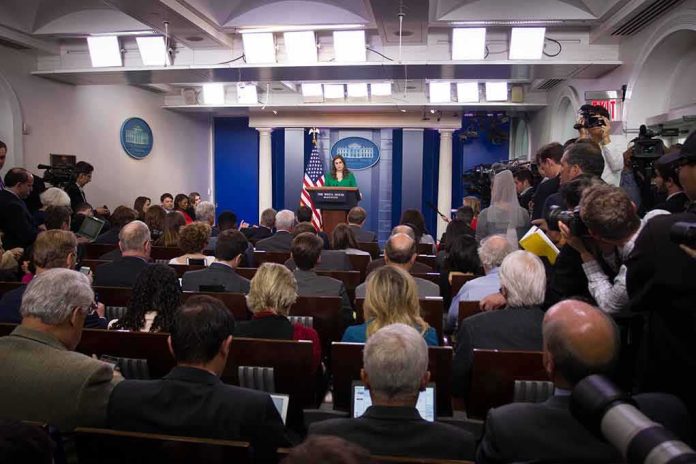
President Trump said he was barring CNN, MS NOW, and Politico from the White House “effective immediately,” describing their work as “fake news” and “purposely negative,” and asserting he did not have to admit them to “the people’s house.” The announcement was not couched in a discrete security or decorum breach; it was cast as a response to years of disfavored coverage, framed as falsity largely because of its negative character. That distinction—equating negativity with “fake”—is the hinge of the legal and constitutional analysis. Once a government office opens its doors to the press broadly, courts have held that it cannot close them selectively based on viewpoint; doing so is impermissible retaliation against protected speech.
The immediate stakes are not abstract. Denying regular access to the grounds, the briefing room, pool rotations, and small-space events constrains how the public learns about presidential activity. It also rewrites the practical incentives for newsrooms: reward consonant coverage with proximity, punish adversarial coverage with exile. The First Amendment exists in no small part to prevent exactly that cycle.
How this differs from routine credentialing—and why that difference is decisive
Credentialing, security screenings, and space-limited pool assignments are normal features of White House reporting; they are content-neutral rules that allow a complex beat to function. The president’s announcement did not rest on those mechanics. He linked the ban to the outlets’ “purposely negative stories” and, when pressed on reasons, offered “no, no reason, no, just because,” after citing years of critical coverage. That is the vocabulary of viewpoint and animus, not of operational management.
Reuters and others reported the White House was notifying outlets about an exclusion from the grounds—going beyond a single briefing-room seat or a one-off event pool—and anchoring the action in the hostility standard the president articulated. Multiple outlets, however, observed that reporters from CNN, MS NOW, and Politico remained on site shortly after the announcement, suggesting either a lag in implementation or unresolved scope and process questions. Vagueness does not cure a constitutional defect; if anything, it compounds risk by leaving enforcement to ad hoc discretion.
The recent legal backdrop: AP’s access fight and the public-forum logic
The closest contemporary precedent involves the Associated Press. In 2025, after the White House curtailed AP participation in certain events over its refusal to adopt “Gulf of America” in place of Gulf of Mexico, a federal judge ordered AP’s readmission, emphasizing that the government may not punish a news organization for the content of its speech when it has opened the relevant space to other journalists. The principle is straightforward: when the White House operates areas or processes as press forums—like the briefing room or established pool rotations—it cannot exclude on the basis of viewpoint. Courts and press-freedom advocates summarized the rule bluntly: open to some, open on viewpoint-neutral terms to all.
That does not mean the president must grant every interview request or seat every reporter in the Oval Office; exclusive interviews and small, security-sensitive spaces allow for editorial discretion and logistical limits. But discretion is not a license for retaliation. The line the courts have drawn is between neutral administration of scarce resources and selective punishment for critical coverage. The announced ban, hitting three entire outlets on the stated ground of disfavored viewpoints, squarely invites that scrutiny.
Where the administration’s stated case is weakest
A government can legitimately contest errors, demand corrections, and even exclude on grounds like disruption or safety—if it can tie its action to specific, neutral criteria and apply them consistently. Here, the president did not cite a catalog of false reports, correction refusals, or standards breaches. He framed “fake” as “purposely negative,” and, when asked for particulars, reiterated dissatisfaction with years of criticism rather than discrete falsities. That makes the ban evidentially thin as a quality-control measure.
Moreover, statements that Politico was financially propped up by public money—“about $8 million from the Biden administration”—were asserted without documentary support in the announcement itself. If the White House intends to ground access decisions in accuracy or conflicts, it needs verifiable, outlet-specific findings and a process that separates editorial judgment from viewpoint displeasure. Without that scaffolding, the legal characterization defaults to retaliation for protected speech.
Competing positions and likely next steps
CNN stated it stands behind the “fair and accurate reporting” of its White House team and called any enforced ban an illegal assault on a constitutionally protected right to report without government interference. Politico vowed to vigorously defend its First Amendment rights. The White House Correspondents’ Association emphasized that constitutional protections do not depend on whether the president approves of a news organization’s coverage or its questions. Those positions tee up an almost certain courtroom collision if the policy is implemented.
Early ambiguity clouds enforcement. ABC, NBC, and CBS noted that, shortly after the president’s declaration, reporters from the affected outlets remained on the grounds and that no formal guidance had yet been distributed—a gap that critics portray as theatrics and supporters as a prelude to policy. Either way, delay does not resolve the core issue: a categorical, viewpoint-grounded exclusion is unlikely to survive judicial review where press access has been opened to others.
CNN reporter denied access to White House and press pass seized as Trump appears to implement ban against the networkhttps://t.co/6qkV6xzWw1
— Shawn Griffin (@509ShawnG) September 19, 2026
What to watch: policy design, consistency, and the long game for press access
The decisive questions now are procedural, not rhetorical. If the White House formalizes criteria tied to specific, provable inaccuracies, sets a transparent process for notice and rebuttal, and applies rules consistently across outlets regardless of ideology, it can reduce legal vulnerability—though it cannot extinguish it in spaces already treated as press forums. If, instead, implementation mirrors the president’s articulated standard—punishing “purposely negative” coverage—the measure will almost certainly be enjoined, and quickly.
Sources:
bbc.com, nypost.com, apnews.com, reuters.com, forbes.com, nbcnews.com, cnn.com, abcnews4.com, nytimes.com, axios.com