

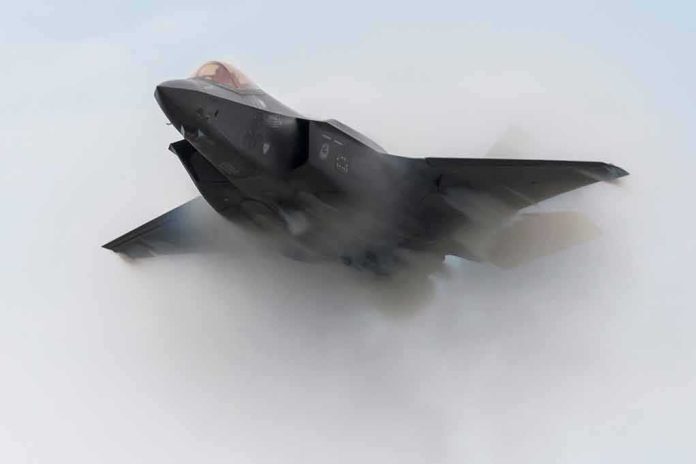
Major U.S. arms transfers aren’t just about hardware; they are instruments of strategy, law, and technology control moving in lockstep — and the proposed $24.3 billion sale of F-35s to Saudi Arabia sits precisely at that intersection.
At a Glance
- State approved and notified Congress of a potential sale: up to 48 F-35s, engines, and long-term support; a 30-day review clock applies.
- Washington frames the package as homeland defense and deterrence for Riyadh amid Iran-aligned threats and Houthi activity.
- Any final deal must preserve Israel’s qualitative military edge; officials say Saudi jets would be less advanced than Israel’s.
- Critics warn of technology-exposure risks tied to China’s footprint in the kingdom and question regional stability effects.
What the United States actually approved — and why the process matters
The State Department formally cleared and notified Congress of a possible Foreign Military Sale to Saudi Arabia: 48 F-35s, 49 engines, and associated communications, training, spares, and sustainment — an end-to-end package that binds buyer and seller for decades of operations and support. This is not a signed delivery contract; it is a statutory milestone that opens a 30-day review period during which Congress can register objections or pass a joint resolution of disapproval. That review power is real, and it is why notices are drafted to withstand legal, policy, and political scrutiny out of the gate. The administration’s public rationale is straightforward: the aircraft would strengthen Saudi homeland defense and deterrence in a threatening regional environment. Reuters’ contemporaneous reporting anchors both the scope and the logic of the approval and the congressional clock that now runs alongside it.
Foreign Military Sales are deliberately procedural. The Defense Security Cooperation Agency coordinates technical and pricing data; State adjudicates policy consistency, including human-rights, technology-security, and alliance considerations; Congress retains a veto-like check. In practice, the 30-day window disciplines the executive branch to demonstrate that a sale aligns with U.S. security interests, does not harm U.S. military readiness, and — in the Middle East — complies with the congressionally codified requirement to preserve Israel’s qualitative military edge (QME). The notice’s inclusion of long-tail support elements is not incidental; it signals an intent to integrate Saudi sustainment under U.S. oversight rather than ship-and-forget, which historically reduces misuse risk and increases transparency over the platform’s life cycle.
How the aircraft would be configured: preserving Israel’s edge
Israel’s legal and political primacy in U.S. arms planning is not a vague norm; QME has been in statute since 2008, obligating any Middle East sale to be certified as non-adverse to Israel’s ability to counter credible threats. In concrete terms for fifth-generation fighters, that has meant configuration management — software loads, electronic-warfare suites, certain mission systems, weapons integration, and external support — that leaves Israel’s F-35I fleet the region’s most capable. U.S. officials have already indicated that any Saudi F-35s would “lack Israel’s advanced features,” a framing consistent with prior export practice and the law’s intent. A final QME determination sits downstream of notification, but the policy vector is clear: sell a deterrent-class platform to Riyadh while keeping Israel’s performance envelope superior.
Mechanically, preserving QME is less about airframes than about what rides inside them. The F-35’s signature strengths — fused sensor data, low observability across bands, electronic attack, and networked kill chains — depend on classified apertures, waveforms, software, and mission data files. By gating those elements and selectively limiting munitions integration, Washington can give Riyadh a formidable air-defense and interdiction tool without erasing Israel’s qualitative advantages. This is how the United States has long squared the circle between partner reassurance and Israeli advantage; the Saudi case follows that template even as it raises technology-security debates more sharply than lower-end aircraft would.
Strategic rationale: deterrence, reassurance, and the Iran-Houthi problem set
The administration’s logic proceeds from the regional threat picture. Iran-aligned networks — including the Houthis in Yemen — have expanded strike reach against Saudi infrastructure and shipping lanes. Saudi air defenses and interdiction capabilities, already anchored by F-15 variants and Patriot/THAAD, are under steady pressure from cruise missiles, drones, and standoff weapons. Fifth-generation aircraft add survivability and sensing in contested environments, improving both homeland defense and the credibility of deterrence. This is not novel framing; U.S. officials have repeatedly linked major Saudi sales to partner defense and regional stability over decades. The timing and tenor of this package align with that established pattern, as reported by multiple outlets focused on escalating Middle East tensions and Washington’s need to signal resolve to Riyadh.
Critics often cast such transfers as escalatory, but the deterrence theory of the case rests on three practical effects: harder-to-target airbases because of dispersal and rapid sortie generation; better early warning and cueing against low-observable or low-flying threats; and tighter integration with U.S. and allied command-and-control networks in the Gulf. Whether one endorses the policy choice, those are the concrete operational gains a Saudi F-35 fleet would deliver — especially when paired with structured training, sustainment, and end-use monitoring built into the sale.
Where the real controversy lies: technology exposure and China
The sharpest opposition is not about whether Saudi pilots can fly the jet; it is about whether Beijing could indirectly learn from it. Members of Congress, led publicly by Rep. Raja Krishnamoorthi and joined by others, have warned that China’s growing presence in Saudi digital infrastructure and security relationships could create unacceptable vectors for espionage or technology compromise. Their objections cite U.S. intelligence warnings and focus on the F-35’s “crown jewels” — sensitive mission systems and data — as risks that cannot be fully mitigated by contractual safeguards. They argue the administration should pause rather than gamble on compliance promises. That critique is specific and sourced, not mere atmospherics; it will resonate during the review window and beyond.
Proponents counter that mitigation is built into the architecture: configuration downgrades versus Israel, compartmented software, rigorous end-use monitoring, controlled depot-level maintenance, and the ability to suspend support or disable key capabilities if end-use terms are violated. Moreover, they argue, the strategic upside — a better-defended Saudi Arabia more tightly linked to U.S. networks — outweighs residual espionage risk. The administration’s position, reflected in the notification and public messaging, is that the sale improves Saudi deterrence without altering the regional balance of power and can be executed with technology safeguards intact. The basic facts of the approval and the structure of congressional review are clearly established; the intelligence community’s internal assessments are not public in detail, which keeps this argument live in Congress.
The administration cleared a potential $24.3 billion sale of F-35 fighter jets to Saudi Arabia, despite U.S. intelligence warnings that China could gain access to the sensitive technology. Is there anything Trump does that doesn’t undermine US security?
— Gary J. Schmitt (@GaryJSchmitt1) September 18, 2026
What to watch next: the review clock, QME certification, and industrial capacity
Three gates will shape the outcome. First, the 30-day congressional review: organized opposition could force conditions, delay, or a resolution of disapproval, even if such resolutions are historically rare for marquee partner sales. Second, the QME certification and allied consultations with Israel: the administration must document how the Saudi configuration preserves Israel’s edge, and Israeli concerns will carry weight in the interagency. Third, industry capacity and sustainment: Lockheed Martin and Pratt & Whitney are stretched by global F-35 demand; integrating a 48-jet fleet for Saudi Arabia requires not only production slots but also training pipelines, spares inventories, and software support arrangements that do not degrade U.S. readiness — a requirement the administration asserts but has not detailed publicly. Each gate is navigable, but none is perfunctory.
Bottom line
The notified F-35 package to Saudi Arabia is a classic U.S. security-cooperation move: strategically purposeful, procedurally disciplined, and technologically fraught. The factual backbone is solid — the approval, the congressional clock, the deterrence rationale, and the QME guardrails. The unresolved question is not whether the sale can be shaped to preserve Israel’s edge; U.S. practice shows it can. It is whether Washington is confident it can keep fifth-generation secrets safe in a country where China’s commercial and digital footprint is growing. That is the point of friction, and it is where the final decision will either stand on its safeguards or stall on its risks.
Sources:
youtube.com, arabtimesonline.com, al-monitor.com