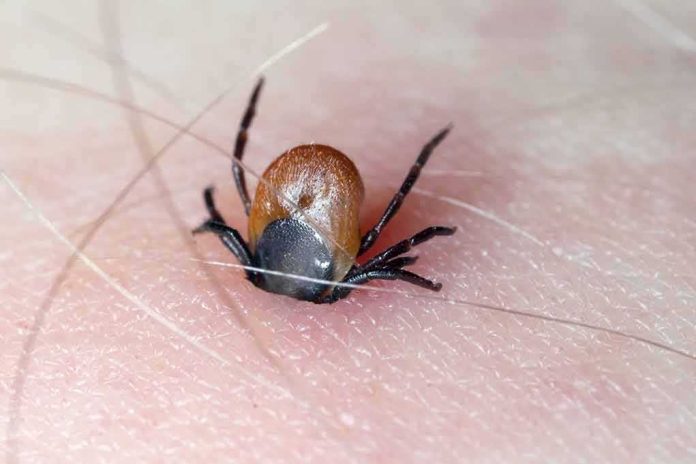
Emerging tick-borne viruses rarely announce themselves with explosive outbreaks; they advance quietly through ecology first, then show up in clinics once physicians know to look. Heartland virus and Bourbon virus fit that pattern in the United States: documented in more states, diagnosable today in a way they were not a decade ago, and dangerous in severe cases—yet still a limited, regional threat tied to the expanding range of the lone star tick.
At a Glance
- Heartland virus has progressed from a Midwestern curiosity to a multi‑state pathogen, now confirmed in patients across the Midwest, South, and parts of the Northeast.
- Bourbon virus remains rarer in people but is plausibly tick‑borne and has been detected in lone star ticks; severe and fatal cases have occurred.
- Both viruses track the ecology of Amblyomma americanum (the lone star tick), whose range has expanded north and east, raising exposure risk where the tick establishes.
- CDC guidance now supports targeted diagnostic testing; apparent rarity likely reflects under‑recognition as much as true absence.
What these viruses are, and how they make people sick
Heartland virus (HRTV) is a phlebovirus and Bourbon virus (BRBV) is a thogotovirus; both are RNA viruses associated with the bite of the lone star tick, Amblyomma americanum. Clinically, the two can be indistinguishable at the bedside: patients develop an acute febrile illness with fatigue, headache, myalgias, and gastrointestinal symptoms, frequently accompanied by laboratory markers of systemic involvement—leukopenia (low white blood cell count), thrombocytopenia (low platelets), and elevated transaminases. There are no licensed antivirals or vaccines. Management is supportive, and severe disease can be fatal, a risk that increases with age and comorbid conditions, as is common across tick‑borne viral syndromes.
Mechanistically, the risk hinges on vector ecology. Lone star ticks feed aggressively on medium to large mammals and humans; they quest low in brush and edge habitats and thrive where white‑tailed deer, small mammals, and fragmented woodlands are abundant. Virus cycles are maintained in nature through tick–vertebrate–tick transmission; humans are incidental hosts. Where A. americanum becomes established, the opportunity for human exposure follows—often years before clinicians in those counties add Heartland or Bourbon to their differential diagnosis.
From local discovery to regional footprint: what the data now show
Heartland virus was first recognized in Missouri in 2009; within a decade, confirmed human cases extended well beyond the original lower Midwest focus. The CDC reported more than 60 cases across the Midwestern, Northeastern, and Southern United States by late 2022, listing residents of Arkansas, Georgia, Illinois, Indiana, Iowa, Kansas, Kentucky, Missouri, New York, North Carolina, Oklahoma, Pennsylvania, Tennessee, and Virginia among those affected. Subsequent CDC mapping has pushed that count above 80 and added West Virginia, reflecting continued detection rather than a sudden change in virulence. Environmental and entomologic studies mirror the clinical spread, with Heartland virus–positive pools of lone star ticks identified hundreds of kilometers apart in Illinois and ongoing circulation documented as far south as Georgia.
Bourbon virus presents a smaller, sharper picture. Human cases remain far fewer and have clustered in Kansas, Missouri, and Oklahoma, where fatal cases first prompted investigation; the virus belongs to a group (thogotoviruses) not traditionally associated with North American human disease. Over the past decade, genetic and field evidence has mounted that lone star ticks are the likely vector: advanced molecular diagnostics applied to field-collected ticks support the transmission link, and CDC now describes Bourbon virus as likely spread by the bite of infected lone star ticks. The epidemiology is nascent but coherent: where A. americanum densities are high, the ecological opportunity exists, even if human case detection is sporadic.
Why “limited threat” and “under‑detected expansion” can both be true
Two realities coexist. First, the absolute number of diagnosed human infections remains low compared with Lyme disease, ehrlichiosis, or anaplasmosis; these viruses are still uncommon causes of fever in most clinics. Second, the enzootic footprint in ticks and wildlife is broader than case counts imply. Surveillance for tick‑borne pathogens is shaped by clinician awareness and test availability; you find what you look for. The Department of Health and Human Services has previously estimated that certain tick‑borne diseases are underreported by nearly an order of magnitude; while that estimate was not derived for Heartland or Bourbon specifically, the same surveillance dynamics apply. CDC’s testing guidance formalizes this: clinicians are advised to test for Heartland or Bourbon when a patient presents with an acute febrile illness plus epidemiologic exposure to ticks and characteristic lab abnormalities—an algorithm designed precisely to surface missed cases.
Entomologic prevalence studies underscore the point. Investigators in Missouri reported measurable proportions of lone star tick pools testing positive for Heartland and Bourbon viruses at an environmental field station near St. Louis—evidence that viral maintenance occurs in the vector in the absence of large recognized human outbreaks. As the lone star tick’s range expands north and east—documented in parts of the Mid‑Atlantic and Northeast—so does the zone of potential exposure, shifting risk profiles in areas historically preoccupied with Ixodes scapularis and Lyme disease.
The vector drives the map: the lone star tick’s expansion
Amblyomma americanum has been migrating beyond its historical strongholds in the South and lower Midwest. Warmer winters, changes in land use that favor deer and edge habitat, and host movement all contribute to establishment in new counties. In some coastal and suburban landscapes, lone star ticks now outnumber blacklegged ticks, raising the baseline encounter rate for humans and pets. This vector expansion aligns strikingly with the growing list of states reporting Heartland virus in people and the detection of Bourbon virus in field-collected ticks; ecologic opportunity precedes clinical recognition, and the clinic catches up later.
For public health planners, the practical consequence is straightforward: where A. americanum is abundant, the clinical index of suspicion should rise. That means summer fevers with cytopenias and transaminitis warrant consideration of Heartland or Bourbon alongside ehrlichiosis and other tick‑borne etiologies—especially in patients with recent outdoor exposure in endemic counties.
Heartland virus and Bourbon virus, which are transmitted by lone star ticks, have killed at least seven people in the US https://t.co/0URtHXJSvM
— New Scientist (@newscientist) August 20, 2026
Clinical and public health implications: what to do now
The viruses are not cause for alarmism, but they demand literacy. For clinicians, the path is clear: take a tick exposure history seriously; order targeted testing when the CDC criteria fit; manage supportively; and report suspected cases to health departments to improve surveillance. For laboratories and health agencies, sustaining capacity for RT‑PCR and serology under validated protocols is essential; the ability to confirm cases turns scattered anecdotes into actionable epidemiology. For the public, the risk calculus looks familiar: avoid tick habitat when possible, use repellents with proven efficacy, perform same‑day tick checks after outdoor activities, and seek care promptly if fever and malaise follow a bite.
The arc here is the familiar one in vector‑borne disease: ecology moves first, medicine follows. Heartland virus is now established enough to be part of routine zoonotic conversation across much of the lone star tick’s range; Bourbon virus, rarer but severe, warrants targeted vigilance in those same geographies. Neither has exploded into a nationwide crisis—and the best way to keep it that way is unglamorous but effective: sharpened clinical suspicion where the vector thrives, steady entomologic surveillance, and the patient discipline of prevention.
Sources:
newscientist.com, archive.cdc.gov, academic.oup.com, wwwnc.cdc.gov, cdc.gov, pmc.ncbi.nlm.nih.gov, stacks.cdc.gov, mdpi.com, frontiersin.org, webmd.com