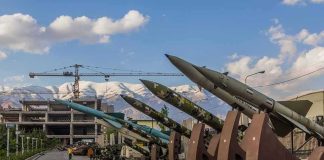
Iran’s drone campaign matters because it exposes the basic arithmetic of modern air war: a force built around cheap, expendable aircraft can impose strategic costs far beyond its unit price, especially when it can launch in volume and force an opponent to spend premium interceptors in response.
Intro Header
- Open-source assessments place Iran’s one-way attack drone capacity far above what many militaries can field at scale.
- By one major policy estimate, Iran and its proxies had launched about 4,400 one-way attack drones before the April 7 ceasefire.
- Reuters reported that a British-funded research group assessed Tehran’s industrial capacity at roughly 10,000 drones per month.
- The Shahed-136 sits at the center of the story because it is cheap enough to be consumed as an attrition weapon, not husbanded like a high-end missile.
The scale of the campaign is the story
The most important fact is not that Iran has drones; it is that Iran appears to have turned drones into a mass-production instrument of war. A Washington Institute analysis said Iran and its proxies launched about 4,400 one-way attack drones before the April 7 ceasefire, with the great majority fired in the first two to three weeks of the conflict. That tempo matters. It shows a force designed to saturate defenses early, keep pressure on multiple fronts, and exploit the fact that defenders cannot fire endlessly at $20,000 to $50,000 targets with million-dollar interceptors.
That is the economic logic behind the attention paid to the Shahed family. ABC News reported that the Shahed-136 costs about $35,000 per unit, while the article framing cited a range as low as $20,000. Either way, the weapon is inexpensive by military aviation standards. In practical terms, it is not built to survive, return, or preserve aircrew; it is built to arrive, detonate, and force an adversary into a costly defensive posture. That is why the drone has become more than a munition. It is a budgetary weapon as much as a physical one.
What the 10,000-per-month estimate actually means
Reuters reported that Tehran’s industrial capacity was estimated at around 10,000 drones per month by the Centre for Information Resilience, a British-funded research group. The distinction between “capacity” and “output” is critical. Capacity is the ceiling a production system can theoretically sustain under favorable conditions; it is not a verified factory ledger. Open-source analysts use it because Iran does not publish audited defense-industrial data, and because debris, launch patterns, and facility footprints can reveal scale even when procurement records do not.
That same problem explains why estimates for Iran’s stockpile and replenishment diverge so sharply. DW cited a lecturer in air power studies who said estimates at the start of February put the number of Shahed drones at around 80,000, while also noting the figure’s uncertainty. The Cipher Brief likewise noted Israeli intelligence assessments above 10,000 and other estimates reaching tens of thousands. Those ranges are not evidence of confusion so much as evidence of a system that is hard to count from the outside. In drone warfare, analysts frequently infer capacity from output signatures, and the signature can be noisy.
How Iran’s attrition model works
Iran’s drone doctrine is built around endurance, dispersion, and psychological persistence. One-way attack drones are slow compared with ballistic missiles, but they are cheaper to build, easier to proliferate, and far more flexible to launch in waves. CSIS reported that early open-source reporting on Iran’s Gulf campaign showed reliance primarily on long-range one-way attack drones, with confirmed use of multiple Shahed-family variants. NBC News data cited an average of roughly 120 drone attacks per day in one campaign, a pace that turns the drone from a precision instrument into a steady drain on defensive magazines.
This is why the “kamikaze” label, while imprecise, sticks. It captures the one-way logic of the weapon: the aircraft is the warhead. There is no need to recover it, and no incentive to make it expensive if the strategic goal is to make the defense spend more than the offense. War on the Rocks warned against counting launches as a direct measure of true drone capacity, because stockpiles, production, and operational readiness do not move in lockstep. That is the key analytical error in public debate: treating a launch tally as if it were a production census. It is not.
The war changed the production question
The war also altered the industrial question. The Washington Institute said that by the end of March, CENTCOM indicated roughly two-thirds of Iran’s drone production facilities and industrial machinery had been damaged or destroyed, along with about half of the stockpiles, launch equipment, and trained crews that supported large-scale one-way attack drone warfare. That is a serious degradation, but it does not end the problem. CNN reported that Iran had already restarted some drone production during the six-week ceasefire that began in early April, suggesting rapid recovery in a constrained but still functional industrial base.
That combination—damage followed by restart—is what makes Iran such an unsettling case study. It suggests not a brittle arsenal that disappears after a few strikes, but a distributed production ecosystem that can absorb blows and rebuild. The broader implication is obvious to any defense planner: if the opponent can replace low-cost strike systems faster than defenders can replenish interceptors, the defense is fighting a losing cost-exchange ratio even when it is winning tactically. The battlefield may be local; the economics are regional.
Iran is signaling that its weapons production capacity could remain intact even during a long conflict. The claim adds another layer to the broader concern over how long Iran could sustain repeated missile and drone operations. https://t.co/qr2QUkYA8H
— DFS (@mabezekdfs) August 12, 2026
Why the numbers have become so large
The public fascination with figures like 4,400, 10,000, or 80,000 comes from the same underlying fact: modern drone warfare is counted in volume, not elegance. The oldest instinct in military analysis is to ask how many aircraft or missiles a state can field; the drone era adds another layer, because output can be dispersed across factories, assembly lines, imported components, and proxy networks. Reuters’ 10,000-per-month figure, the Washington Institute’s 4,400-launch estimate, and the various stockpile assessments are measuring different things, and that is why they can all be simultaneously useful.
The Shahed-136 has become the emblem of this shift because it links industrial throughput to battlefield effect. ABC News noted its roughly 1,000-mile range and payload of 66 to 123 pounds. Those are enough to make it a serious strike system, especially when fired in numbers and used against energy facilities, bases, or air-defense nodes. The strategic lesson is not that Iran invented mass attack by drone; it is that Iran helped prove that mass attack by drone can be sustained by a state under pressure. That is a more consequential lesson than any single launch count.
Sources:
19fortyfive.com, reuters.com, drone-zone.replit.app, jinsa.org, warontherocks.com, quwa.org, smallwarsjournal.com, i24news.tv