Four people bleeding on East Los Angeles pavement after a World Cup match should force us to ask why a soccer game keeps ending with gunfire instead of just goals.
Story Snapshot
- Four people were shot across three East Los Angeles crime scenes after Mexico’s World Cup loss.
- Los Angeles police launched a citywide tactical alert as fan celebrations spilled into the streets.
- A separate Koreatown World Cup watch party saw a man shot in the leg and a suspect arrested.
- Media framed “Mexico fans” as the problem, while deeper evidence points to long ignored neighborhood violence.
What We Know About The East Los Angeles Shootings
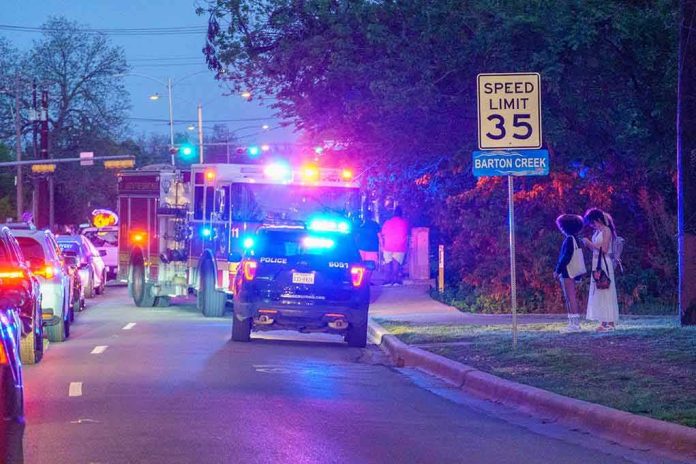
Officials and local outlets agree on the core facts: four people were shot in East Los Angeles across three different crime scenes as crowds flooded Whittier Boulevard after Mexico’s World Cup loss to England. Reports say a woman and a child were among the victims, and social posts describe chaotic street celebrations that turned deadly. Law enforcement treated the scenes as active investigations, but as of now no suspect has been publicly named and no detailed victim conditions released.
Those missing details matter. When four people are hit in three locations, that suggests more than a single argument gone wrong. It suggests guns already in these streets, ready for the moment emotions spike. Yet we still do not know if these shootings came from one shooter driving through, several people firing in separate disputes, or something else entirely. That lack of clarity lets everyone project their favorite narrative onto the night, from “rowdy fans” to “lawless California.”
The Koreatown Shooting Was Real, But It Was Different
On June 18, several days before the East Los Angeles violence, police responded to gunfire near Seoul International Park in Koreatown, where hundreds watched Mexico play South Korea. Officers found a man shot in the leg and used a tourniquet to stop the bleeding, while bystanders detained a 19-year-old suspected gunman nearby. That man, identified as Andy Rodriguez, now faces a felony assault charge and gun enhancement counts, and remains in jail on a seven figure bond.
Video from that scene shows a confrontation, shots, panic, and then a suspect in handcuffs. This Koreatown incident came after Mexico’s win over South Korea, not the later loss to England. Law enforcement timelines and media headlines sometimes blur these two nights, but they are separate events with different victims, different charges, and a clear suspect in one case versus none in the other. Honest reporting should keep those lines sharp instead of using them as background noise for “World Cup chaos.”
The Tactical Alert And The Limits Of Policing Emotion
As celebrations grew across Los Angeles after Mexico’s victory over South Korea, the Los Angeles Police Department declared a citywide tactical alert, keeping officers on duty past normal hours. ABC7 described throngs of soccer fans flooding streets as police in riot gear tried to prevent street takeovers and fights from spinning out of control. This was an effort to contain disorder before it turned violent, not after-the-fact theater once cameras arrived.
Yet even with expanded deployment, a man still ended up shot near the Koreatown watch party, and days later four people were wounded in East Los Angeles. That gap exposes a hard truth conservatives often point to: you cannot expect police alone to manage crowds supercharged by alcohol, nationalism, and underlying gang or neighborhood tensions. Tactical alerts may limit damage, but they cannot reverse years of policy that let crime rise and street culture grow more brazen.
Are These “Mexico Fan” Crimes Or Neighborhood Violence On Display?
The fastest narrative after nights like these is simple and lazy: blame “Mexico fans,” imply foreign culture equals violence, and move on. Several outlets leaned into phrases like “frenzy,” “violent turn,” and “street takeovers” when describing the celebrations, framing the problem as ethnic fan behavior rather than the mix of guns, gangs, and long term neglect in specific neighborhoods. That makes for easy clicks but weak thinking.
Four people were injured in a shooting in East Los Angeles on Sunday night after the World Cup match between Mexico and England.
Read here: https://t.co/MyCawklnt9 pic.twitter.com/6FqE5ftl0S
— KNX News 1070 AM (@knxnews) July 6, 2026
Serious research on gun violence shows something different. In city after city, shootings cluster in a small number of disinvested neighborhoods that have lived with high violence for years, while richer and more stable areas stay relatively safe. These places often carry concentrated poverty, fractured families, and young men who are disconnected from work and school. Add a World Cup loss, drinking, old grudges and illegal guns, and you do not create a new problem—you expose an old one in a louder way.
Sporting Events As Spark, Not Cause
Large games have a long record of stirring trouble, even outside soccer. Studies on football in the National Football League found domestic violence reports rise around 10 percent after teams lose unexpectedly, especially where sports betting adds money stress to emotional shock. Another multi city study showed assaults and robberies increase near sports venues when games are played, while auto theft and larceny spike during events as crowds gather. Big games push already fragile systems harder.
At the same time, other research finds crime often drops during game time as people stay inside to watch, then ticks up in the hours after the final whistle. That pattern fits nights like the East Los Angeles shootings. The World Cup did not plant guns in anyone’s waistband or teach gangs to feud. It simply gave people a reason to pour into the streets at the same moment, with legs of traffic blocked, emotions hot, and police stretched thin from Hollywood to Boyle Heights.
Law And Order, Community Roots, And What Comes Next
For Americans who care about law and order, the lesson is not that soccer is dangerous. The lesson is that weak enforcement and weak institutions turn every major event into a stress test our poorest neighborhoods keep failing. Borderline chaos after the game in Santa Ana, where a reporter saw little visible police presence, points to uneven enforcement even inside the same region. That undermines trust and confirms the sense that some areas are simply on their own.
Real public safety in East Los Angeles will not come from one more tactical alert or one more press conference after the next World Cup match. It will come from the hard mix of firm policing of repeat violent offenders, steady investment in poor blocks, and connecting young men to school and work so they are less likely to reach for a gun in the first place. Until that happens, every big game is just another chance for existing gun violence to step into the spotlight and remind us what we keep avoiding.
Sources:
nypost.com, instagram.com, abc7.com, facebook.com, aol.com, now.org, crimrxiv.com, pmc.ncbi.nlm.nih.gov, irlaw.umkc.edu