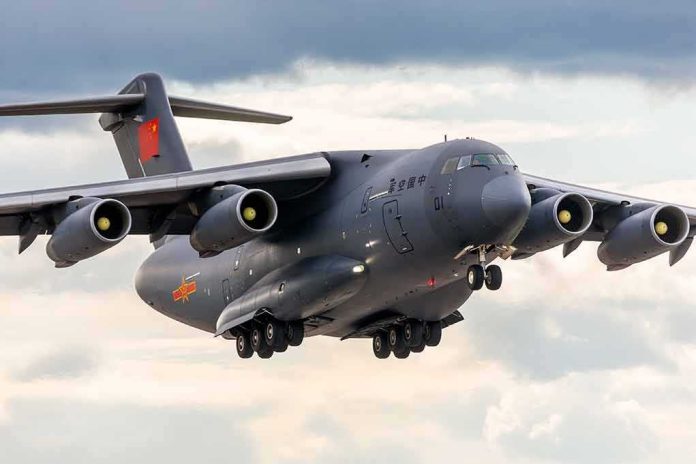
The most consequential fact about China’s Y-20B strategic airlifter is not its size — it is that China finally built an engine worthy of it, and is now producing that engine at scale.
Key Points
- China’s Y-20B transport aircraft has entered full domestic production with the WS-20 high-bypass turbofan engine, eliminating a decade-long dependency on Russian D-30KP-2 powerplants.
- The WS-20 delivers roughly 138 kilonewtons (approximately 31,000 pounds) of thrust per engine, enabling a maximum payload of 66 to 70 tons — placing the Y-20B among the most capable heavy airlifters currently in active production anywhere in the world.
- With the Boeing C-17 Globemaster III out of production since 2015 and Russia’s Il-76 program constrained by sanctions and war, China is now the only country actively building a large strategic transport at meaningful scale.
- The engine breakthrough unlocks not just the Y-20B cargo variant but an entire family of derivatives: the YY-20 aerial refueling tanker and the KJ-3000 airborne early warning and control aircraft.
Why the Engine Was Always the Real Problem
When the Y-20 — named Kunpeng after a mythical giant bird — made its first flight in January 2013, Chinese state media celebrated it as a leap into the ranks of great-power airpower. That framing was not wrong, exactly, but it obscured an embarrassing dependency. The aircraft flew on four Russian D-30KP-2 turbofans, the same engine family that powers the Il-76, a Soviet-era design whose lineage stretches back to the 1960s. China had the airframe; it did not have the engine. And in aerospace, the engine is the program.
A high-bypass turbofan — the engine architecture that makes modern large aircraft efficient — is among the most technically demanding objects humanity manufactures. The “bypass ratio” describes how much air the engine moves around the combustion core relative to through it; a higher ratio means more thrust from less fuel, quieter operation, and longer range. Mastering the metallurgy of turbine blades that spin at temperatures exceeding the melting point of the alloys themselves, held together only by internal cooling channels and thermal barrier coatings, is a challenge that took the United States and Britain decades to solve commercially. China set out to solve it for military purposes, and the WS-20 is the result of more than twenty years of sustained effort.
What the WS-20 Actually Is — and What It Replaced
The Shenyang WS-20, developed by the Shenyang Aeroengine Research Institute and manufactured by Xi’an Aero-Engine, is a large-fan high-bypass turbofan derived from the core of the WS-10A, itself a low-bypass engine used in China’s Flanker-derivative fighters. The architecture — a single-stage fan, three-stage booster compressor, seven-stage high-pressure compressor, annular combustion chamber, and a three-stage low-pressure turbine — is broadly analogous to Western engines of the 1980s generation, and Western analysts have noted it does not yet match the fuel efficiency, noise characteristics, or composite fan-blade technology of current GE or Rolls-Royce products. That caveat matters for commercial aviation. It matters considerably less for military airlift, where strategic independence from foreign supply chains outweighs marginal efficiency differences.
The D-30KP-2 it replaces produces around 117 kilonewtons of thrust and carries a bypass ratio of roughly 2.4:1 — a figure that reflects its Soviet-era origins. The WS-20 delivers approximately 138 kilonewtons per engine, with a substantially higher bypass ratio that translates directly into lower specific fuel consumption, extended range, and greater payload. Four of them on the Y-20B produce a meaningfully different aircraft: longer legs, heavier lift, and — critically — no Russian intermediary in the supply chain.
Full Domestic Production: What That Actually Means
The phrase “full domestic production” carries weight precisely because it has so often been aspirational rather than factual in Chinese aerospace. The C919 commercial airliner, for instance, still relies on CFM LEAP-1C engines and numerous foreign-sourced avionics systems — a dependency that has kept it out of international airspace certification. The Y-20B is a different story. Yang Shushuai, an airborne mechanic with the first PLAAF unit to receive the new variant, stated plainly in June 2026: “The Y-20B has achieved full domestic production. The WS-20 engine is fully independently designed and manufactured. The electronic components are all domestically produced.” That is a specific on-record claim from an operational maintainer, not a press release — and it aligns with intelligence assessments that showed Y-20B airframes with PLAAF markings expanding at Kaifeng Air Base from 2024 onward.
The strategic implication is not subtle. Analysis cited by The War Zone noted two consequences of WS-20 mass production reaching operational reality: first, the Y-20 fleet has severed its dependence on Russian engines entirely; second, production is now constrained only by China’s own industrial capacity and political will — meaning the fleet can expand as rapidly as Beijing chooses to fund it. That is a qualitatively different situation from the years when every Y-20 required a Russian engine to fly.
The Competitive Landscape: Who Else Is Building at This Scale?
Context sharpens the significance considerably. The Boeing C-17 Globemaster III, the West’s premier strategic airlifter, ceased production in 2015. The United States Air Force operates 222 of them, and that number will only decline as airframes age. There is no Western replacement in development. Russia’s Il-76 line, based at Ulyanovsk, has been severely disrupted by sanctions following the 2022 invasion of Ukraine, with production rates far below what the Russian military requires. The Antonov An-124 Ruslan — still the world’s largest production military transport by payload — is Ukrainian-designed and effectively stranded by the war.
That leaves China as the only nation currently building a large strategic transport in meaningful volume. The Y-20B’s payload of 66 to 70 tons does not match the C-17’s 77-ton capacity or the An-124’s extraordinary 150-ton figure. But the Y-20B is being built now, in quantity, with a fully domestic supply chain. An “elephant walk” — the aviation term for a mass taxi of aircraft to demonstrate operational readiness — of ten Y-20B airframes on a single runway is a statement of industrial momentum that no Western air force can currently answer with a comparable production program.
China has unveiled new footage showcasing the full Y-20 transport aircraft family, including the Y-20A, Y-20B, and YU-20 tanker. The video also highlights the YU-20 refueling an H-6N bomber in mid-air, demonstrating China's expanding long-range operational capability.
Powered by… pic.twitter.com/9oN1Y1s1HG
— Srijan Pal Singh (@srijanpalsingh) July 2, 2026
The Platform Family: Why the Engine Unlocks Much More Than Cargo
The Y-20 airframe was always conceived as a platform, not a single-mission aircraft. With the WS-20 now in reliable domestic production, that concept is materializing across three distinct variants. The Y-20B is the baseline heavy cargo configuration. The YY-20A is an aerial refueling tanker derived from the same airframe — a capability that directly extends the combat radius of China’s fighter and bomber fleets. The KJ-3000 is an airborne early warning and control system aircraft, China’s answer to the E-3 Sentry, built on the same wing and fuselage. Each of these variants requires the same WS-20 engine in quantity. The engine program, in other words, is not just powering a transport aircraft; it is the enabling technology for a broad expansion of PLAAF long-range and force-multiplication capability.
There is also a longer-term commercial dimension. The WS-20’s commercial designation is SF-A, and Chinese documentation describes future applications in large passenger aircraft, medium twin-engine transports, and maritime patrol aircraft. Whether the engine achieves international airworthiness certification — a process that has proven genuinely difficult for Chinese commercial aviation programs — remains an open question. For military purposes, no such certification is required.
The Honest Assessment: Capability Gap and Strategic Reality
Intellectual honesty requires acknowledging what the WS-20 is not. It is not a match for the GE CF6 or the Pratt and Whitney PW4000 in fuel efficiency or technological sophistication. Its design reflects engineering choices from an earlier generation of turbofan development, and Western analysts have noted the absence of advanced composite fan blades and other features that define current-generation large turbofans. An unofficial “WS-20K” higher-thrust variant has been discussed in defense analysis circles as a potential future development, but it remains speculative. The gap between China’s best engine and the West’s best engine is real, and it matters for commercial competitiveness.
What has changed is the strategic calculus. China no longer needs a foreign supplier’s permission to build, maintain, or expand its heavy airlift fleet. The vulnerability that Russia’s engine dependency represented — and that sanctions on Russian aviation have illustrated vividly in a different context — has been closed. The Y-20B entering full domestic production in 2024, with an on-record fleet expanding visibly through open-source satellite imagery and official PLAAF media, represents a genuine milestone in Chinese aerospace autonomy. The engine problem that shadowed the Y-20 program for its first decade has been solved. The consequences of that solution are still unfolding.
Sources:
19fortyfive.com, globaltimes.cn, youtube.com, globalsecurity.org, chinadaily.com.cn, reddit.com, afa.org