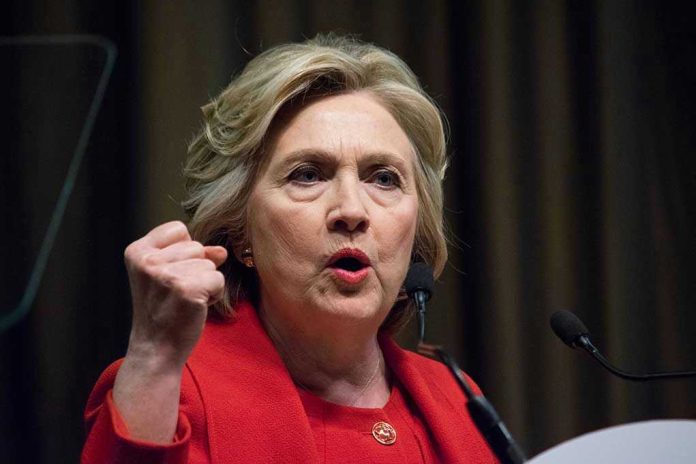
Hillary Clinton did not become a punchline by accident; she became a political test case for whether America can separate female leadership from partisan reflex.
Quick Take
- Clinton made history in 2016 as the first woman nominated for president by a major United States party .
- Her career as first lady, senator, and secretary of state gives her real credibility on public leadership [5][3].
- The claim that her remarks predict a coming female president is stronger as symbolism than as hard electoral evidence [2][3].
- The louder the media clip, the easier it becomes to miss the larger story about representation and voter behavior.
Why Clinton Still Matters in the Female Presidency Debate
Clinton’s significance rests on a simple fact: she broke a barrier that had stood for generations when she became the 2016 Democratic nominee . That milestone matters because political history often changes through one visible breach, not through a neat sequence of statistics. Her resume also made the case harder to dismiss. The White House archive records her service as first lady and later as secretary of state, giving her the kind of national record that invites serious discussion about executive leadership [5].
That is why her comments about the first female president do not land as empty celebrity chatter. They come from someone who spent years at the center of power and who already proved that a woman can reach the top of a major-party ticket [3]. Still, the evidence in this research package supports a narrower conclusion than the viral framing suggests. It shows precedent, not prophecy. It shows viability, not inevitability. In politics, that distinction matters more than most audiences want to admit.
What the Record Actually Proves
The strongest factual ground here is historical, not predictive. The sources confirm that Clinton was the first woman nominated by a major party for president and that she became the first woman in history to represent a major party in a United States presidential election . The Catt Center biography also lists her as a United States senator and secretary of state [3]. Those milestones show how far female advancement in American public life has already gone. They do not, by themselves, prove when voters will choose a woman again.
That limitation is where common sense should cut through the noise. A nomination can signal openness, but it cannot guarantee an outcome in a presidential system shaped by Electoral College mathematics, candidate quality, turnout, and partisan geography. The available sources do not include polling trend lines, demographic modeling, or state-by-state analysis [2][3]. So the most responsible reading is modest: America has already crossed the symbolic threshold, but the final step from nominee to president still depends on more than symbolism.
Why the Viral Angle Misses the Larger Point
The social-media version of this story thrives on ridicule because ridicule is fast, sticky, and emotionally satisfying. A clip can frame Clinton’s advice as proof of arrogance, partisanship, or cultural warfare in a few seconds. But the underlying issue is bigger than one sharp quote. The materials here show a long public career, a historic nomination, and a durable place in the argument over women’s leadership [5]. That is not a scandal. It is evidence that the argument is still alive because the question is still unresolved.
Hillary Clinton Trashes EVERY Republican Woman With Her Advice to the First Female President of the U.S. https://t.co/7XEP3Tokns
— Meredith (@Mermaz) May 21, 2026
American conservatives who value merit, institutional continuity, and plain dealing should recognize the basic principle at work: achievements should be judged on record, not caricature. Clinton’s record gives supporters a legitimate precedent to cite, while critics can fairly argue that one breakthrough does not erase future electoral hurdles. Both positions can coexist without pretending the facts are ambiguous. The facts are clear enough. A woman has already come within reach of the presidency. The unresolved part is whether the next breakthrough will come because voters want it, not because pundits declare it overdue.
Sources:
[2] Web – Hillary Clinton – Wikipedia
[3] Web – Hillary Rodham Clinton
[5] Web – Hillary Rodham Clinton | whitehouse.gov