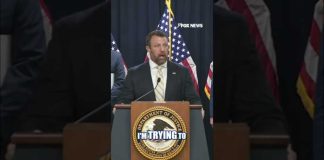
One county prosecutor turned a local charging policy into a national fight over crime, immigration, and equal justice.
Quick Take
- The Justice Department opened a civil rights investigation into Fairfax County Commonwealth’s Attorney Steve Descano’s plea bargaining, charging decisions, and sentencing policy [3].
- House Republicans and victims’ families argue his office gave illegal immigrant defendants overly favorable outcomes in serious-crime cases [2].
- Descano’s office had a written policy telling prosecutors to consider immigration consequences where possible, which his critics say crossed a line [2].
- Descano and his supporters say prosecutors still used ordinary discretion and did not base outcomes on immigration status .
The Federal Probe Changed the Stakes Overnight
The Justice Department’s investigation matters because it moved the dispute out of cable-news territory and into federal civil rights enforcement [3]. Federal officials said they will examine whether Fairfax County’s office discriminated by offering preferential treatment to illegal alien criminal defendants [3]. That language sharpened the debate immediately. Critics now see a test of whether prosecutors can weigh immigration consequences at all without drifting into unequal treatment. Supporters see a routine review of a local office’s discretion under pressure.
The political force of the case comes from the simple fact that the allegations involve serious crimes, not paperwork disputes. Prosecutors were questioned about plea deals, charge reductions, and dismissals in cases tied to murder, attempted murder, and child sex offenses [2]. That combination almost guarantees outrage. It also creates a real problem for public officials: once a case becomes emblematic, every later decision gets read as proof of a broader agenda, whether the record supports that leap or not.
What Descano’s Policy Said
Reporting says Descano’s office had a policy stating prosecutors “shall consider immigration consequences where possible” and the “detrimental impact” of deportation on families and communities [2]. On paper, that sounds like a humanitarian judgment, not a public surrender. In practice, critics argue it invites prosecutors to factor in a defendant’s immigration status in ways that citizens cannot benefit from. That is why the policy sits at the center of the controversy: the same language can look compassionate or discriminatory, depending on how it was applied.
Descano has denied that his office gives sanctuary or safe harbor to undocumented immigrants and has said a non-citizen cannot get a better deal than a citizen . That defense matters because it goes to the heart of the dispute: motive versus outcome. The available public record does not show a DOJ finding, only an active investigation [3]. So the strongest conservative reading is cautious but unsentimental: if local prosecutors start treating immigration status as a sentencing cushion, they owe the public a far better explanation than slogans about fairness.
The Hearing Put Real Faces on the Frustration
The congressional hearing made the issue more vivid by tying policy to victims [2]. Lawmakers and witnesses pointed to a stabbing death, a rape-related plea controversy, and other examples to argue that leniency for undocumented defendants can have deadly consequences [2]. Descano disputed the premise that immigration status drove those outcomes . That contest matters because hearings rarely settle facts, but they do expose the moral fault line: should prosecutors prioritize mitigation for a defendant’s status, or prioritize equal treatment and public safety first?
Steve Descano tells prosecutors in his office to "consider immigration consequences" in plea deals.
What about the safety of families in Virginia? pic.twitter.com/pr1X5MrLxK
— Rep. Jim Jordan (@Jim_Jordan) May 14, 2026
Common sense leans toward the latter. Prosecutors have wide discretion, but discretion is not a license to create two systems of justice. If a policy invites special consideration for one class of defendant, the public will reasonably ask whether citizens receive the same mercy. The available record still leaves key questions unanswered, including whether any defendant truly received a better deal because of immigration status, or whether criticism is drawing broad conclusions from a handful of shocking cases [3].
Why This Fight Is Bigger Than Fairfax County
Fairfax County is now a proxy for a national argument about whether progressive prosecutors have gone too far. Descano’s supporters see a prosecutor trying to account for collateral consequences. His critics see a local office that blurred the line between discretion and favoritism. The Justice Department investigation will not just decide one prosecutor’s reputation; it will shape how other offices think about immigration in plea bargaining. If the evidence shows unequal treatment, the backlash will be severe. If not, the outrage may still linger.
Sources:
[2] Web – House members accuse Fairfax prosecutor Descano of leniency for …
[3] Web – Justice Department Notifies Fairfax County, Virginia …