
When a U.S. president openly threatens a treaty ally with bombing to shape its behavior in a strategic waterway, it is not just an episode of blunt talk; it is coercive diplomacy in its most explicit form, with all the risks and mechanics that come with trying to force outcomes at a global chokepoint.
At a Glance
- President Trump publicly warned Oman that the U.S. would bomb it if Muscat “gets in the way” of U.S. aims over the Strait of Hormuz, reiterating that Oman must “behave” or be “blown up.”
- The threats emerged as a U.S.–Iran negotiating window lapsed and amid reports Oman and Iran had discussed management arrangements in Hormuz that Washington rejects.
- The Strait of Hormuz is a governed transit passage, not a tollable fief; any postwar regime that imposes fees or vetoes would clash with prevailing navigational norms.
- Coercive threats often fail without credibility, consistency, and cumulative pressure; overt menaces can mobilize resistance as easily as compliance.
What happened and why it matters
President Trump said Oman would “behave just like everybody else, or we’ll have to blow them up,” and, in a separate Fox News exchange, that if Oman “gets in the way,” the U.S. would “bomb the [expletive] out of them.” The remarks were not stray whispers; they were on-camera warnings during a period when Washington sought to reopen the Strait of Hormuz and end a grinding conflict with Iran. Multiple outlets recorded and replayed the phrasing, leaving little ambiguity about the intent to menace a longstanding U.S. security partner to deter any arrangement that might constrain American freedom of action in the strait.
The point of leverage is geographic. Hormuz is the world’s oil aorta. Any hint that Muscat would legitimize tolls, shared vetoes, or other gatekeeping over commercial shipping with Tehran is, in Washington’s view, strategically unacceptable. Hence the message: no deals that infringe transit; no de facto control for Iran; no Omani facilitation of either. The White House’s words aimed to foreclose what it sees as an emerging governance gambit—and to do so in public, where the threat is unmistakable.
Hormuz: chokepoint, law, and leverage
Hormuz sits at the intersection of maritime law and hard power. Under the modern “transit passage” regime—designed to keep sea-lanes predictably open through straits used for international navigation—coastal states are not supposed to institute mandatory fees, hard vetoes, or other mechanisms that convert a strait into a toll road. The core idea is stability: the arteries of global trade cannot be hostage to bilateral bargains that rewrite navigational rights. U.S. policy analysis concerning postwar arrangements in Hormuz has been clear on this point: preserve transit passage, restore safe use of the established International Maritime Organization routing, and reject mandatory fees or veto rights.
Because Oman abuts the southern littoral and historically mediates between Iran and the Gulf, any Omani move that even appears to normalize Iranian leverage over the shipping lane becomes a first-order U.S. concern. In that light, Trump’s threat functions as a preemptive veto—an attempt to deter Muscat from crossing a policy red line by making the cost of defection explicit and severe.
Coercive diplomacy 101: how threats are supposed to work
What Trump did is textbook compellence: a demand paired with a credible promise of punishment if the target refuses. Scholars who study coercive diplomacy emphasize why such threats often miss their mark. For compellence to succeed, the target must judge the sender willing and able to act, read the demand as consistent and not capricious, and see no better alternative than compliance. Even powerful states fail often; raw military superiority does not guarantee compellent leverage. Four factors recur in successful cases: relative menace, credibility, consistency, and cumulative pressure.
Against that framework, a public presidential threat raises both the stakes and the test. Overt menace can harden the target’s resolve or trigger counter-coalitions, especially if the target is a partner with domestic and regional equities to defend. Conversely, clarity can help—there is no misreading what Washington wants: no Omani role that grants Iran lasting control or rents on a global artery. The success or failure of such a gambit typically turns on the backstage signals that complement the front-stage rhetoric: private assurances, inducements, synchronized allied messaging, and the calibrated use—or conspicuous readiness—of force.
Why threaten an ally? The logic and the liabilities
Threatening a partner carries a qualitatively different risk profile than coercing an adversary. Oman is not an enemy state; it has been a quiet facilitator in U.S.–Gulf–Iran diplomacy for decades and has provided access and deconfliction channels through tense cycles of regional confrontation. Publicly menacing such a partner can rupture trust, complicate basing and overflight arrangements, and chill the very mediation Washington often relies upon when crises escalate beyond the reach of formal channels. That is the liability side of the ledger.
The strategic logic, however, is plain: Washington believes that any Omani arrangement that normalizes tolls or control-sharing with Tehran would rewrite the rules of the waterway and create a durable Iranian veto over a critical conduit. The United States has framed any such outcome as unacceptable, and Trump externalized that view through unvarnished deterrent language—designed as much for Iranian consumption as Oman’s. This is coercion aimed at preempting a governance fait accompli in Hormuz.
What the historical record suggests about outcomes
The historical record counsels caution about expecting verbal threats to do the heavy lifting. Compellence works best when threats are nested in a coherent campaign: demands are specific and limited; timelines are credible; costs of defiance are visible and immediate; and the target can claim some face-saving off-ramp. Broad, performative bluster untethered to a policy scaffold usually underperforms. The literature is unsparing on this point, finding the United States succeeds at compellence far less often than its material power would predict, absent those enabling conditions.
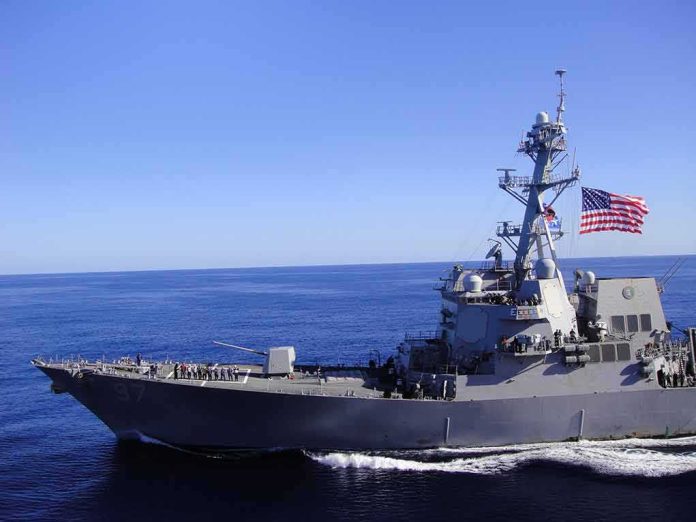
In the Hormuz context, the enabling conditions are not abstract. They involve sustaining naval presence that can enforce free navigation without triggering escalation spirals; aligning European and Gulf partners around a single message on transit norms; offering Muscat a role in post-crisis safety regimes that does not inch toward tolling or veto rights; and maintaining a coherent diplomatic track with Tehran that puts measurable de-escalation on the table without conceding legal ground on navigation. Threats can open a door; they do not build the hallway.
The law’s shadow and the politics of signaling
International law does not end wars or open straits on its own, but it shapes the legitimacy of actions and the coalition politics around them. The “transit passage” construct gives Washington a lawful baseline from which to argue that unilateral tolls or joint veto mechanisms violate navigational norms. That matters for maritime insurers, for flag states calculating risk premiums, and for partners deciding how far to follow America’s lead if enforcement operations become necessary. The more U.S. demands line up with that legal bedrock, the easier it is to sustain a coalition and the harder it is for Iran (or any facilitator) to paint Washington as the norm violator.
Public presidential threats sit within that legal-political field. They amplify resolve but can also invite scrutiny under the U.N. Charter’s prohibition on the threat or use of force against the territorial integrity or political independence of any state—an injunction scholars debate vigorously when states deploy coercive rhetoric as part of crisis management. The crux is whether such signaling constrains aggression or corrodes the norm by making threats of force routine.
JUST IN: US-Iran peace talks stall as Trump says no timeline for deal.
US naval blockade on Iranian ports continues. Trump warns of bombing Oman if it interferes. Brent crude rises 1.3% to $89.68/barrel.
— snipy.in (@snipy_in) August 18, 2026
What to watch next: credibility, cohesion, off-ramps
Three indicators will reveal whether Washington’s hard-edged signaling compels the outcome it seeks. First, credibility: does the military posture in and around Hormuz align with the message, and can it be sustained without creating vulnerabilities elsewhere. Second, allied cohesion: do European and Gulf partners echo the transit-passage baseline and refuse any legitimization of tolls or veto schemes, or do they splinter under commercial and political pressure. Third, off-ramps: can Oman be offered a leadership role in safety, demining, or traffic-separation management that preserves international norms while satisfying Muscat’s need to show agency in its own neighborhood. If those elements cohere, the threat may never need to be tested. If they do not, words can become a trap.
Sources:
theguardian.com, youtube.com, nypost.com, foxnews.com, english.ahram.org.eg, politico.com