

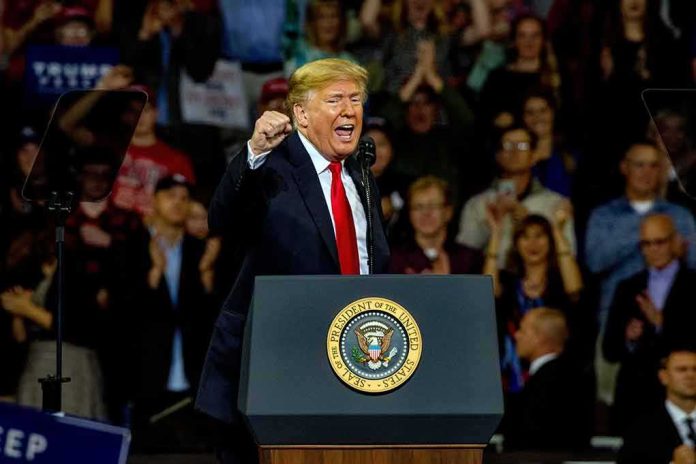
The fight over whether strong jobs should trigger higher interest rates is really about the transmission of inflation risk, not about punishing success; in a hot labor market, the central bank’s job is to judge whether momentum is feeding prices or merely reflecting healthy growth—and that is where President Trump’s calls to cut or hold rates collide with the Fed’s inflation mandate.
At a Glance
- Trump argues robust employment is a reason to avoid hikes and even cut rates; he frames higher rates as “killing success.”
- Markets routinely reprice toward tighter policy after upside jobs surprises, reflecting inflation vigilance rather than anti-growth bias.
- Fed officials and outside research warn that tariffs can add inflation pressure, strengthening the case for monetary restraint.
- The core policy question is not whether jobs are “good,” but whether labor strength is consistent with the 2% inflation target without tighter policy.
Trump’s Pressure Campaign and Its Economic Logic
President Trump has made a clear, repeated claim: strong jobs data do not justify tighter monetary policy, and the Federal Reserve should avoid hikes—and ideally cut—when growth beats expectations. In interviews and social posts surrounding hot labor prints, he has pressed the case bluntly: there’s “no reason to raise interest rates,” and rate hikes “try and kill success.” His messaging aims to reframe the usual market reaction function, asserting that financial conditions should ease when the economy demonstrates strength, because, in his telling, a stronger United States is a stronger credit that merits lower borrowing costs.
There is an intuitive core to this view. In corporate finance, better fundamentals drive tighter spreads; stronger borrowers pay less. Trump tries to map that intuition directly onto macro policy. But central banking is not a corporate loan committee. The Fed sets the price of money to achieve a dual mandate—maximum employment and price stability—across the whole economy, balancing near-term growth signals against medium‑term inflation dynamics. That distinction is why markets often respond to upside jobs surprises by trimming rate-cut odds or raising hike probabilities: the risk that momentum bleeds into persistent inflation pushes policy toward restraint, even when the growth headline looks stellar.
What Markets Actually Do With Strong Jobs Prints
For years, the pattern has been consistent: surprisingly strong payrolls tend to lift Treasury yields and nudge traders toward tighter policy expectations, even as equity investors welcome lower recession odds. In practical terms, that means the same report can be “good news” for growth and still reduce the probability of imminent rate cuts; yields rise, the dollar firms, and risk assets wobble as the path to easier money lengthens. This is not a conspiracy against prosperity; it is the bond market’s cold arithmetic that inflation control requires some headroom in policy rates when demand is running hot.
Conversely, when jobs data cool meaningfully, markets often do the opposite—pricing more room for easing and less risk of a hawkish turn. Reuters documented this repricing after softer labor reports, with traders marking down the odds of near‑term hikes and embracing the view that the Fed could pause or cut without reigniting inflation. The swing underscores the point: it is the inflation outlook conditioned on labor tightness—not the political attractiveness of strong jobs—that tends to drive rate expectations.
Where Trump’s Case Runs Into the Inflation Constraint
The tension in Trump’s argument is not about whether growth is desirable; it is whether the combination of strong hiring, wage dynamics, and policy shocks is compatible with the 2% inflation target absent tighter financial conditions. On this point, the counter-evidence is specific and named. Fed research and officials have warned that tariff policy—another pillar of the administration’s economic strategy—adds to price pressure by raising imported input costs passed through supply chains, complicating the case for rate relief. One analysis summarizing Federal Reserve economists’ work tied recent excess inflation in core goods to tariff pass-through; the estimate put the impact at roughly a 3.1% rise in core goods prices over the period studied.
Current policymakers have made similar points. Federal Reserve Governor Michael Barr cautioned that higher tariffs risk boosting inflation, slowing growth, and raising unemployment as supply chains adjust—exactly the cocktail that makes rate cuts harder to justify while inflation is above target. Governor Adriana Kugler likewise flagged upward inflation risks and a likely growth slowdown as tariff details landed, emphasizing the Fed’s need to monitor how much inflationary pressure would materialize. If tariffs are pulling prices higher, the central bank cannot simply celebrate jobs strength and cut; it must offset that pressure or risk losing nominal anchors.
Central Bank Independence and the Cost of Political Pressure
Another friction is institutional. The Fed’s credibility rests on its willingness to follow its mandate rather than short-term political incentives. Research surveyed by Equitable Growth argues that presidential pressure on the central bank tends to raise inflation without lifting real growth—an adverse trade that erodes the institution’s standing and ultimately forces more pain later to reestablish control. Markets know this history and often treat open-pressure campaigns as signals of future volatility in policy, not as reasons to rally on promised easy money.
That credibility channel matters because expectations are the lever arm of modern monetary policy. If households and firms begin to assume that political actors can bully the Fed into easier settings when data are hot, inflation expectations can drift upward, requiring still tighter policy down the line. That is how “kill success” rhetoric can boomerang—by forcing precisely the restraint it sought to avoid.
Trump is urging the Federal Reserve to cut interest rates as stronger U.S. jobs data fuels expectations of higher rates. The conflicting signals are keeping markets on edge, with investors watching inflation, employment figures and the Fed’s next policy move closely. #Trump #Fed pic.twitter.com/a3KRymlhz4
— James William (@JamesWillis8nz) September 5, 2026
The Real Disagreement: Signal vs. Risk in Labor Strength
Strip away the soundbites, and the dispute narrows to one analytic question: when employment is robust, what does that say about underlying inflation—especially with policy-sensitive shocks like tariffs in the mix? There are credible scenarios where strong jobs coexist with disinflation, particularly if productivity is improving and wage growth is moderate. In those episodes, easing can be consistent with the target. But when upside surprises persist and policy adds to cost-push dynamics, the preponderance of evidence points the other way: keep—or even increase—policy restraint until inflation momentum breaks decisively. That is why upside jobs reports repeatedly “nibble at” rate-cut bets and lift yields; traders are reading the same mandate the Fed is obligated to honor.
Trump’s position channels a business-finance instinct—reward strength with cheaper capital. The Fed’s position channels a macro-stability constraint—guard the nominal anchor when demand is hot and price shocks are in play. The second view is better supported by the public record of how markets reprice on labor beats and by named Fed officials tying tariffs to inflation risk. Absent a detailed, quantified framework from the administration—one that reconciles strong payrolls with the inflation path and with tariff pass-through effects—the case for cutting or even holding solely on the back of hot jobs data remains weak relative to the inflation-first logic of contemporary monetary policy.
What to Watch Going Forward
Three markers separate rhetoric from policy signal. First, the inflation mix: core PCE and trimmed-mean measures will tell us whether strong hiring is translating into persistent price pressure. Second, wage dynamics: if nominal wage growth cools while jobs stay healthy, the easing case strengthens. Third, the tariff channel: if trade measures continue to add to core-goods prices, the Fed’s tolerance for easy money will stay low regardless of payroll headlines. On each of these, publicly available evidence and official commentary currently lean against Trump’s preferred rate path and in favor of the Fed’s caution.
Sources:
youtube.com, finance.yahoo.com, thehill.com, news.meaww.com, cnbc.com, yahoo.com, reuters.com