

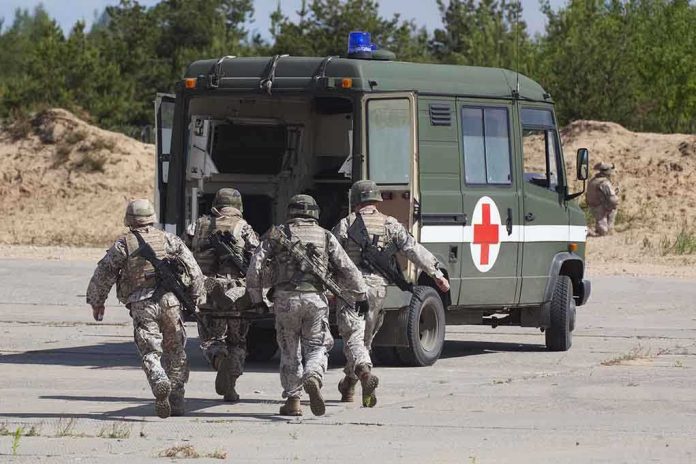
The number itself — 757 wounded, 18 killed — is not really where the controversy lives. It lives in how that number came to be reported, revised, split apart, and quietly reassembled over a matter of weeks, a pattern that turned a routine wartime statistic into a case study in institutional trust.
Key Points
- The Pentagon’s Defense Casualty Analysis System (DCAS) currently shows 18 U.S. service members killed and 757 wounded since the Iran war began February 28, according to an August 19 update reported by CNN.
- That figure climbed in stages — from roughly 482 wounded in mid-July, to 624 by late July, to more than 750 by mid-August — as the database absorbed a fast-moving conflict in real time.
- In late July the Pentagon briefly removed four deaths from its official tally, dropping the count from 18 to 14, before restoring the fuller figure — a move Defense officials attributed to a “technical” issue.
- Casualties since July 7 were shifted into a newly created “Overseas Operations” category separate from the original “Operation Epic Fury” tally, requiring the public to add two web pages together to get a full count.
- Lawmakers from both the House and Senate, veterans, and independent reporting have accused the Department of Defense of slow-walking and obscuring the human cost of the war, prompting a formal House Oversight records request.
What the Pentagon Now Says, and How It Got There
By the Defense Department’s own accounting, the Iran war has cost 18 American lives and produced 757 wounded as of the August 19 update to DCAS. That figure is the sum of two ledgers the Pentagon maintains separately: the original “Operation Epic Fury” tally from the war’s opening weeks, and a newer “Overseas Operations” category covering casualties from renewed fighting after a ceasefire broke down around July 7. Combined, the two categories tell the story of an escalating conflict — wounded totals that stood near 482 in mid-July jumped to 624 within days and then climbed past 750 a month later, each update reflecting fresh exchanges of fire rather than newly discovered old casualties.
DCAS has functioned, in effect, as the only public window into the war’s toll. CNN reported as early as July 20 that the database had become “the primary official source for the number of US casualties in the conflict,” precisely because the Pentagon was not otherwise disclosing injuries in real time. That reliance on a single, delayed database is itself unusual for a war of this duration and intensity, and it set up nearly every subsequent controversy that followed.
The Reclassification Fight: A Real, Documented Dispute
The most consequential development wasn’t a number — it was a category. In late July, the Pentagon created the “Overseas Operations” designation and moved casualties from the post-ceasefire fighting into it, separating them from the original Iran-war ledger. The New York Times described this as “an unusual new accounting method” that required the public to stitch together two separate web pages to understand the war’s true toll. The Washington Post reported that critics saw the relabeling as a way to obscure the human cost of the conflict and potentially complicate benefits and recognition for affected troops and their families. This is not speculation about intent; it is a documented structural change to how casualties are displayed, confirmed by multiple outlets and by the Pentagon’s own database architecture.
Compounding the reclassification, the database briefly showed the death toll falling from 18 to 14 — a drop of four — before officials restored the higher number, attributing the discrepancy to what CNBC and ABC News both described as a technical error. CNN reported the site “left casualty totals uncorrected” for nearly a full day after the anomaly appeared. Whatever the underlying cause, the sequence — a public reduction in the war’s toll, unexplained for hours, on a database with no other independent verification mechanism — is precisely the kind of event that erodes confidence even when it’s eventually corrected.
Congress and Veterans Push Back — On the Record
The criticism here is not vague public skepticism; it comes from named officials citing specific discrepancies. Rep. Ted Lieu stated flatly that the official death toll was 18, not the temporarily displayed 14, accusing the Pentagon of withholding accurate figures. Rep. Adam Smith said officials had not fully disclosed the scope of injuries, equipment losses, or missile-defense failures. Senator Elizabeth Warren called the revision “an act of” bad faith toward the families of the fallen, and Senator Tammy Duckworth, herself a combat veteran, labeled the relabeling a “slap in the face” to service members and their families. House Oversight Democrats, led by Rep. Robert Garcia, formally requested records behind the database changes in early August, with Garcia stating the Pentagon “appears to be lying about the casualties of fallen soldiers”.
The sharpest documented contradiction came from The Intercept, which reported that Pentagon spokesman Sean Parnell publicly acknowledged nearly 100 service members had “some degree of injury” since July 7 — while the official DCAS database, at that same moment, continued to display zero wounded-in-action for the month of July. That is a direct, on-record mismatch between an official’s spoken statement and the government’s own published data, and it is the strongest single piece of specific evidence that the public-facing numbers lagged reality by weeks rather than days.
Why Wartime Casualty Reporting Is Structurally Prone to This
None of this unfolded in a vacuum particular to this war. Defense Department policy — codified in DoD Instruction 1300.18 and parallel service regulations — bars public release of casualty information until 24 hours after next-of-kin notification, a clock that resets each time notification is delayed. Initial reports must reach commanders within four hours, but public disclosure is intentionally slower, built around protecting families rather than satisfying the news cycle. Analysts at institutions like SIPRI and RAND have long observed that casualty-recording systems earn public trust only when they explain their definitions, exclusions, and publication timing clearly — precisely the transparency that lapsed here when two overlapping categories, an unexplained four-death swing, and a monthlong wounded-in-action gap all surfaced within the same two-week span.
What It Means Going Forward
The underlying casualty figures — 18 dead, 757 wounded as of the latest update — are very likely close to the war’s real toll to date, and no credible reporting disputes the scale of the numbers themselves. What remains genuinely contested, and well-documented, is whether the Pentagon’s presentation of those numbers — through reclassification, delay, and an unexplained data reversal — has served accuracy or obscured it. For a public and a Congress trying to hold wartime decisions accountable, that distinction between “the count is wrong” and “the count is hard to see clearly” matters enormously, and it is the latter charge the evidence actually supports.
750 Homes. 750 Empty Chairs. 🇺🇸💔
CNN International Report:
The Pentagon's own war casualty database is speaking.
Since the start of the war with Iran, more than 750 U.S. service members have been wounded.750.
That’s not just a number.
That’s 750 sons. 750 daughters.… pic.twitter.com/uCg7djx6dF— US News Desk (@TheUSLens) August 20, 2026
Sources:
military.com, theguardian.com, cnn.com, abcnews.com, cnbc.com, theintercept.com, apnews.com, bbc.com, yahoo.com, en.wikipedia.org