The last American factory capable of making penicillin’s core ingredient shut down in 2004, and nobody in Washington did anything about it for two decades.
Quick Take
- The United States has zero domestic production capacity for penicillin active pharmaceutical ingredients, with the last U.S. plant closing in 2004 due to foreign price competition.
- China controls the upstream active pharmaceutical ingredient stage for antibiotics; India formulates the finished doses; the U.S. imports the result with minimal backup options.
- Estimates of U.S. exposure to Chinese-sourced drug ingredients range from 8% to 87% depending on what is being measured, which creates a dangerous policy fog.
- A State Department report confirms the U.S. directly imports roughly 17% of its active pharmaceutical ingredients from China, with additional indirect exposure running through Indian manufacturers dependent on Chinese inputs.
The Chokepoint Nobody Wanted to Talk About
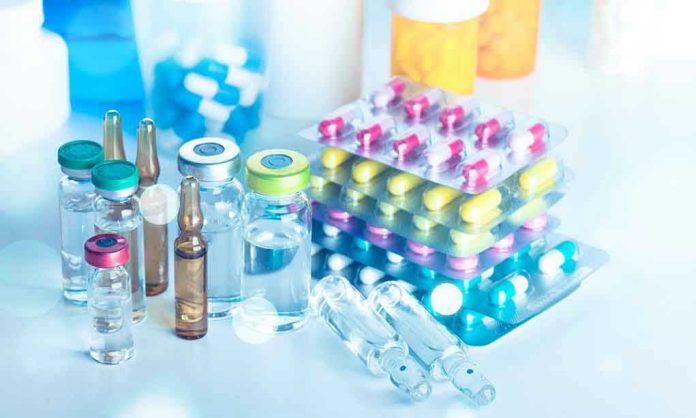
Active pharmaceutical ingredients, the chemically active components that make a drug actually work, are not manufactured where most Americans assume. As of 2019, only 28 percent of the facilities making active pharmaceutical ingredients for the U.S. market were located inside the United States. [8] The remaining 72 percent were spread across foreign countries, with the heaviest concentration in China and India. [9] That is not a supply chain. That is a dependency with a foreign address.
The structure is not accidental. Price competition from Chinese manufacturers drove U.S. producers out of the market over decades. Peer-reviewed research published in a National Institutes of Health archive confirms that in 2004, the last U.S. manufacturing plant for penicillin active pharmaceutical ingredients ceased operations because it could not compete on cost. [2] What replaced it was a global assembly line where China produces the upstream chemical building blocks, India formulates them into finished pills and capsules, and the United States buys the output. The Council on Geostrategy describes this structure plainly: it is a single chokepoint with minimal redundancy. [3]
What the Numbers Actually Say, and Why They Fight Each Other
The headline figures in circulation do not agree, and that disagreement matters. The Coalition for a Prosperous America cites a figure of approximately 87% of U.S. antibiotic active pharmaceutical ingredient imports coming from China. [1] The Brookings Institution puts current U.S. reliance on Chinese-made active pharmaceutical ingredients closer to a quarter of total drug volume sold in the U.S., while acknowledging some estimates run as low as 8%. [4] The U.S. State Department’s own May 2026 report lands at roughly 17% for direct Chinese imports, then adds that indirect exposure through Indian manufacturers dependent on Chinese inputs pushes real exposure meaningfully higher. [6]
Brookings explains the divergence: analysts frequently blend upstream chemical inputs, active pharmaceutical ingredients, and finished dosage forms into a single exposure number without distinguishing between them. [4] That methodological sloppiness produces incompatible headlines. But here is the critical point: even the most conservative honest reading of the data shows the U.S. cannot produce its own penicillin ingredient, cannot quickly substitute that capacity from allied sources, and has structured its generic drug economy around the lowest-cost foreign supplier for a strategic medicine class. The debate over exact percentages should not obscure that structural reality.
The Risk Is Not Theoretical, But It Has Not Been Stress-Tested
Foreign active pharmaceutical ingredient dependence creates exposure to shipping delays, factory shutdowns, pandemic lockdowns, and export bans imposed by other governments, all of which fall outside U.S. regulatory control. [2] Less than 5% of large-scale active pharmaceutical ingredient manufacturing sites globally are located in the United States, with the majority concentrated in India and China. [5] That concentration means a single geopolitical event, a trade dispute, a military conflict in the Taiwan Strait, or a repeat of COVID-era export restrictions, could interrupt supplies of medicines that American hospitals and military personnel depend on daily.
Critics correctly note that no documented case yet shows Chinese active pharmaceutical ingredient sourcing producing an acute national security failure in the United States. That absence of incident is real. But waiting for the failure to arrive before treating the vulnerability as serious is precisely the logic that left the country without domestic mask production in February 2020. The pharmaceutical supply chain is a slower-moving version of the same problem. Reshoring active pharmaceutical ingredient production alone will not solve everything, since the risk can migrate further upstream to raw chemical precursors. [7] But doing nothing while China holds the only keys to penicillin production is not a defensible position for a country that considers itself strategically serious.
The Policy Gap Is as Large as the Manufacturing Gap
The Food and Drug Administration (FDA) has testified before Congress that it lacks the data and legal authority to fully map or compel supply chain resilience across the pharmaceutical sector. [8] That means the federal government is flying partially blind on a dependency that the State Department itself has now flagged in an official report. [6] The conservative case here is straightforward: markets optimized for lowest cost produced this vulnerability, and only deliberate policy, including domestic production incentives, allied sourcing agreements, and strategic reserve requirements, will reverse it. The price of amoxicillin being cheap today is not worth the price of having none of it when it matters most.
Sources:
[1] Web – CPA Warns of Critical U.S. Vulnerabilities in Antibiotic Supply Chain …
[2] Web – US Antibiotic Importation and Supply Chain Vulnerabilities – PMC
[3] Web – Foreign control of antibiotic supply: American and European import …
[4] Web – US drug supply chain exposure to China – Brookings Institution
[5] Web – [PDF] Where are the Vulnerabilities in the U.S. Pharma Supply Chain?
[6] Web – [PDF] Report Medicine Supply Chain Security – State Department
[7] Web – Building Resilience Upstream in the Pharmaceutical Supply Chain
[8] Web – Safeguarding Pharmaceutical Supply Chains in a Global Economy
[9] Web – U.S. Reliance on Foreign Sources of API