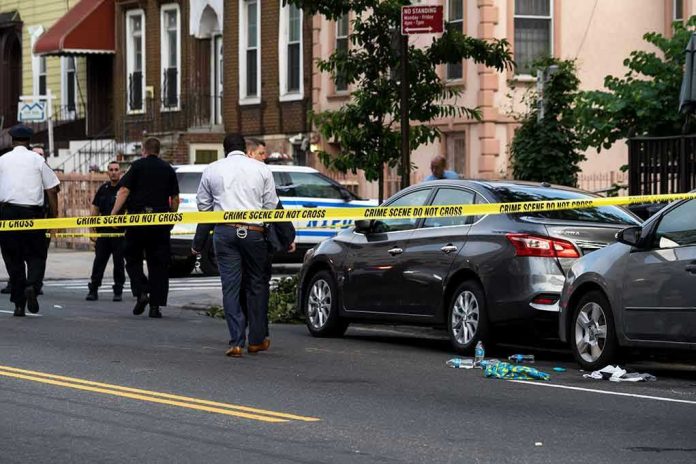
A Brooklyn man is now facing hate crime charges after allegedly whipping a 12-year-old boy with a belt while shouting anti-gay slurs near a Manhattan playground.
Story Snapshot
- Kevin Maxwell, 37, was arrested for allegedly attacking a 12-year-old near a Lower East Side playground and is charged with hate crime assault and menacing.
- Police and prosecutors say Maxwell beat the boy with a belt and yelled explicit anti-gay slurs, claiming the attack was driven by bias against perceived sexual orientation.
- The case shows how New York’s hate crime system works, but key documents and direct victim testimony backing the motive are not yet public.
- Media and advocacy groups quickly framed the incident as part of a wider anti-LGBTQ+ pattern, raising questions about politicized labeling and due process.
What Police Say Happened Near the Manhattan Playground
New York City police say the attack happened on April 29 near a public playground by the New York City Housing Authority complex on the Lower East Side. A 12-year-old boy was leaving a playground restroom when a man allegedly approached him and began shouting anti-gay insults. Reports say the suspect then hit the child several times with a belt, leaving minor injuries before running away from the scene. Officers later released a sketch and description while they searched for the attacker.
After more than two months, police arrested 37-year-old Kevin Maxwell of Canarsie, Brooklyn, just after 1 a.m. on a Sunday in early July. According to news reports, Maxwell was charged with assault and menacing as hate crimes, along with acting in a manner injurious to a child. One station reported that the attacker yelled, “you stupid gay f—, shut the f— up,” as he struck the boy with the belt, which is central to the hate crime claim. The boy’s injuries were described as minor, but the event was labeled a “hate-fueled” attack.
How the Hate Crime Label Is Being Used in This Case
New York’s hate crime laws add tougher penalties when a crime is motivated by bias, such as against sexual orientation. In this case, prosecutors and media outlets say Maxwell targeted the boy because of his perceived sexual orientation, not just random anger or normal street crime. Headlines and social posts state flatly that this was an “anti-gay hate crime” and a “whipping boy with belt” attack, signaling the bias conclusion before any trial. That framing matters, because it shapes public opinion long before a jury hears the evidence.
Right now, the public does not have access to the exact criminal complaint or full court filings that spell out the evidence for the bias motive. Reports repeat that anti-gay slurs were shouted, but they do not show direct victim statements or full police interview transcripts. There is no released surveillance video in the record yet, and there are no detailed affidavits explaining how officers linked the slurs to a hate crime charge rather than simple verbal abuse during an assault. For many readers, this raises the issue of how quickly serious motive labels are attached without transparent documentation.
Media Pressure, Advocacy Narratives, and Due Process
Major outlets and advocacy sites moved fast to tie this case to a broader pattern of anti-LGBTQ+ violence in New York. LGBTQ Nation and others placed the playground attack alongside other incidents, building a story line that hate toward gay and transgender people is surging and must be confronted with strong penalties. State reports do show that hate crime incidents have risen sharply, with over one thousand cases logged in 2023 and many involving bias against gay men. That context gives prosecutors strong political cover when they add hate crime charges.
At the same time, City Limits and other sources note ongoing doubts about how hate crime laws are enforced. Some critics warn that in a charged culture, police and district attorneys may stretch bias labels based on thin or untested evidence, especially when media and advocacy groups reward tough symbolism. In this case, there is still no public statement from Maxwell or his defense team, and no detailed counter-evidence challenging the belt assault or the timeline. But a future defense could argue that prosecutors overreached on motive, even if they cannot dispute that an assault on a child occurred.
What This Means for Families, Communities, and the Justice System
For parents, the most basic fact is alarming: a grown man is accused of beating a 12-year-old with a weapon near a city playground. That should concern every New Yorker, no matter their politics. Families want safe parks, and they expect law enforcement to protect kids and punish adults who prey on them. At the same time, they also expect clear, honest facts, not fast political labels that may or may not hold up once all evidence is reviewed in court.
For conservatives watching from across the country, this case highlights two big worries. First, many see a justice system that will gladly stack charges with fashionable labels, while being slower to tackle everyday crime and repeat offenders in their neighborhoods. Second, they see media that jump to the loudest narrative, often using terms like “anti-gay hate crime” before the public has a chance to see the proof. As the Trump administration pushes for law and order, transparency, and equal treatment under the law, this New York case is a reminder that protecting children and guarding due process must go hand in hand.
Sources:
nypost.com, instagram.com, facebook.com, imdb.com, live.house.gov, nhd.org, latimes.com, youtube.com, washingtonpost.com, gettyimages.com