

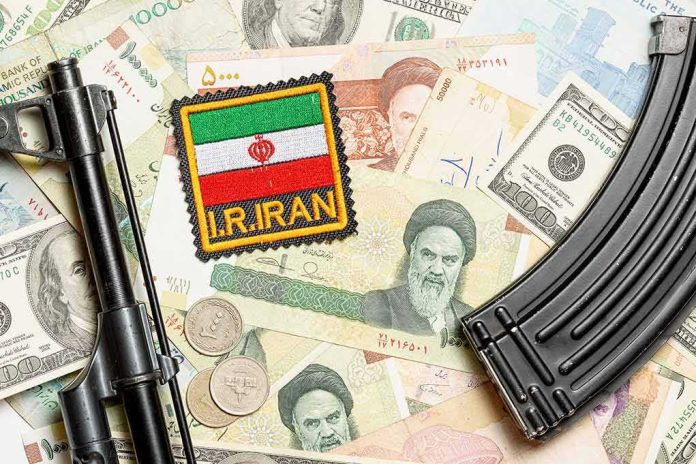
Sanctions have not merely inconvenienced Iran’s economy; they have methodically constricted its core cash flows—oil earnings and access to foreign exchange—producing repeat cycles of contraction, high inflation, and trade dysfunction that leaders in Tehran now acknowledge as urgent problems.
The Short Version
- U.S. and allied measures were designed to choke Iran’s oil revenue and financial channels; that is policy by architecture, not rhetoric.
- Independent analysis links sanctions to sharp export losses and recessions when oil restrictions bite, including a deep downturn in 2019/20.
- IMF reporting ties pressure to reduced economic activity, disrupted trade finance, and weaker investment—classic symptoms of constrained foreign exchange.
- Current statements from Iran’s own leadership cite steep trade declines and extreme inflation, consistent with a system under acute external squeeze.
What sanctions are engineered to do: sever oil cash and complicate payments
In the Iran case, sanctions are not symbolic. They are built to deny the state convertible currency by suppressing oil export volumes, boxing in payment channels, and freezing or fragmenting access to proceeds. Treasury has been explicit: its campaign targets Iranian oil sales to deprive the government and military of financial resources—an objective pursued by designating shippers, front companies, and brokers tied to petroleum and petrochemicals. Earlier iterations focused on repatriation: post-2012 rules sought to restrict Iran’s ability to bring home oil revenue and to sharply limit use of those funds for bilateral trade, a direct strike at the country’s balance-of-payments lifeline. This is why pressure endures even when barrels move; if proceeds are trapped, discounted, or circuitous, macro stress accumulates.
The mechanics ripple predictably. When exporters struggle to get paid in hard currency, the central bank’s usable reserves thin. Banks and importers then face costlier, slower, and riskier trade finance, often off the formal dollar system. That raises transaction costs across the real economy, weakens investment, and, in a partially dollarized setting, transmits into the exchange rate and inflation. These are not theoretical channels; they are the lived pattern of Iran’s sanctions episodes.
What the record shows: recessions and lost exports when oil is hit
When oil sanctions tightened last decade, export earnings fell sharply. World Bank analysis estimated a $17.1 billion loss in export revenues during 2012–2014—13.5 percent of total exports in that period and roughly 4.5 percent of GDP—quantifying the bite of restricted energy sales and financial services. The more recent “maximum pressure” round produced another steep contraction as oil restrictions matured: Iran’s GDP decline accelerated from 4.7 percent in 2018/19 to 8.2 percent in 2019/20, a textbook response to curtailed hydrocarbon cash and limited access to reserves. These are economy-wide, not sectoral, outcomes; once oil dollars shrink and become stickier to use, domestic demand, investment, and imports adjust down.
The multilateral lens aligns. The IMF, through Reuters’ summary, tied sanctions to lower economic activity, complications in trade finance and payments, and deterred foreign investment—channels that compress growth while amplifying price and currency volatility. That combination—FX scarcity plus weaker capital inflows—explains why sanctions can trigger both recession and inflation in an oil exporter: the supply side is constrained while the currency pass-through raises domestic prices.
The current pressure campaign is active, not static
Sanctions are cumulative because enforcement and evasion co-evolve. Treasury’s recent actions target Iran’s “shadow oil economy,” including ship-to-ship transfers, front firms, and a fleet of vessels moving tens of millions of barrels; more than 170 vessels have been cited across related programs, signaling iterative adaptation rather than a one-off regime. Each new designation moves the goalposts—insurers balk, banks de-risk, freight costs jump—forcing Tehran to accept deeper discounts, longer settlement chains, or barter-like arrangements. The macro result is familiar: fewer clean dollars per barrel and longer lags to deploy them domestically.
Tehran’s own admissions track with that reality. Reporting attributed to President Masoud Pezeshkian cited a roughly 35 percent fall in trade alongside inflation spiking to 66 percent—figures that, while filtered through secondary coverage, are directionally consistent with FX shortages and stressed logistics. Supreme Leader messaging has emphasized inflation, unemployment, and price management—an implicit recognition that the transmission from external squeeze to internal hardship is acute.
Where advocates and skeptics actually disagree
The enduring debate is not whether sanctions hurt—Iran has repeatedly entered recession when oil restrictions and payment blocks tighten; that point is well supported. The argument is over magnitude and endgame. Iranian officials often insist Washington will “gain nothing” from coercion and that the economy can adapt; such declarations are political positioning, not data, and they do not directly rebut measured export losses, GDP contractions, or the operational choke points that create them. By contrast, U.S. releases tout each designation as proof of success; they are authoritative on policy intent and targets but are not neutral performance audits.
The middle view, best represented by multilateral work, is that sanctions materially depress output and welfare by constraining oil and finance, and that partial relief reliably improves performance. World Bank and IMF simulations have long shown that removing oil and financial restrictions would lift per-capita welfare and growth—mirror evidence that the constraints themselves are binding. That is not a collapse thesis; it is a durable, empirically grounded picture of significant, repeated macro damage under tight sanctions.
Economic pressure is real, but “collapse” is not a strategy—it’s a prediction.
Iran is signaling that it still has financial reserves and the capacity to intervene. If Tehran can absorb the sanctions without economic breakdown, Washington’s pressure campaign will face a very…
— Ibadat Ullah (@iukhalil1) September 1, 2026
Implications: persistent strain, episodic relief, and the limits of improvisation
Iran has developed workarounds—barter structures, non-dollar settlements, opaque intermediaries, and discounted crude into willing markets—but these are, by design, second-best. They deliver fewer net dollars, increase frictions and legal risk for counterparties, and leave the central bank managing with thinner, less liquid reserves. The result is a stop-start economy that can stabilize temporarily—especially when oil prices rise or enforcement ebbs—but re-enters stress when enforcement tightens or geopolitical risk spikes. The 2019/20 contraction, the documented export losses in 2012–2014, and the current leadership’s focus on inflation and trade strain all fit that pattern.
Two corollaries follow. First, sanctions efficacy is path-dependent: targeting the revenue chain (barrels, shipping, insurance, payments, and proceeds) compounds pressure more than headline designations alone, which is why the recent focus on shipping facilitators and “dark fleet” logistics matters. Second, adaptation has ceilings. As long as oil cash remains discounted, delayed, or sequestered, Tehran’s capacity to fund imports, service domestic price stability, and sustain investment is structurally weaker. The lived symptoms—exchange-rate volatility and inflation—are hard to mask for long; they show up at the checkout counter and in factory procurement cycles, which is why even official rhetoric has shifted toward triage on prices and jobs.
How to read the next phase
Ignore absolutist language—“dead” or “unbowed”—and track the plumbing: realized oil export volumes and discounts, settlement lags, the mix of currencies Iran can actually use, and whether trade finance routes open or close. Independent anchors exist. World Bank monitors have linked tighter sanctions to recessions when oil is hit; IMF assessments flag financing frictions; and Treasury’s targeting patterns reveal where enforcement is tightening. If sanctions ease on oil and payments, growth will lift; if they harden, strain will deepen. That conditional remains the most reliable guide to Tehran’s economic trajectory, and it is grounded in a decade of observable data rather than slogans.
Sources:
facebook.com, home.treasury.gov, iranintl.com, documents1.worldbank.org, state.gov, bbc.com, aljazeera.com, worldbank.org, cnbc.com, nypost.com, dohainstitute.org