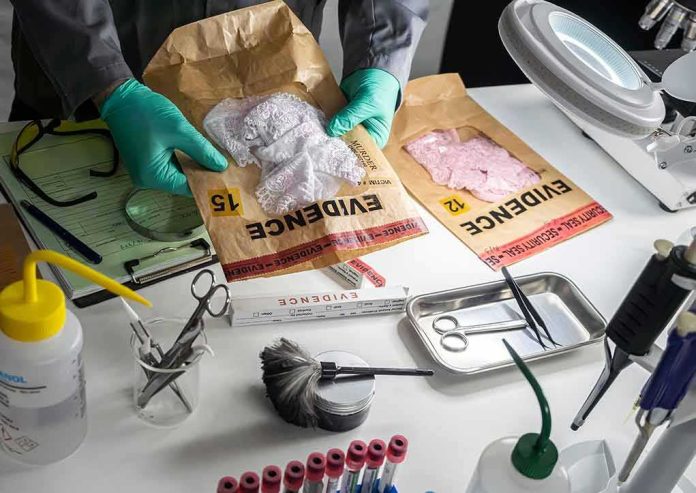
A discarded Coors Light can, paired with modern genetic genealogy, transformed a 45-year-old homicide file into a chargeable case by delivering a direct DNA match to material preserved under the victim’s fingernails—and, according to investigators, a subsequent confession.
The Short Version
- Investigators say DNA on a Coors Light can discarded in 2025 matched DNA recovered from the victim’s fingernail clippings in 1981.
- Forensic genetic genealogy supplied the lead that focused the investigation on Kelly Lee Brower after labs developed a usable male DNA profile from preserved evidence.
- Authorities report Brower, arrested in Arizona in 2026, admitted involvement during interviews before extradition steps began.
- The victim, 23-year-old Yolanda Herrera, was last seen leaving a bar in Schertz in April 1981; her body was found two days later in Universal City.
What investigators say tied the 1981 crime to a 2026 arrest
Cold cases that turn on DNA often hinge on a simple but decisive link: the same genetic profile recovered from preserved crime-scene evidence shows up again, years later, on something tied to a living person. In the Herrera case, multiple outlets report that Texas investigators collected a discarded Coors Light can from outside Kelly Lee Brower’s residence in Arizona in 2025. Laboratory testing reportedly produced a profile that matched DNA found beneath Herrera’s fingernails, with a random-match probability on the order of 1 in 31 billion; investigators also said Brower could not be excluded from the sexual-assault-kit sample. That kind of statistic reflects standard short tandem repeat (STR) analysis—comparing allele patterns across a set of loci and calculating how rarely that combination would occur by chance in the population.
On the investigative side, the can functioned as a lawful surreptitious DNA collection—an approach long used when a suspect declines to provide a voluntary sample. The evidentiary side still turns on something older and more fragile: material recovered in 1981. Reports indicate fingernail clippings and semen were preserved, partial DNA profiles were generated in the 2000s, and subsequent submicroliter extraction and amplification techniques later yielded a profile robust enough to compare against modern databases and a fresh reference sample.
How forensic genetic genealogy narrowed the field
The match did not appear out of thin air. In 2020, the Texas Rangers and Universal City Police Department submitted original autopsy evidence for advanced testing; by 2021, a lab had developed a male DNA profile from case evidence, and later analytic work in 2025 focused the investigation on Brower, according to the coverage. That path—extracting a profile, uploading a version suitable for genealogical comparison, building a family tree from distant relatives, and then using records to converge on a candidate—matches the standard workflow of investigative genetic genealogy (IGG). Since 2018, IGG has been credited with leads in dozens to hundreds of unresolved cases, both homicides and unidentified remains, precisely because it can convert partial, decades-old DNA into a navigable kinship map when CODIS-style law-enforcement databases produce no hit.
The Herrera file followed that arc: once a candidate was identified genealogically, investigators sought a reference—first by requesting a voluntary sample, and when that was declined, by collecting DNA from the discarded can. The resulting laboratory comparison, according to reports, delivered the statistic that underwrote a warrant and, ultimately, an arrest.
The timeline: from disappearance to alleged admissions
Herrera, 23, was last seen leaving a bar in Schertz on April 11, 1981; her body was discovered two days later in a greenbelt off East Aviation Boulevard in Universal City. That contemporary history is consistent across outlets and police summaries. After the genealogical lead and the can-derived DNA match in 2025, Texas Rangers traveled to Arizona to interview Brower, who had lived in the San Antonio area around the time of the killing. Reports say he initially denied knowing Herrera and refused a voluntary sample; after additional interviews, authorities say he made inculpatory statements, with one account quoting, “I’m sorry for what I did”. He was arrested in Arizona in August 2026 and is being extradited to Texas to face a capital murder charge, according to these reports. As in any case at this stage, the charge is an allegation until proven in court.
Confession evidence, when present, is ordinarily corroborative rather than foundational in modern cold-case work. Here, it reportedly followed both the genealogical identification and the STR match to the 1981 fingernail evidence—an order of operations that matters. Investigators had an independent forensic link first; any admission then becomes one more strand in the braid.
Mechanism and evidentiary logic: why fingernails and cans can be decisive
Fingernail clippings are biologically rich in assault investigations because they can capture an assailant’s epithelial cells when a victim struggles. The DNA yield is often low and mixed with the victim’s own material, which historically made profiling challenging. Advances in extraction chemistry, probabilistic genotyping, and low-template amplification now allow analysts to detect and interpret partial contributor profiles at quantities that would have been unusable two decades ago. When those allele calls cohere into a profile, analysts can perform population-statistics calculations to express how rare that profile is; figures like “1 in tens of billions” communicate evidentiary weight to courts and juries when properly contextualized.
Discarded items—cigarette butts, drink containers, utensils—are targeted precisely because they carry fresh, high-quality saliva or touch DNA. If the same multilocus STR profile appears on both the can and the fingernail evidence, the inference is straightforward: the person who drank from that can is the source of the alleles recovered from beneath the victim’s nails. The legal doctrine around abandoned property supports collection of such items without a warrant in most circumstances, and courts have repeatedly accepted matches derived from them when supported by sound laboratory practice.
Where this case fits in a decade of DNA-driven cold-case work
Herrera’s case reads like a compressed history of the field: the preservation of biological evidence in 1981; the emergence of partial DNA profiling in the 2000s; the turn to IGG when CODIS yielded nothing; and, finally, a targeted reference sample obtained from abandoned property to clinch the comparison. That sequence has become increasingly common since the adoption of IGG after 2018, with peer-reviewed reviews and field summaries documenting leads or identifications in dozens to hundreds of cases nationwide. The attraction for agencies is obvious: the method can resurrect dormant files in which traditional leads are exhausted, witnesses are gone, and paper records are thin, by letting DNA “speak” across time where human memory cannot.
Universal City Police and the Texas Rangers, as reported, followed that playbook—submitting old evidence for advanced testing, developing a profile, working a genealogical tree to a living candidate, and then securing a reference sample that matched the crime-scene DNA. The technical steps are difficult, but the logic is linear.
🚨DNA Breakthrough Leads to Arrest in 1981 Universal City Cold Case Murder🚨
More than 45 years after 23 year old Yolanda Herrera was sexually assaulted and beaten to death, Texas authorities say modern DNA testing has identified the man responsible.
Kelly Lee Brower, 68, was… pic.twitter.com/GylaoIilxC
— The Hawk’s Eye – Consulting & News (@TheHawksEyeNews) August 28, 2026
What to watch as the case moves to court
From here, the case will shift from investigative thresholds to courtroom standards. Prosecutors will have to translate the laboratory’s statistics and the genealogy narrative into testimony that satisfies evidentiary rules; defense counsel may probe sample handling, mixture interpretation, or how the genealogical lead informed subsequent steps. The core through-line, however, is concrete: preserved DNA from beneath Herrera’s fingernails reportedly matches DNA from a can tied to Brower, and authorities say he made incriminating statements after interviews in Arizona. In cold-case prosecutions, that combination—biological trace to defendant, plus reported admissions—has been repeatedly sufficient to put a jury in the position to decide.
Sources:
independent.co.uk, abcnews4.com, yahoo.com, news4sanantonio.com, annexpublishers.com