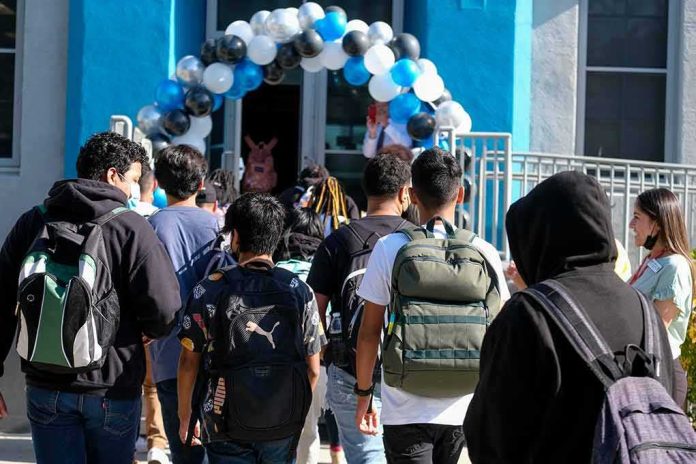
When school becomes the most reliable refuge in a fearful city, communities build their own perimeter; in Los Angeles, that has meant educator-led, volunteer “patrols” around campuses designed to spot possible immigration-enforcement activity and route students safely to class before panic steals the school day.
At a Glance
- Educators and volunteers in Los Angeles organized low-profile patrols near schools to serve as an early-warning and safe-passage system for immigrant families.
- The stated function is observation and notification—not confrontation—with quick school-based alert protocols ready if agents are seen.
- LAUSD layered its own monitoring and “watch zones” around high-risk campuses, which union networks and community groups fed with sightings.
- Training events at United Teachers Los Angeles (UTLA) and by Unión del Barrio established procedures and grew volunteer capacity, though reported scale estimates vary.
What Was Built: A Community Perimeter Aimed at Keeping School Normal
Multiple newsrooms documented that as the school year opened, Los Angeles educators joined with community volunteers to monitor the blocks around campuses, looking for signs of immigration-enforcement operations and relaying credible sightings into school alert systems. El País reported “dozens of educators and volunteers” on these routes and described one elementary school’s code-based protocol that, if triggered, would secure doors and shelter students; teachers were trained to document activity with phones, not to interfere. The Los Angeles Times described district-organized “watch zones” encircling at least 100 schools considered highest risk, with a second tier of union-led observers to watch and notify. The objective was tight and practical: preserve calm, get children through the gate, and prevent rumors from upending instruction.
That objective shaped the rules of engagement. FOX 11’s on-the-ground segment captured the approach succinctly: the intent was to notify a school if federal agents appeared nearby, not to confront agents or escalate; Unión del Barrio’s trainings conveyed similar guidance, positioning teachers as lookouts and messengers rather than actors in any roadside drama. In short, this was information hygiene around campuses—confirm what’s real, move students quickly, and avoid the spiral where fear and half-truths do more damage than any operation underway.
How the System Worked: Sightings, Tiers, and Rapid Alerts
Operationally, the effort fused three layers. First, a district layer: LAUSD staff monitored perimeters at selected schools and coordinated with principals and operations teams. Second, a union-and-community layer: educators and trained volunteers—many linked to UTLA and Unión del Barrio—patrolled feeder streets before first bell and dismissal, scanning for telltales such as unmarked vehicles and characteristic vests, and relayed vetted information. Third, a schoolhouse layer: front offices and site leaders maintained codes and scripts for locking doors, staging shelter-in-place, or quietly shifting student arrival routes when warranted, minimizing disruption. Reporting from the New York Times underscored that early alerts allowed calm adjustments without resorting to lockdowns; state superintendent Tony Thurmond said four first-day sightings were significant enough to share but did not require closures, suggesting the filters were functioning—serious enough to act, not so dire as to stop school.
Crucially, these are not ad hoc texts among friends. The training pipeline mattered. LAist and broadcast outlets detailed public and staff-specific sessions at UTLA’s headquarters, with community organizations standardizing what to look for, what to record, and how to hand off information without creating chaos. While estimates of trained educators ranged from dozens to “about 1,000,” the shared throughline is capacity-building: create enough eyes to matter, teach enough restraint to avoid missteps, and connect those eyes to the only nodes that can act proportionately—the schools themselves.
Why It Emerged: Attendance, Anxiety, and the Cost of Uncertainty
For immigrant-heavy schools, rumor itself can hollow out a school day. Years of campus-level accounts describe families staying home when raids ripple through a neighborhood and students avoiding bus stops they believe are watched. These behaviors are not abstractions; educators and parents told reporters that fear was already altering routines. The Guardian profiled teachers coordinating rapid response precisely because raids were “terroriz[ing] their students,” while HuffPost traced how UTLA members folded safe-passage work into broader school supports, from route changes to pushing for virtual options where needed. The immediate stakes were not ideology but operational: ensure children reach class and that the day’s first decision—go or don’t go—tilts toward go.
School systems are not police agencies and cannot adjudicate immigration policy, but they are stewards of access. LAUSD’s “watch zones” formalized that duty at scale: if activity near a campus spikes anxiety, staff will monitor the perimeter and respond in measured steps. In that context, educator patrols functioned like a community mesh network feeding reliable, time-stamped signals into a system designed to keep learning on track.
Rules of the Road: Observation, Documentation, and Legal Caution
The protocols emphasized observation and documentation from public spaces. Training briefings reminded participants of their rights to film in public and to stand on sidewalks, with strong warnings against obstruction—lines that are bright in law and practical in their wisdom. Coverage also flagged the personal risks if participants blurred those lines; FOX 11 reported trainers warning that attempts to physically impede officers could invite detention or arrest. This caution was not theoretical. It reflected an acknowledgment that the legitimacy of the entire enterprise rests on two premises: it helps kids reach class, and it does not interfere with law enforcement duties.
Within school grounds, the playbook is more defined: administrators manage entry points, activate shelter-in-place if needed, and route students indoors quickly. Off campus, restraint rules. That boundary—school operations versus street-level observation—kept the focus on what educators can responsibly control.
Who Led and How It Scaled: Named Groups, Public Trainings, Uneven Numbers
The spine of this effort ran through named institutions. Unión del Barrio publicly trained educators and community members in patrol methods, and UTLA hosted sessions and recruited volunteers, with local media invited to witness and question. Spanish-language outlets profiled the same training arc for Spanish-speaking families and teachers, highlighting continuity across language communities. Broadcast segments repeated the “about 1,000 teachers trained” figure attributed to summer sessions; print outlets more often described “dozens” of active patrollers at a given time, which makes sense when distinguishing headcount trained from daily deployment. Either way, the architecture—train broadly, deploy selectively, connect locally—tracks with how schools and unions normally operationalize contingency plans.
Inside schools, codes and scripts are standard emergency-management tools. El País described one elementary site’s “secret code” to cue a rapid, quiet shift to secured posture—doors shut, students sheltered—without dramatizing the moment for children. The mechanics resemble weather or neighborhood-policing alerts: tuned to local risk, minimally invasive, and reversible when the threat window closes.
Results So Far: Early Warning Over Theater
Because the point was prevention and calm, the most telling outcomes were the nonevents—school days that started on time, with no lockdowns, despite credible fears swirling. The New York Times’ first-day account is the best snapshot: alerts went out in response to several sightings; none required shutting down instruction, and the precautions held. That is precisely what an early-warning system is supposed to deliver: visibility without spectacle, action without disruption. HuffPost’s broader survey of district and union measures—patrols, rights education, closer bus pickups, and contingency remote options—shows a layered risk-reduction strategy, not a single dramatic tactic.
These networks also absorbed misinformation. When rumors flash through social media, a trained pair of eyes on the nearest corner can check the claim within minutes and spare a neighborhood hours of avoidable panic. In communities where absence spikes after high-profile raids, that verification function alone can recover hundreds of instructional hours over a semester.
𝐋𝐎𝐒 𝐀𝐍𝐆𝐄𝐋𝐄𝐒 𝐓𝐄𝐀𝐂𝐇𝐄𝐑𝐒 𝐏𝐀𝐓𝐑𝐎𝐋 𝐒𝐂𝐇𝐎𝐎𝐋 𝐙𝐎𝐍𝐄𝐒 𝐓𝐎 𝐓𝐈𝐏 𝐎𝐅𝐅 𝐈𝐂𝐄 𝐓𝐀𝐑𝐆𝐄𝐓𝐒 𝐁𝐄𝐅𝐎𝐑𝐄 𝐀𝐆𝐄𝐍𝐓𝐒 𝐀𝐑𝐑𝐈𝐕𝐄
Tuesday was the first day back to class for the Los Angeles Unified School District — and instead of settling into lesson… pic.twitter.com/pCKADMYzzE
— M.A. Rothman (@MichaelARothman) August 13, 2026
The Bigger Picture: Rapid-Response Models Will Reappear Wherever Fear Meets the Schoolhouse Door
Los Angeles did not invent community lookouts; it systematized them. In immigrant-dense districts, the combination of heightened enforcement activity and fragile trust reliably produces the same pattern: educators organize observation-and-notification networks, districts formalize perimeter monitoring, and families recalibrate morning routines around the most credible information available. When done with restraint and clear handoffs, these systems become another quiet layer in the school-safety stack—akin to crossing-guard programs and neighborhood watch, but calibrated for a uniquely fraught kind of uncertainty.
There are limits. Reporting to date leans on participant testimony and day-of observations; comprehensive outcome data—detentions averted, attendance trending in covered versus uncovered zones—lag the narrative. But the core facts are settled in the record: educators and volunteers trained, deployed around campuses, observed from public spaces, and fed school-based alert protocols that prioritized continuity of instruction and student calm. The model’s durability will hinge on that discipline. If it continues to deliver normal school days in abnormal times, it will endure—quietly, which is the point.
Sources:
nypost.com, english.elpais.com, youtube.com, foxla.com, latimes.com, calonews.com, cbsnews.com, thelalocal.org