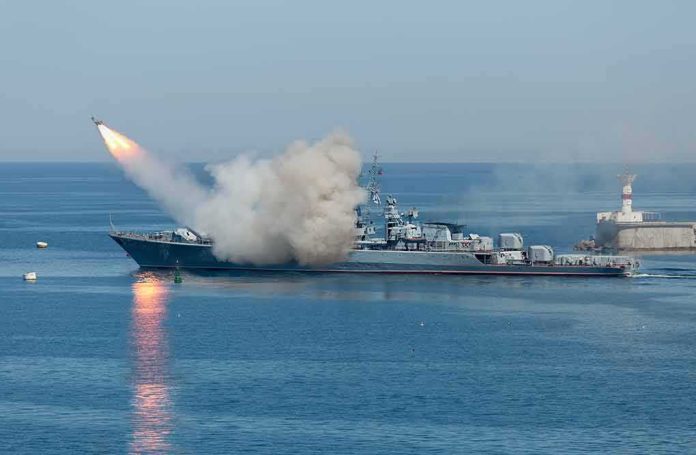
Deterrence in the Red Sea is not a single decision point but an ongoing contest of leverage: Iran-backed Houthis use targeted disruption at chokepoints to squeeze global trade and allies; Washington calibrates force, threat, and restraint to keep waterways open without tripping a wider war.
The Short Version
- President Trump has framed Houthi attacks as piracy and terrorism that threaten freedom of navigation, pairing military strikes and explicit threats with warnings to Tehran as the sponsor network behind the violence.
- The United States has already tested coercion: a March–May 2025 air campaign ended after Houthi assurances led Trump to halt strikes, a sign of tactical deterrence but not a settled end state.
- After renewed Houthi pressure on Saudi oil infrastructure, Trump weighed a “big” response even as reports indicated he declined Riyadh’s push for immediate U.S. strikes, underscoring a deliberate balance between escalation and restraint.
- International institutions and independent analysts warn that broadening the fight risks regional war and deepening humanitarian crisis, arguing for managed restraint and active defense over open-ended escalation.
What Washington Is Trying to Deter: Maritime Coercion at a Chokepoint
Red Sea security has become the paradigm case of maritime coercion: a nonstate actor does not need to sink the fleet to shape global behavior; it only needs to make a narrow sea lane feel risky enough that insurers, shippers, and energy planners reroute. Bab el-Mandeb is a classic vulnerability—compact geography, high traffic, and thin margins for error—so even intermittent missile or drone salvos can distort trade patterns and raise costs. Studies of the crisis since late 2023 converge on the same mechanism: a small cluster of attacks or credible threats produces outsized logistics and price effects by forcing detours around the Cape and choking Suez throughput. That asymmetry is why U.S. presidents, including Trump, cast freedom of navigation as a core interest rather than a navy’s vanity project.
For the Houthis, this is leverage, not a stand-up naval fight. Analysts and official briefs have documented dozens of threat incidents and a sustained rerouting dynamic; the deterrence story is mixed even with multinational patrols in theater, underscoring the difficulty of coercing a movement that can fire sporadically, claim symbolic wins, and retreat into Yemen’s depth while still moving insurance markets. The operational lesson: presence helps; certainty is elusive.
Trump’s Stated Doctrine: Keep Waterways Open, Signal to Tehran
Trump’s position has been explicit. In 2025, he labeled Houthi operations “piracy, violence, and terrorism” and vowed that no terrorist force would stop American commercial or naval vessels from freely transiting “the Waterways of the World,” wedding freedom of navigation to U.S. credibility. He yoked this to deterrent signaling—“Your time is up” and “hell will rain down”—and broadened the aperture to Iran, promising to hold Tehran fully accountable for proxy actions. The logic is straightforward: if the sponsor network pays a price, the proxy recalculates.
Policy was not rhetorical alone. The United States executed a strike campaign against Houthi capabilities in March–May 2025. The campaign ended, however, when Trump announced the Houthis had offered assurances to halt ship attacks and that the U.S. would “take their word” and stop bombing, effective immediately. Supporters can argue that limited, focused airpower extracted a tactical concession; skeptics counter that a pledge is not a durable settlement and that deterrence remained inconsistent afterward. Both points are grounded in the record.
When Allies Ask for More: Saudi Appeals, U.S. Calculus
Renewed Houthi targeting of Saudi oil infrastructure and advances that pressured Red Sea lanes put Riyadh back on Washington’s line. Multiple reports describe the Saudi crown prince urging Trump to conduct strikes; accounts suggest Trump took the calls but did not greenlight U.S. attacks, offering intelligence and targeting support instead. That choice signaled two truths at once: the administration was prepared to escalate—by doctrine and by precedent—yet remained attentive to the escalatory ladder and coalition optics. Declining immediate kinetic requests from an ally while keeping force on the table is not indecision; it is a recognition that large, visible U.S. strikes can improve tactical suppression while also widening the aperture of the war if misread in Tehran or Sana’a.
Trump’s own public narrative in this later window was ambivalent by design. He said the Houthis had reached out to avoid fighting the United States and were letting most ships pass, even as he intimated Iranian fingerprints on attacks against Saudi oil systems. Those claims, while politically salient, rest largely on presidential attribution rather than publicly released transcripts or diplomatic notes; Reuters and AP’s earlier documentation around the 2025 halt, by contrast, provides firmer ground for assessing how threats and strikes interface with short-term Houthi behavior.
The Constraint Set: Escalation Risks and Humanitarian Cost
It is not just U.S.–Saudi preference that shapes the ceiling on force. The United Nations Security Council has urged immediate de-escalation, warning that tit-for-tat attacks could widen the war with consequences far beyond Yemen. Independent assessments forecast that if Houthi activity broadens—against U.S. assets, maritime trade, or Gulf energy infrastructure—the humanitarian situation in Yemen worsens and access constraints intensify, sharpening the tradeoffs around sustained bombing or blockade enforcement. Regional research centers converge on a likely near-term pattern: a limited but prolonged hybrid conflict—reciprocal strikes, maritime harassment, and attrition across fronts—unless a major ground offensive shifts the incentives structure. That is an argument for calibrated defense and deterrence, not for passivity.
In practice, that has looked like layered air and missile defense, naval interception, quiet liaison with insurers and shippers, and episodic precision strikes against launch platforms when necessary, coupled with channels—via Gulf or Omani intermediaries—that keep off-ramps available. The 2025 episode showed that a credible strike threat can elicit a pause; it also showed the pause is perishable without broader political settlement.
What Actually Works: A Coercion Playbook for a Proxy Adversary
Against a movement that thrives on episodic disruption, durable deterrence turns on three levers. First, denial: make it technically hard to score visible hits by degrading sensors, stockpiles, and launch crews at the moment of preparation, not retaliation. Second, cost-imposition: strike back in ways the adversary cares about—specific command nodes or revenue-generating assets—without climbing into a public campaign that Tehran feels obliged to answer. Third, assurance: signal clearly what behavior will pause U.S. strikes and what will restart them, so that intermediaries can carry messages that stick. The 2025 halt, publicly tied to a Houthi assurance, is a textbook example of assurance messaging; the re-emergence of threats against shipping is a reminder that assurance must be paired with verifiable benchmarks and immediate snapback if violated.
Allies complicate but also enable this approach. Saudi requests for strikes are a barometer of risk tolerance in Riyadh; U.S. acceptance or refusal telegraphs the intended scope of American involvement. Balancing those signals—backstopping air defense, sharing targeting, preserving interdiction authority, and reserving independent strike options—keeps the coalition aligned without outsourcing escalation control to the most threatened capital.
Day 205: The Fed hiked anyway. 10Y hits 5% for the first time in ~20 years, MiddleEast war is taking new direction and BRICS just doubled down on Russian oil. Full breakdown below
Not financial advice.#SeaHorse #Macro #IranWar #FedWatch https://t.co/IB05Jrlw1Z— Anton (@seahorse_anton) September 20, 2026
The Road Ahead: Keep the Waterway Open, Keep the War Contained
Two truths can coexist. Freedom of navigation through Bab el-Mandeb is a U.S. interest worth defending with force when necessary; a rush to broad escalation invites a larger regional conflict and humanitarian disaster. The record of the last few years counsels a layered approach: persistent naval presence and interception; rapid, precise suppression of imminent launch threats; explicit, verifiable off-ramps carried by trusted intermediaries; and a willingness to re-strike the moment those assurances lapse. Trump’s rhetoric and actions fit that template more than they depart from it—harder edges in threat language, selective use of force, and periodic pauses to test whether coercion has bought a window.
That window should be used to do the unglamorous work that actually normalizes traffic: harmonized insurer guidance, convoy scheduling when risk spikes, broader sensor sharing across allied navies, and a sanctions and interdiction regime that pinches drone and missile inputs at their sources. None of this is headline-grabbing; all of it moves the deterrence needle against an adversary optimized for sporadic disruption over decisive battle. The measure of success is not rhetorical victory or a single “big” response—it is whether the tankers and boxships clear the strait, week after week, without widening the war.
Sources:
cbsnews.com, abc.net.au, thehill.com, theguardian.com, axios.com, reuters.com, indianexpress.com, en.wikipedia.org, transcripts.un.org, stimson.org