
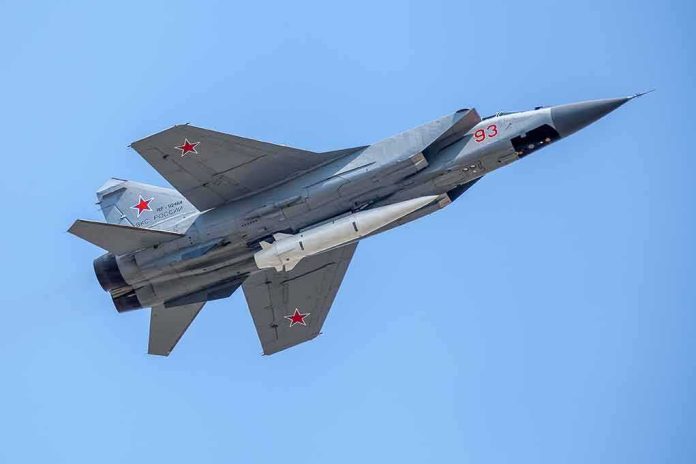
In a long war, fleet health is not decided by a single shootdown or a single factory photo; it’s the balance between attrition and replenishment. For Russia’s Su‑35S force, the best available evidence points to a simple truth: production has continued in organized batches throughout the conflict, while combat losses—real and sometimes dramatic—remain materially lower than the flow of new airframes.
The Short Version
- Rostec and United Aircraft Corporation (UAC) have delivered recurring batches of Su‑35S fighters to Russia’s Air Force each year of the war.
- Open-source loss counts for Su‑35S are in the single digits to low double digits over four years, depending on cutoff and methodology.
- A July 2026 Su‑35 shootdown is well attested, reinforcing that losses are real even as production persists.
- The core uncertainty is arithmetic, not direction: deliveries are confirmed in batches, but batch sizes and audited fleet ledgers remain opaque.
What the record actually shows: deliveries have persisted
Start with what is firm. Rostec—the state corporation overseeing much of Russia’s defense aerospace—has repeatedly announced Su‑35S batch deliveries during the war. In April 2024, UAC’s Komsomolsk‑on‑Amur plant delivered the first batch of that year to the Ministry of Defence, signaling that the Su‑35S line remained hot well into the conflict. In September 2025, Rostec stated UAC had again delivered new Su‑35S under the state defense order, confirming continuity in the production‑to‑acceptance pipeline. And in May 2026, Rostec reported yet another delivery of Su‑35S to the Air Force, framed as part of the current annual program. Independent trade reporting also captured the year’s first 2026 batch the prior month, underscoring that replenishment was not merely a press‑office flourish but a visible, recurring output pattern.
These are not granular ledgers—Rostec does not publish serial‑by‑serial manifests or batch counts in these summaries—but they are consistent in timing and tone across multiple years. For a reader trying to anchor an assessment, that continuity matters more than a single number: it demonstrates an industrial system that has not stopped feeding the frontline units, even if the exact quantity per tranche is withheld.
Losses are real, sometimes spectacular, but numerically limited
On the other side of the ledger sit combat losses. Open‑source compilations and specialist outlets put confirmed Su‑35S losses in the single digits to low double digits over the war’s span, with a mid‑2026 snapshot frequently citing “at least eight” destroyed airframes. The count is not static; a July 2026 shootdown on the eastern front was publicly claimed by Ukraine’s Air Force and reported across multiple outlets, with imagery from Ukrainian units showing the crash site—an incident that, by itself, pushes the running tally higher. The precise number at any given week depends on methodology (visual confirmation versus credible reportage), cut‑off dates, and whether damaged but repairable airframes are included or excluded. But the broad conclusion holds: Su‑35S losses, while operationally significant, have not matched the cadence of reported deliveries in the sources we can see.
Two caveats are essential. First, Moscow does not publish an audited, up‑to‑date in‑service inventory; outside counts necessarily rely on OSINT, satellite imagery, and episodic official imagery, which means undercounting is always possible. Second, loss statistics often lag events—wreckage may be inaccessible or censored—so today’s “at least N” could be tomorrow’s “at least N+1.” Even so, when cross‑referenced against recurring delivery announcements, the shape of the curve is intelligible: production replenishes faster than visually confirmed losses deplete.
Why the Su‑35S balance has held: mechanism and industrial cadence
Understanding the mechanism clarifies why this balance is plausible. The Su‑35S production base—principally the Komsomolsk‑on‑Amur Aircraft Plant under UAC—works to state defense orders structured in batches. Rostec communiqués reflect this cadence: a “first batch” early in the year, another tranche later, sometimes bookended by year‑end deliveries. While the communiqués do not enumerate aircraft, secondary assessments describe annual throughputs on the order of low double digits, with deliveries continuing each war year. Pair that with a pre‑war inventory commonly estimated in the low hundreds—roughly 110 to 115 Su‑35S in service—and you get an air arm that can absorb periodic losses without immediate collapse of its Su‑35S squadrons, provided the industrial base stays on pace.
The operational use case also moderates attrition. The Su‑35S is typically tasked for air superiority and long‑range missile carriage, often operating within protective envelopes and at standoff ranges. Losses occur—ambushes, air defense traps, pilot error—but the platform is not routinely hurled at the densest air defenses the way strike aircraft must be, and that employment pattern tends to keep the loss rate below that of frontline bombers. Analysts who track Russian airpower have repeatedly framed the war’s air‑order‑of‑battle in these production‑versus‑attrition terms, noting that several Sukhoi fleets, including the Su‑35S, appear to have maintained net numbers through continuing production.
Where the evidence is thin—and how to read around it
Three gaps constrain precision. First, batch opacity: Rostec confirms deliveries but withholds aircraft counts per tranche, forcing outside observers to infer totals from plant rhythms, budget lines, and rare spot imagery. Second, loss accounting: not every crash site is photographed and geolocated; some trackers enforce strict visual confirmation, which produces conservative totals that may undercount losses in controlled or remote areas. Third, inventory status: “delivered” does not always equal “combat‑ready”; quality escapes, retrofit cycles, and cannibalization for parts can make a paper fleet larger than the set of flyable tails on a given day. Those caveats do not erase the pattern—they merely counsel humility about tight numeric claims, such as “exactly X delivered since 2022” or “exactly Y destroyed.”
For readers weighing competing narratives, anchor on what is specifically attested. Deliveries: yes, in recurring batches across multiple years of war, from primary‑source industrial statements and mirrored in defense trade press. Losses: yes, including a high‑profile July 2026 shootdown corroborated by multiple Ukrainian‑side sources and imagery, with open‑source tallies citing at least eight destroyed Su‑35S prior to that incident. The net: despite noise in the numbers, the direction of travel favors a fleet that is being replenished faster than it is being attrited in publicly confirmed losses.
Operational implications: capability, not just counting
Counting tails is only half the story. Combat power hinges on sortie generation, pilot proficiency, availability of long‑range air‑to‑air and air‑to‑surface munitions, and the opponent’s evolving air defense network. A force can maintain tail numbers while losing operational edge if supply chains for sensors and missiles degrade or if training pipelines thin. Conversely, even with periodic shootdowns, a fleet that keeps receiving modernized airframes can preserve deterrent value along the front. The Su‑35S balance to date suggests Russia can keep presenting a credible air‑to‑air threat and standoff missile truck, forcing Ukraine to husband scarce fighter hours and high‑end air defense interceptors. The July 2026 kill demonstrates that with the right tactics and systems integration, those threats can be answered—but it does not, by itself, shift the underlying replenishment trend.
What would settle the debate
Two disclosures would turn inference into accounting: a serial‑numbered delivery ledger from UAC with acceptance dates since 2022, and an official in‑service Su‑35S count from Russia’s Ministry of Defence. Short of that, a rigorously curated OSINT registry that segregates Su‑35S from other Flanker variants, classifies each loss by destroy versus repair, and pairs each claim with geolocated imagery is the next best thing. Until such clarity arrives, the prudent read is the one the public record supports: Russia’s Su‑35S fleet has taken losses, including recent headline incidents, but recurring batch deliveries have sustained the force numerically through the war years documented so far.
Sources:
19fortyfive.com, rostec.ru, euromaidanpress.com, milmag.pl, nationalsecurityjournal.org