When a sitting head of government alleges that a foreign adversary targeted his child for assassination, the claim is not a media soundbite; it is a statement with direct implications for national security protocols, deterrence signaling, and the boundaries of a shadow conflict that increasingly blurs family and state.
At a Glance
- Benjamin Netanyahu stated on live Israeli television that Iran tried to kill one of his sons, without naming which son or providing operational details.
- Multiple independent outlets documented the same on-air allegation, establishing the fact of the statement itself.
- He linked the claim to security arrangements for political figures, indicating an active protection concern.
- The assertion sits within a decades-long pattern of Iranian external plots against dissidents and Israeli/Jewish targets abroad.
What Netanyahu Said, and Why It Matters
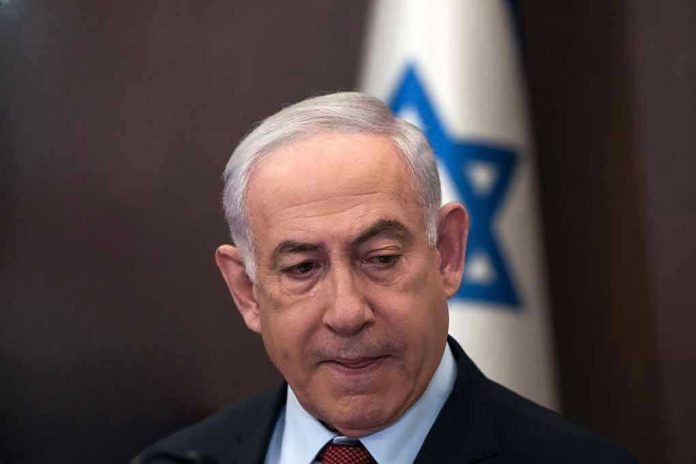
Benjamin Netanyahu, Israel’s prime minister, asserted in a live phone interview with Israel’s Channel 14 that “Iran tried to kill one of my sons,” language he repeated as a concrete attempt rather than an abstract threat. He did not specify whether Yair or Avner was the target, did not give a date, and did not disclose method or location, but he explicitly tethered the claim to ongoing security arrangements for political figures—framing it as a live protective-security concern rather than a retrospective anecdote. The allegation was promptly carried by several outlets that monitored the broadcast and published same-day accounts of the statement, ensuring a consistent public record of what he said even as further specifics remain withheld.
Two facts are, therefore, clear: Netanyahu made the allegation on air, and he connected it to protection protocols overseen by Israel’s security services, referencing discussion with the Shin Bet’s leadership. In the context of Israel–Iran hostilities—overt and covert—such claims function as both domestic justification for elevated family security and as international messaging aimed at Tehran. They communicate that family members, not only officials, are within the contemplated battlespace.
The Security Mechanism Behind a Statement Like This
In modern protective doctrine, an “attempt” is not merely a social-media threat; it implies an operational threshold—surveillance consistent with pre-attack planning, an interdicted approach, or a disrupted plot cell—that prompts specific countermeasures. Even when details are classified, the public-facing part of the mechanism is visible: changes in route discipline, protective detail augmentation, and strictures on routine. Netanyahu’s framing—casting the allegation as the reason security for political figures and their families needs reinforcement—matches that logic. Israel’s internal security agency (Shin Bet) is responsible for protecting senior officials and, at times, their immediate family; an elevation in protective posture typically signals intelligence indicating intent plus capability, not intent alone.
That said, Israeli services rarely disclose sources-and-methods-level particulars. The public hears the headline; the operational file, if one exists, remains sealed. This secrecy can be frustrating to observers, but it is consistent with how counter-intelligence and VIP protection function in every advanced security service—when the stakes include foreign state tradecraft, the evidentiary trail is often classified to preserve collection channels.
How We Got Here: Iran’s External Operations Playbook
Whether in Europe, the Middle East, or North America, the Islamic Republic and its proxies have long mixed surveillance, abduction, and targeted killings to advance regime ends abroad. Serious research organizations and government cases document a pattern spanning decades; databases maintained by subject-matter scholars and policy institutes catalogue dozens of assassination or abduction plots, with targets ranging from dissidents to Israeli and Jewish figures tied—directly or symbolically—to the state of Israel. In U.S. courts, individuals acting at Iran’s direction have been convicted in connection with foiled assassination planning, underscoring both capability and intent beyond rhetoric.
This backdrop matters because it makes Netanyahu’s allegation legible within a known repertoire of action. It does not prove the particulars of a specific incident, but it establishes that the strategic behavior he imputes to Iran—targeting family members linked to a principal adversary—would not represent a category error in Tehran’s external operations doctrine, especially in periods of heightened confrontation.
The Information Environment: What Is Public, What Is Not
Across the day’s coverage, major outlets converged on the same two points: the on-air allegation and the absence of identifying details about which son, when, or how. Reporters also highlighted that Netanyahu moored the claim to security arrangements and referenced his conversation with the Shin Bet chief—again pointing to an active protection lens rather than a campaign-trail flourish. The immediate media effect is predictable: the principal’s words shape the initial frame, and subsequent reporting has limited capacity to add granularity without official declassification or named sources within the security services willing to speak on background.
One sentence of prudence belongs here and only here: the public descriptions to date preserve Netanyahu’s assertion; they do not include a police file, open-court record, or a named official’s corroboration. That is a statement about the visibility of the record, not a challenge to what was said on air.
Implications for Israeli Security Policy and Deterrence Signaling
Allegations that family members are in the targeting aperture invariably drive reassessment of protection tiers. In Israel, that reassessment intersects with perennial debates about the scope and duration of state-funded protection for current and former officials’ families. Tying the claim to security arrangements makes the policy vector explicit: raising the protective baseline around those connected to decision-makers, on the logic that a hostile service might view vulnerable family targets as lower-friction pressure points.
Externally, the message to Tehran is deliberate. By putting the allegation on the record personally, Netanyahu signals that any plot against his family is inseparable from the core Israel–Iran contest, inviting the inference that deterrent responses could be triggered by actions short of a successful attack. In strategic communications terms, it is an attempt to impose costs preemptively—deterrence by denunciation—without disclosing the intelligence that precipitated the warning.
What a Serious Reader Should Watch Next
Three developments would materially advance the public record. First, any on-record statement from the Prime Minister’s Office that adds even coarse-grained facts—approximate timing or travel context—would help distinguish a specific interdicted attempt from a generalized threat curve. Second, parliamentary oversight or authorized briefings from the Shin Bet that describe adjustments in the protection posture, without compromising sources, would corroborate that an operational threshold was crossed. Third, independent reporting anchored in named security officials—Israeli or allied—would either validate the existence of a discrete plot file or clarify that the elevation remains at the level of threat intelligence rather than attempted execution.
Bottom Line
Netanyahu alleged, clearly and on the record, that Iran tried to kill one of his sons; he cast the claim as part of an immediate security calculus rather than a rhetorical escalation. That assertion sits squarely within Iran’s established external operations toolkit, which includes plots against dissidents and Israeli/Jewish targets overseas documented by think-tank databases and court cases. The details that would satisfy a lay reader’s curiosity—who, when, how—remain withheld, as they often do in live counter-intelligence matters. Until security authorities speak further, the value of the statement is twofold: it justifies a higher protective baseline around political families and serves notice to Tehran that the family sphere is treated as part of the strategic battlefield, with all the deterrent implications that follow.
Sources:
insiderpaper.com, timesofisrael.com, arabnews.com, english.varthabharati.in, washingtoninstitute.org, aljazeera.com