

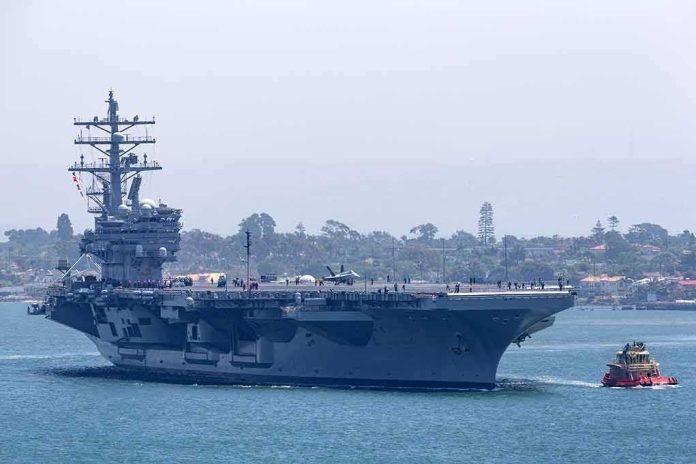
When sailors aboard a carrier start trying to go overboard, the immediate story is not a single dramatic act; it is the pressure system that made the deck feel like an exit. On the USS Abraham Lincoln, reporting points to multiple overboard attempts, an unusually prolonged deployment, and families describing a crew stretched by exhaustion, poor living conditions, and mounting psychological strain.
Key Points
- Multiple reports say sailors aboard the USS Abraham Lincoln attempted to go overboard during the current deployment.
- The carrier has been at sea for more than eight months, with no publicly announced return date.
- Families and shipboard accounts connect the incidents to overextension, fatigue, and deteriorating morale.
- The Navy says it is monitoring sailors’ psychological readiness and provides access to counselors, chaplains, and medical support.
What the Reporting Says Happened Aboard the Lincoln
Military Times reported that Annabelle Loma said her husband attempted to jump overboard from the USS Abraham Lincoln during the deployment, after being “repeatedly overextended,” and that Maria Rodriguez described a separate episode in which her husband saw a shipmate preparing to go overboard and pulled him back onto the deck. That account matters because it is not framed as rumor or social-media repetition; it is a set of named family statements tied to specific incidents, which is the level at which this story first becomes concrete.
The same reporting says Lincoln’s roughly 5,000 sailors and Marines had been at sea since Nov. 21, more than eight months into a deployment originally expected to end in May. Other coverage described the ship as having spent about 250 consecutive days at sea without reaching land, a measure that captures the human strain of continuous maritime operations more clearly than abstract talk of “extended deployment” ever does. When a ship remains underway that long, the problem is not merely boredom; it is the cumulative wear of compressed routines, limited privacy, irregular sleep, and the slow corrosion of normal life.
Why Extended Deployments Become Mental-Health Stressors
Carrier deployments are hard even under routine conditions, because a flight deck is a machine for converting manpower into tempo. Sailors work long hours, live in dense quarters, and operate in an environment where maintenance, watchstanding, and flight operations never really stop. A prolonged deployment magnifies every ordinary discomfort. The result is not one dramatic breaking point but a layered fatigue: physical exhaustion, social isolation, sleep disruption, and the feeling that there is no meaningful relief in sight.
That is the frame families and reporters are using here. Military Times said Loma’s husband had been repeatedly overextended before his attempt, and Rodriguez described a different sailor being stopped before reaching the side. India Today similarly relayed family accounts that linked the reports to food shortages and other difficult conditions aboard the ship. These are not official Navy findings about causation, but they are consistent in one essential respect: the people closest to the sailors are describing a crew under exceptional strain, not a one-off disciplinary problem.
The Navy’s Public Position and What It Does Not Yet Say
The Navy has said Lincoln’s leadership is continuously assessing sailors’ psychological readiness and that the ship has access to counselors, chaplains, medical professionals, and other support services. That is the standard institutional response to a readiness crisis: acknowledge concern, describe the support architecture, and avoid overcommitting to any causal explanation before the facts are settled. It is also notable for what it does not include. In the material available here, the Navy does not provide a precise count of overboard attempts or self-harm incidents during the current deployment.
That absence should not be mistaken for a denial, but it does keep the public account incomplete. Military organizations often disclose shipboard incidents in fragments, especially when the events involve mental health, operational security, or ongoing investigations. The public is left with a familiar asymmetry: families and crew members describe what happened in human terms, while the institution speaks in the language of readiness, support resources, and non-specific review. On a tight timeline, that gap can be enough to fuel confusion; over months, it can harden into distrust.
Why This Story Resonates Beyond One Ship
The Abraham Lincoln reporting sits inside a broader pattern in naval life: the carrier is one of the most capable instruments the United States fields, but it is also a sealed social world. A modern carrier can project power across an ocean while simultaneously trapping stress inside a floating city. That tension explains why stories about morale, hygiene, food, and mental health on ships travel so quickly. They are never just about comfort. They are about how long an institution can ask people to absorb hardship before the hardship begins to show up as conduct, danger, and breakdown.
This is also why reports of shipboard distress are so often read as indictments of command, even when the evidence is incomplete. Continuous deployment without a clear end date creates a predictable psychological burden, and anecdotal complaints about living conditions become more consequential when paired with concrete signs of distress. None of that proves a single official cause. It does, however, explain why multiple overboard attempts aboard one carrier have triggered alarm well beyond the ship itself.
Sailors have been attempting to go overboard from the aircraft carrier USS Abraham Lincoln during an open-ended deployment that is now nearing nine months at sea.. https://t.co/C6BDUGBE1Y
— Old Man Lefty (@OldManLefty1) August 12, 2026
What to Watch Going Forward
The key issue is whether additional official reporting clarifies how many incidents occurred, what sequence they followed, and whether command treated them as separate events or as part of a larger morale crisis. The public record already supports the central facts that sailors were reported attempting to go overboard, that the deployment had become unusually long, and that families were attributing the strain to overextension and harsh conditions. What remains less visible is the internal Navy accounting: how many cases were confirmed, what interventions were made, and whether the ship’s operational tempo itself is being reconsidered.
For readers, the important distinction is between speculation and pattern. The speculation is about motive and ultimate responsibility. The pattern is harder to dismiss: prolonged sea duty, anecdotal reports of poor conditions, family testimony about distress, and repeated references to sailors being stopped before reaching the rail. Taken together, those details describe not a freak occurrence but a deteriorating human environment aboard a warship that has stayed at sea far longer than planned.
Sources:
realcleardefense.com, militarytimes.com