
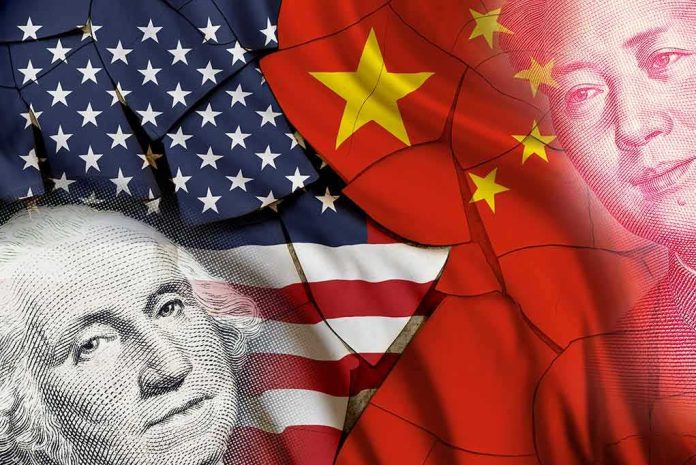
Tariff relief between the United States and China now advances through tightly scoped, reversible bargains that buy stability without pretending to settle the rivalry—and the agreed $30 billion in reciprocal tariff reductions fits that model exactly.
At a Glance
- Washington and Beijing agreed to identify and reduce tariffs on roughly $30 billion of non-sensitive goods on a reciprocal basis, as part of an eight-point summit consensus.
- The move accompanies a short extension of the existing trade truce, preserving a predictable tariff environment while broader strategic disputes persist.
- The $30 billion tranche is a managed, tactical easing—material for affected sectors, modest against total bilateral trade.
- The deal sits within a multi-year pattern of summit-driven de-escalations tied to side commitments on fentanyl precursors, agricultural purchases, and rare earths.
What was agreed: a narrow, reciprocal tariff unwind
U.S. and Chinese negotiators locked in a reciprocal framework to reduce tariffs on approximately $30 billion worth of goods on each side, focusing on “non-sensitive” products—categories that avoid direct friction with national security controls or advanced technology export restrictions. Chinese officials publicly described the arrangement as part of an eight-point consensus reached during President Xi Jinping’s visit to Washington, confirming both the $30 billion figure and its reciprocal character. On the U.S. side, Treasury Secretary Scott Bessent had previewed the scope months earlier, indicating that an initial tranche would target about $30 billion where tariffs could be cut or eliminated, consistent with a managed-trade approach designed to insulate the carve-out from the next round of frictions.
To maintain the space for implementation, the two governments also extended their tariff truce by roughly two months beyond its looming expiry, pushing key deadlines into January and signaling continued talks on a longer runway for relief. These timelines matter: prior truces have lapsed into renewed escalation when the clock ran out, so even a short extension lowers the immediate risk premium in supply chains and procurement decisions.
How this mechanism works in practice
Think of the $30 billion figure not as a single legal instrument but as a target envelope: each side’s trade authorities task working groups to identify discrete tariff lines—inputs, intermediate goods, and selected finished products—where lowering or removing duties yields bilateral gains without compromising leverage on strategic sectors. The practical effect is to cordon off small, mutually tolerable zones of normalcy while keeping the broader defensive architecture—Section 301 actions, IEEPA-based surcharges, entity listings, licensing, and investment screening—intact. U.S. statements around prior steps point to complementary measures such as temporary rate trims and exclusion extensions, which knit together with the tariff carve-outs to create a predictable path for specific categories through a volatile landscape.
China’s incentives are symmetrical but not identical. Relief on selected U.S. tariffs helps Chinese manufacturers of lower-tech goods and protects access to U.S. agricultural and energy supplies; in return, Beijing can channel purchases toward politically salient American exports while keeping levers on critical minerals, industrial policy, and technology self-reliance. This is why the agreement explicitly targets “non-sensitive” goods—both capitals want tactical economic gain without eroding coercive options on semiconductors, AI compute, telecoms, and critical inputs.
How we got here: de-escalation by increments
Since 2025, the trade relationship has moved through punctuated truces rather than a single grand bargain. The arc is consistent. After crisis-level tariffs and counters, negotiators engineered temporary reductions—short windows when both sides dialed back elevated rates to buy calm and test compliance. That logic resurfaced across 2025 and 2026: a Geneva truce; a Busan framework tied to fentanyl precursor actions, resumed U.S. soybean purchases, and a pause on rare-earth export controls; and then a Washington follow-on that marries a narrow tariff unwind to limited process agreements and a near-term truce extension.
Officials telegraphed the $30 billion tranche long before signature, signaling a preference for managed, line-item relief over system-wide reform. Bessent’s spring comments about cutting or eliminating duties on an initial $30 billion of goods mapped directly to the summit outcome; contemporaneous reporting framed it as a quasi-managed-trade device, identifying products that could move with minimal security crossfire. Beijing’s post-summit description simply confirmed that design from its side of the table.
China and the United States have agreed on a $30 billion reciprocal tariff-reduction arrangement and a new dialogue on artificial intelligence. The agreement followed Chinese President Xi Jinping’s three-day visit to Washington and his meeting with U.S. President Donald Trump.… pic.twitter.com/J7YvcFxHg3
— The Hindu (@the_hindu) September 26, 2026
Why the figure matters—and what it doesn’t do
Thirty billion dollars is meaningful to firms captured inside the carve-out; for some product lines, tariff relief flips margin math, revives shelved orders, or stabilizes input costs. But set against the scale of U.S.–China trade flows, this is a targeted intervention, not a structural reset. The headline number buys predictability where it is most feasible—lower-tech components, industrial inputs, and politically favored commodities—while leaving advanced technology, data, and investment restrictions untouched. That circumscription is deliberate: each side wants economic oxygen without surrendering the strategic high ground.
Linkages to non-tariff deliverables underscore the tactical nature of the easing. Earlier de-escalations were explicitly bundled with actions on fentanyl precursors, agricultural purchases, and rare-earths posture—areas that Washington and Beijing respectively treat as near-term priorities with domestic resonance. The $30 billion carve-out keeps that pattern intact: concrete but limited relief in exchange for progress in a few verifiable lanes. It is a stabilization tool, not a reconciliation.
Implementation, governance, and the managed-trade turn
Two institutional innovations give this narrow bargain a chassis. First, U.S. and Chinese officials have stood up or proposed boards and working groups—variously described as a Board of Trade and a Board of Investment—to troubleshoot access frictions and curate product lists where reciprocal tariff cuts make sense. Public remarks from U.S. officials around earlier summits placed the initial curation target right around the same $30 billion mark, suggesting continuity in mandate and scale. Second, periodic truce extensions create rolling windows for adjustments: exclusions can be extended, rates trimmed temporarily, and compliance checked before moving to the next tranche.
This is managed trade by design. Rather than chase a maximalist settlement that would collapse under today’s strategic rivalry, both governments are institutionalizing a tempo of modest, defensible wins. Businesses adjust accordingly: route transactions through the green lanes when they open, hedge exposure elsewhere, and assume reversibility. For investors and operators, the rational stance is to treat the $30 billion tranche as a tariff corridor with guardrails, not a corridor to détente.
What to watch next
Three signals will determine whether this carve-out expands or stalls. First, the product list: if authorities populate it with inputs central to mid-skill manufacturing and agriculture, usage will be high and political support durable. Second, compliance on the side deals: demonstrable action on fentanyl precursors, steady agricultural purchase flows, and a quiet rare-earths posture have been the past price of admission for further easing. Third, the renewal cadence: a short truce extension implies the next checkpoint arrives quickly; hitting deliverables on schedule is the prerequisite for a second tranche.
The through-line is clear. The $30 billion reciprocal tariff reduction is real, material, and bounded. It improves the operating climate for specific sectors while preserving each side’s strategic leverage. In a relationship defined by contention, that combination—modest relief, high reversibility, credible incentives—has become the durable equilibrium.
Sources:
reuters.com, noticias.foxnews.com, cmsapi.theepochtimes.com, thehill.com, yahoo.com, foxbusiness.com, kfgo.com