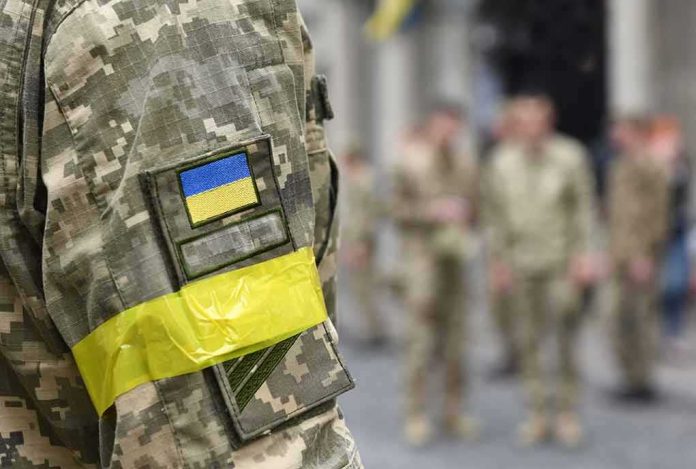
In the middle of a grinding war and a domestic political crisis, Volodymyr Zelensky has removed Oleksandr Syrskyi as commander‑in‑chief and installed frontline commander Mykhailo Drapatyi, folding a wave of street protests into a broader attempt to reset Ukraine’s war leadership and command culture.
At a Glance
- Zelensky dismissed Commander‑in‑Chief Oleksandr Syrskyi after days of mass protests and immediately named Maj. Gen. Mykhailo Drapatyi as his replacement.
- Drapatyi comes to the top job as a combat‑tested operational commander, not a political figure, with a record in Kherson, Kharkiv and joint forces operations.
- The change is part of a wider wartime shake‑up that also saw the sacking of reformist Defence Minister Mykhailo Fedorov, triggering the largest street protests since the invasion.
- Zelensky publicly framed the move as a “reset” of the war effort and a shift in command philosophy, even as the timing clearly reflects intense public pressure.
- The appointment reinforces a longer‑running pattern: repeated leadership churn and structural reforms inside Ukraine’s armed forces as they adapt to a protracted, high‑intensity war.
Zelensky’s Decision: From Crisis Protests to Command Reset
The bare facts of the decision are clear. After six consecutive days of protests in Kyiv and other cities demanding the removal of Commander‑in‑Chief Oleksandr Syrskyi, President Volodymyr Zelensky announced that Syrskyi was being dismissed and that Maj. Gen. Mykhailo Drapatyi would take over as head of the Armed Forces. The protests themselves were sparked not by Syrskyi directly but by Zelensky’s earlier dismissal of Defence Minister Mykhailo Fedorov, a popular reformer credited with modernising Ukraine’s drone and digital warfare systems and symbolising a more tech‑driven, transparent defence sector.
Al‑Jazeera, Reuters and Ukrainian outlets describe the sequence in similar terms: Fedorov’s ouster produced the largest wartime street mobilisations since Russia’s full‑scale invasion; demonstrators quickly folded grievances about military leadership and stalled reforms into demands that Syrskyi be removed; Zelensky met commanders and protest representatives and then announced Syrskyi’s dismissal and Drapatyi’s promotion. In his public statement, Zelensky said the leadership change was intended to “reset” the war effort against Russia, signalling that he wanted Ukrainians to see the move as strategic adaptation rather than capitulation to protests.
Who Is Mykhailo Drapatyi? A Combat Commander at the Top
Drapatyi’s profile matters because it shapes whether this looks like a political concession or a military reorganisation. Unlike many defence ministers or security chiefs, Drapatyi is a career field commander. Western and Ukrainian reporting consistently place him in combat roles: he has led joint forces coordinating daily operations across branches, commanded land forces, and held key battlefield commands on the eastern front.
Accounts of his record converge on three theatres. First, Drapatyi built his reputation during the defence of Kryvyi Rih, his home region, when Russian forces pushed towards the industrial heartland. Second, he played a central role in the liberation of the right‑bank portions of Kherson oblast, an operation that required coordinating artillery, riverine logistics, and infantry manoeuvre under constant Russian fire. Third, he has been closely associated with the defence of the Kharkiv front and subsequent counteroffensive operations there, including managing the Khortytsia operational‑strategic group responsible for some of the most intense fighting.
Equally important is his command philosophy. Where Syrskyi was frequently described as running the armed forces with an “old‑school Soviet style” of highly centralised control and tight grip over subordinates, Drapatyi is portrayed as an advocate of delegated authority and initiative at lower echelons. One profile describes him as consistently pushing decision‑making down to those “closest to the fight” – battalion and company commanders with immediate situational awareness – rather than requiring clearance from top headquarters for tactical adjustments. For a military under stress from Russian massed fire and the need for rapid local adaptation, that doctrinal difference is not cosmetic; it goes to the heart of how Ukraine fights.
Oleksandr Syrskyi’s Tenure and the Rationale for Change
Syrskyi’s dismissal does not erase his importance in Ukraine’s war record. Zelensky himself, in announcing the change, credited Syrskyi with leading the defence of Kyiv in the war’s opening phase, overseeing the Kharkiv counteroffensive, and commanding the operation commonly referred to as the Kursk campaign inside Russia. Earlier analyses of Ukraine’s wartime leadership also underline that Syrskyi’s appointment in February 2024, replacing Valerii Zaluzhnyi, was a major moment: it shifted command from a widely popular, independently minded general to one seen as closer to the president’s inner circle.
Yet the evidence base presented publicly for Syrskyi’s removal is notably thin on documented operational failures. There is no released after‑action report, parliamentary inquiry, or performance audit that Zelensky has pointed to as a formal trigger. Instead, the official rationale stresses the need for a leadership “reset,” internal “changes,” and a refocusing of the command system on combat effectiveness and soldier welfare amid a long, attritional war. In Zelensky’s pattern of reshuffles over the past two years, this language recurs: generals and ministers are moved with a blend of praise for their past contributions and insistence that the next stage of the war demands different skills.
In practice, that means outside observers must infer the reasons for his dismissal from context. That context includes tensions with Fedorov over reforms, criticism from parts of civil society about casualty management and mobilisation, and the perception that the command system had become too closed to innovation and too slow to correct errors. It is reasonable to see Syrskyi’s removal as a product of both operational and political forces – an attempt to restore public confidence, reduce friction with reformist constituencies, and adjust doctrine at the top of the armed forces without publicly airing every grievance.
A Leadership Shake‑Up, Not a One‑Off Event
Zelensky’s decision on Drapatyi sits inside a much larger pattern: repeated, clustered reshuffles of Ukraine’s wartime leadership. Analysts at the OSW think tank described the February 2024 changes that accompanied Zaluzhnyi’s removal as a “personnel revolution,” noting that over a dozen senior positions were altered in a matter of days, with only partial public explanation. Similar cycles have recurred since – changes to land forces command, eastern front leadership and specialised branches like unmanned systems and airborne forces.
Reporting by Jamestown and CEPA shows that these personnel waves have coincided with structural reforms, notably a transition to a corps‑based command structure, elevation of permanent operational commands, and the creation of new specialised commands for drones and unmanned systems. Defence Minister Rustem Umerov has spoken of comprehensive reviews of command systems and personnel policy, aiming to professionalise the army and make it more resilient under sustained pressure. In that environment, the line between individual performance, organisational reform and political management blurs; moving a commander can serve all three objectives at once.
Critics inside and outside Ukraine warn that such frequent top‑level change risks fragmenting continuity and weakening institutional memory. Russian‑leaning analysts, for example, frame repeated replacements of defence ministers and commanders‑in‑chief as a sign of management crisis and personnel shortages. Many Western observers, by contrast, view it as messy but consistent with a democracy learning to run a modern war machine under fire, incorporating lessons quickly and battling entrenched habits from the Soviet era.
Zelensky Replaces Commander-in-Chief of Armed Forces of Ukraine
Major General Mykhailo Drapatyi has replaced Oleksandr Syrskyi. pic.twitter.com/eVORqjL866
— Sota News (@sotanews) July 21, 2026
Public Pressure, Presidential Authority and Wartime Governance
The protests that set the stage for Syrskyi’s ouster were not marginal. Reuters, the Los Angeles Times and others describe thousands of people in Kyiv and multiple other cities turning out over several days, chanting slogans, calling for Fedorov’s reinstatement and Syrskyi’s removal, and warning of eroding national unity. Demonstrators included soldiers’ families, civic activists and veterans, and their demands blended practical complaints – mobilisation, equipment, corruption – with broader fears about concentration of power under martial law.
This raises a central question for any wartime democracy: how far does public pressure legitimately shape command appointments? Under Ukraine’s martial law, parliamentary elections are postponed, but parliament still formally holds the power to approve governments; Zelensky’s dismissal of Fedorov and subsequent cabinet manoeuvres prompted criticism that he was stretching constitutional norms. His choice to respond to protests by changing the military commander‑in‑chief rather than reversing the defence‑minister decision reflects an attempt to channel discontent into a visible corrective without relinquishing control over the civilian defence portfolio.
The available record suggests Zelensky tried to frame the moves as part of a sequenced plan rather than panic. In earlier months, he had publicly addressed rumours about replacing Syrskyi, saying any such decision would be part of “sequential actions” to revamp the defence sector and only then the Armed Forces. The eventual timing – following Fedorov’s ouster and days of protests – makes it hard to draw a neat line between planned restructuring and responsive crisis management. But it is not inconsistent with his broader pattern: use reshuffles to show responsiveness, pair them with messaging about modernisation, and keep formal deliberations behind closed doors.
Strategic Implications: Doctrine, Morale and the Long War
What does Drapatyi’s elevation change on the battlefield? At a doctrinal level, if his reputation for decentralised command and frontline focus is matched by practice at the top, Ukraine’s forces may see more authority pushed to operational and tactical commanders, faster adaptation to local conditions, and greater emphasis on integrating new technologies – particularly drones and autonomous systems – into unit‑level decision‑making. That aligns with lessons distilled by Western studies of the war, which identify autonomous systems, information operations, resilient logistics and adaptive air defence as key dimensions where agility matters as much as firepower.
At a political‑psychological level, the change signals to both the domestic audience and Ukraine’s partners that the leadership heard the protests and did not simply reassert the status quo. Protesters who saw Syrskyi as blocking reforms or mishandling casualty risks have some reassurance that their voice can influence wartime policy. At the same time, the manner of the change – without an election, via presidential decree – reinforces the reality that Zelensky’s personal authority is the fulcrum of Ukraine’s wartime governance, for better and for worse.
For Russia, the shake‑up is read through its own lens. Russian media and commentators have painted the crisis as evidence of fracturing unity and “color revolution”‑style street pressure, even as Russian forces endure what one analysis called their bloodiest month in over a year, with tens of thousands of casualties in July alone. The Kremlin will look for any sign that Ukraine’s command changes weaken coordination; Ukraine’s leadership plainly hopes the opposite will be true – that bringing a combat general like Drapatyi to the top will harden the system and make it more responsive to frontline realities.
Sources:
theamericanconservative.com, timesofisrael.com, kyivindependent.com, yahoo.com, washingtonpost.com, pbs.org, reuters.com, bastillepost.com, latimes.com, indianexpress.com, nytimes.com, youtube.com, neweuropeans.net, cepa.org, jamestown.org, english.nv.ua, voennoedelo.com, osw.waw.pl, londonlovesbusiness.com