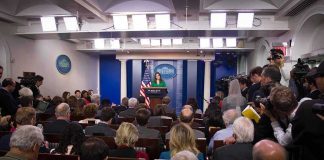
Standing at Mount Rushmore on July 3, 2026, President Trump declared communism a bigger threat to America than World War II, Pearl Harbor, and 9/11 combined — and said it is already here.
Story Snapshot
- Trump called communism a “mortal threat to American liberty” — greater than any war or attack in U.S. history — during America’s 250th birthday celebration at Mount Rushmore.
- He cited a death toll of 100 to 120 million people killed by communist regimes in the last century, though he did not name a specific source for that figure.
- Trump said communism has been “totally normalized in the Democrat Party” but did not name specific individuals or provide documents to back that claim.
- Critics called the speech “darkly political,” while supporters said it was a necessary warning about a real and growing danger to American freedom.
What Trump Said at Mount Rushmore
On July 3, 2026, President Trump spoke at Mount Rushmore as part of the “Freedom 250” celebration marking America’s 250th birthday. He told the crowd that communism is “the enemy of the Constitution and the enemy of July 4th.” He said it is “the greatest threat to our country, including World War I, World War II, Pearl Harbor or even 9/11.” Those are his direct words from the official White House transcript and video.
Trump also said communist regimes killed between 100 and 120 million people over the last century. He did not cite a specific study or source for that number during the speech. Historians who study communist regimes — including those in the Soviet Union, China, and Cambodia — have produced estimates in a similar range, though the exact figures are debated. The core point that communism caused massive death tolls is not seriously disputed by mainstream historians.
The Claims That Sparked Debate
Trump went further than history. He said communism has been “totally normalized in the Democrat Party” and that “self-identified communists” now exist in U.S. cities. He did not name any political figures or provide membership records, party documents, or voting records to support that claim. Critics, including reporters at The Hill and The New York Times, noted that Trump “did not identify the political figures he sees as a communist vanguard.”
Trump also described the Communist Party as made up of “illegal immigrants, criminals, and everybody that doesn’t want to work.” No immigration data, arrest records, or party membership rolls were offered to back that up. He also mentioned a bill called the “Save America Act” as a solution, but no bill number or official text was provided. These gaps give critics room to argue the speech was political rhetoric aimed at the 2026 midterm elections rather than a factual threat assessment.
Why This Debate Matters Beyond Party Lines
Anti-communist rhetoric has a long history in American politics. Fear of internal communist influence drove the Red Scare of the 1950s, when Senator Joseph McCarthy accused hundreds of Americans of being communist sympathizers. Many of those accusations turned out to be false, and McCarthy was eventually condemned by the Senate. That history makes many Americans — on both the left and the right — cautious when they hear sweeping claims about communist infiltration without specific proof.
At the same time, the documented record of communist regimes causing mass suffering is real and well-established. Many Americans, especially those who fled communist countries or whose families did, take the warning seriously. The honest tension here is this: the historical danger of communism is not in question. What is in question is whether the specific claims Trump made — about the Democrat Party, about immigrants, about named communists in U.S. cities — are backed by evidence. Right now, the speech did not provide that evidence. That does not make the broader concern wrong. It does mean voters on both sides deserve more than declarations — they deserve facts.
Sources:
thegatewaypundit.com, foxnews.com, whitehouse.gov, thehill.com, wsj.com