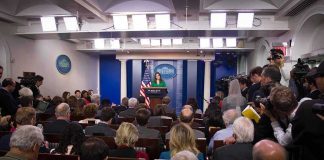
President Trump’s plan to deploy a massive “Election Integrity Army” into every state for the 2026 midterms raises alarms about potential voter intimidation amid widespread distrust in federal election safeguards.
Story Snapshot
- Trump credits his 2024 victory, including sweeps in swing states, to an RNC-recruited “Election Integrity Army” of poll watchers that preserved vote sanctity.[1]
- He announced a larger version for 2026 midterms, promising it will be “much bigger and stronger” without detailing size, training, or operations.[1]
- House Republicans advance the “Make Elections Great Again Act” mandating photo IDs, citizenship proof, and bans on mail-in and ranked-choice voting.[2]
- Critics warn of dismantled federal election security agencies and risks of military involvement at polls, fueling fears of interference.[2][5]
- Courts have struck down related executive orders, like barring late mail-in ballots, adding legal uncertainty.[2]
Trump’s Announcement and 2024 Context
President Donald Trump posted on Truth Social that during his 2024 election win, the Republican National Committee deployed an “Election Integrity Army” in every state.[1] This force of thousands of volunteers handled poll watching and election litigation support. Trump claimed it ensured the sanctity of legal votes, contributing to his victories in all swing states and wide electoral and popular vote margins.[1] Supporters view this as a triumph against perceived fraud risks.
House Republicans, led by Representative Bryan Steil, echo these efforts with the “Make Elections Great Again Act.”[2] The bill requires photo identification, proof of citizenship, clean voter rolls, and prohibits universal mail-in and ranked-choice voting. Steil stated these changes build voter confidence and make voting easy but cheating hard.[2] Trump signed a prior executive order imposing citizenship checks, now sought to be codified into law.
Criticisms and Legal Challenges
Opponents frame the army as a threat to fair elections. Reports highlight dismantled federal protections, including the Cybersecurity and Infrastructure Security Agency, National Security Council’s election group, and Department of Justice voting rights teams.[2] Career officials resisting 2020 challenges were replaced by Trump allies. Critics like University of California Berkeley’s Erwin Chemerinsky warn of military deployments in cities like Los Angeles as tests for broader interference.[2]
Courts invalidated parts of Trump’s executive order, such as barring absentee ballots post-election day and strict citizenship proofs.[2] The Justice Department threatened charges against election workers, while calls for atypical reapportionment in Texas risk nationwide court battles.[2] These moves create confusion and delays, eroding trust across political lines.
Broader Implications for Midterms
A Pew Research analysis shows 68% of Republicans distrusted elections pre-2024, driving volunteer surges: RNC poll watchers rose 400% in swing states from 2018 to 2022.[3] Trump’s March 2025 executive order mandates voter-verifiable paper records and enforces federal integrity laws.[6] Yet, groups like Clean Election USA and the Election Integrity Network mobilize armed “citizen armies” to monitor polls, raising intimidation concerns.[3]
Trump is talking about a bigger volunteer “Election Integrity Army” — Republican poll watchers and election observers in every state for the 2026 midterms.
Both parties recruit thousands of these volunteers every cycle to monitor polling places, ballot handling, and voter ID…
— Dr. Cole (@1drcole) May 10, 2026
Amid GOP control of Congress and the White House, Democrats obstruct these reforms. Both sides express frustration with a federal government seen as elite-driven and unresponsive. Conservatives decry past fraud risks from lax rules; liberals fear suppression. This polarization tests democratic norms, as midterms approach with potential for disputes over results in a divided nation.[1][2]
Sources:
[1] Trump says he will send an ‘Election Integrity Army’ into every state …
[2] The Trump Administration’s Efforts To Undermine Election Integrity
[3] What Is Trump’s ‘Election Integrity’ Order Even Trying to Achieve?
[5] Key Takeaways from President Trump’s Election Integrity EO
[6] Preserving and Protecting the Integrity of American Elections