

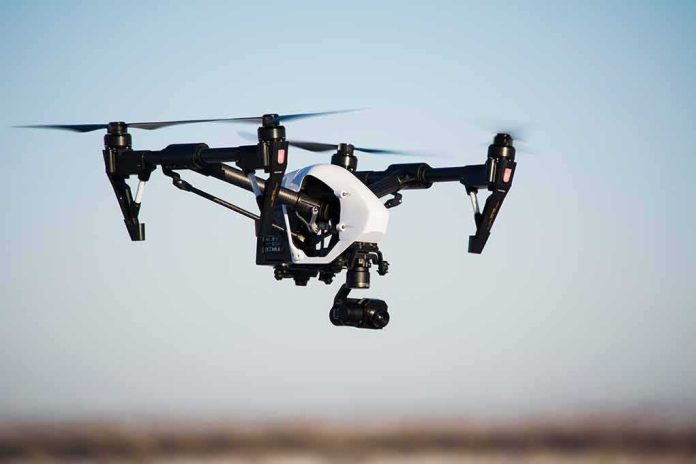
The administration’s drone initiative is not a one-off tariff headline; it is a whole-of-government attempt to rewire the U.S. unmanned systems supply chain around security, resilience, and domestic capacity, using executive authorities and trade tools to force a structural shift that market forces alone have not delivered.
At a Glance
- Two-step policy: a 2025 executive order to map and restrict risky foreign suppliers, followed by a 2026 Section 232 tariff regime that changes the economics of importing drones and key components.
- Tariffs scale with sensitivity: up to 100% ad valorem on larger or capability-rich “sensitive” drones and docking stations; lower but still material rates on sub-25 kg systems and selected parts.
- Legal ground is established: Section 232 gives the President broad latitude to “adjust imports” on national security grounds, a scope repeatedly upheld in federal courts.
- Strategy aligns with defense demand: Pentagon programs seeking hundreds of thousands of small, expendable drones require a secure, scalable, China-light supply base.
What changed: from policy intent to binding economics
In June 2025, the White House issued “Unleashing American Drone Dominance,” instructing agencies to identify “covered foreign entities,” constrain procurement from them, and set the conditions for a secure domestic supply chain. It tasked the Federal Acquisition Security Council to publish a Covered Foreign Entity List within 30 days and directed the Commerce Department to move within 90 days on supply-chain security actions—an explicit signal that drone risk would be treated like any other critical technology exposure, not an isolated procurement preference.
The economic lever arrived the following summer. On August 13, 2026, President Trump signed a proclamation under Section 232 of the Trade Expansion Act imposing new tariffs on unmanned aircraft systems (UAS) and select components. The structure is deliberate: a 100% ad valorem tariff on “sensitive” drones—typically heavier platforms or those equipped with specific capabilities—and their docking stations; lower but significant rates, often 25%, on consumer and many commercial drones under 25 kilograms; and a schedule that brings additional component lines under duty after a phase-in. Most measures took effect September 3, 2026, with certain component tariffs beginning in February 2027.
How the mechanism works: aligning trade tools with supply-chain security
Section 232 is the statutory engine. It empowers the President to adjust imports that threaten to impair national security—an authority that covers not only defense articles but also economic and industrial base capacities judged essential to security. Federal courts have consistently affirmed both its constitutionality and the President’s broad discretion in applying it; challenges to prior 232 actions failed to persuade the Federal Circuit, which rejected arguments that threats must be “imminent” or that the executive exceeded statutory bounds.
By design, the drone tariffs alter landed cost calculations across the stack—finished systems, subsystems, and certain electronics—pushing integrators to re-source away from covered suppliers or absorb steep price penalties. The administration coupled this with procurement-side constraints and a listing regime that clarifies which entities and inputs are off-limits for federal buyers. The practical consequence is a nudge-and-shove approach: nudge with federal demand and clarity; shove with border taxes and exclusion for noncompliant pathways.
Why drones are different: concentration, dual-use tech, and battlefield lessons
The U.S. drone ecosystem has long leaned on foreign—especially China-linked—inputs for motors, batteries, sensors, and software. Analysts and government programs have documented the bottlenecks: critical components, persistent vendor lock-in, and a domestic base that can assemble and innovate but often can’t scale at price points driven by offshore supply chains. When you add dual-use capabilities—thermal imaging, navigation stacks, encrypted links—the national-security rationale strengthens, because the same module that inspects a powerline can also cue a munition.
Operational demand is amplifying the pressure. The Pentagon’s emerging “drone dominance” approach treats small, expendable airframes more like munitions than aircraft, with targets in the hundreds of thousands. That scale is incompatible with supply chains that can be throttled by a single country’s export rules or by one vendor’s firmware. Program documentation and testing cycles have steadily raised bars on country-of-origin and cyber-security, which dovetails with the administration’s push to reduce exposure to covered foreign suppliers.
The tariff architecture in practice: who pays, who pivots, who gains
The rate card is not arbitrary; it maps to risk and leverage. Larger, more capable drones—a set that includes platforms over 25 kg or carrying specified sensitive payloads—face 100% duties. Sub-25 kg systems and many parts draw 25% in most cases, with a timetable that staggers implementation across SKUs, giving integrators a window to re-source. Industry rundowns captured the split-rate structure and the effective dates, noting a 21-day runway for most tariffs and about 180 days for some less-sensitive components, which creates a short but real reconfiguration period for procurement teams.
Immediate effects are predictable. Importers of finished foreign systems absorb or pass through price hikes; integrators accelerate supplier qualification in North America, Europe, and trusted-ally Asia; and domestic producers—especially those already investing in vertically integrated lines—gain relative pricing power. Market coverage at the time showed public drone company shares rallying on the policy, a signal that investors read the proclamation as a tailwind for U.S.-aligned manufacturers and for component makers able to onshore or nearshore quickly.
The legal and policy scaffolding: durable beyond one announcement
Anchoring the policy in a pair of instruments—a White House executive order and a Section 232 proclamation—matters for durability. The executive order built the definition space (covered foreign entities, supply-chain security mandates, interagency roles). The proclamation imposed the price signal. Even if tariff schedules evolve, the institutional machinery—Commerce investigations, Federal Acquisition Security Council listings, and procurement rules—is now trained on drones as a strategic industry. That alignment, plus court precedents affirming 232 breadth, suggests the framework will outlast any single tranche of duties.
It is also consistent with a wider industrial-security pattern. When policymakers treat a technology supply chain as a strategic vulnerability, they typically combine import adjustments, procurement bans or preferences, and domestic-content incentives. In drones, those levers are reinforced by documented dependency on foreign components, elevating the national-security justification beyond rhetoric into the practicalities of vendor lists, country-of-origin attestations, and secure firmware chains.
Cheap drones from Aliexpress – with a few kilometers of range, crappy battery, and open, unencrypted frequencies – won't get you anywhere on their own against a professional army.
You need secure long-range data links (Starlink works the best…), real-time targeting data,…
— Tomas Orpington (@TomasOrpington) August 18, 2026
Capabilities and capacity: the onshoring challenge
Policy can change incentives overnight; factories cannot. Standing up high-volume, secure lines for motors, ESCs, batteries, image sensors, radio modules, and ground-control electronics requires capital, process engineering, and patient qualification cycles. The domestic sector has credible bright spots—vertically integrated facilities built to push six- and seven-figure annual outputs, 100% flight-test regimes to debug reliability at scale, and iterative designs that trade flashy castings for thermally efficient, serviceable structures—but those capabilities must propagate across the tiered supplier base to meet defense and commercial volumes at the new price points.
The phased tariff schedule is, in effect, a calendar for that build-out. Integrators that move quickly to dual-source critical parts in allied countries or to stand up U.S. lines will capture share as import parity erodes. Laggards will pay a tax or cede market. Either way, the system converges on the policy’s aim: reducing the likelihood that a single foreign chokepoint can stall U.S. drone availability precisely when demand spikes—whether after a hurricane for utility inspections or during a contingency when swarming attrition drives daily replenishment needs.
What to watch: metrics that separate rhetoric from re-shoring
Three indicators will tell you whether “drone dominance” is more than a slogan. First, component localization rates: the percentage of bill-of-materials value sourced from the U.S. and treaty allies for motors, batteries, sensors, radios, and compute. Second, cost curves: whether domestic suppliers can hold unit economics within the mission’s tolerance bands as cybersecurity, EW hardening, and reliability requirements rise. Third, throughput: actual monthly deliveries into defense programs measured against publicly discussed phase goals in the hundreds of thousands. Legal authority and tariffs can create space; only sustained throughput closes the gap.
The administration’s approach—define the risk in an executive order, then force the economic shift with Section 232—is the classic national-security industrial playbook. The difference in drones is the immediacy of battlefield lessons and the breadth of civil use. That combination makes resilience, not just protectionism or price, the central variable in the years ahead.
Sources:
youtube.com, finance.yahoo.com, abcnews.com, whitehouse.gov, cnbc.com, x.com, fdd.org, globenewswire.com, trumpwhitehouse.archives.gov