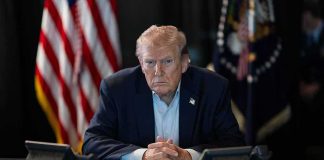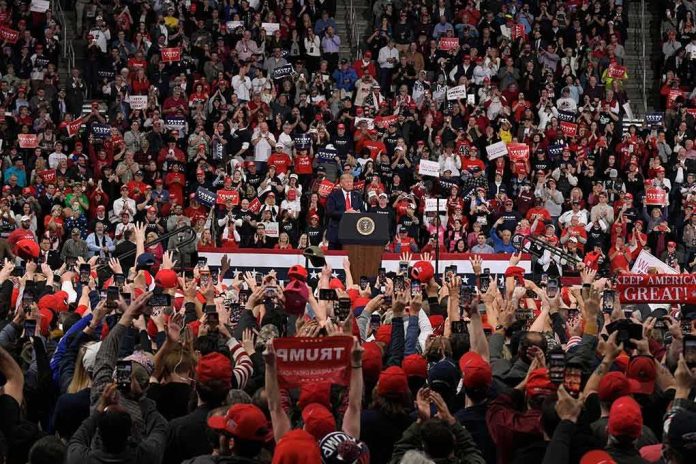
Trump’s push for a first-ever Republican midterm convention is less about logistics in Dallas than about attempting to rewrite a stubborn law of American politics: the tendency of the president’s party to lose ground in the midterms.
Key Points
- President Trump has personally announced a first-ever national GOP midterm convention, with Dallas and September 9–10, 2026 cited by allies and local reporting, even as the Republican National Committee has yet to issue a formal venue confirmation.
- The midterm convention rests on a rules change the RNC adopted to permit such an event and is explicitly framed by party strategists as an attempt to “defy history” and avert the typical midterm seat losses.
- Republicans see the convention as a turnout machine built around Trump, designed to nationalize congressional races, showcase policy achievements, and keep Trump symbolically “on the ballot” even in a non-presidential year.
- The plan unfolds amid internal GOP frustrations over Trump’s erratic midterm strategy, legislative standoffs, and critics’ claims that his focus on voting rules and polarizing rhetoric could sow chaos rather than bolster durable support.
What Trump Has Announced—and What Remains Unofficial
By mid-2025, Trump had moved the midterm convention idea from trial balloon to explicit commitment. In a Truth Social-style post highlighted by The Hill, he declared that Republicans “are going to conduct a Midterm Convention to highlight the remarkable achievements we have accomplished since the Presidential Election of 2024,” promising that time and location would follow. Earlier messages carried the same theme in more tentative form—Trump mused about suggesting a national convention “right before the midterms,” emphasizing that it “has never been done before” and urging supporters to “STAY TUNED.”
Dallas emerged as the leading site through a mix of leaks and local officials’ statements. Texas Attorney General Ken Paxton told a tele–town hall audience that “we are having the midterm convention in Dallas in September,” and that Trump was expected to attend and speak. Regional outlets and national campaign reporters followed with more specificity: a U.S. News piece cited September 9–10, 2026, in Dallas as the planned dates; CBS Texas and the Washington Examiner reported that RNC officials had toured the American Airlines Center as a prospective venue, underscoring that Dallas was at least the front-runner.
Yet the formal machinery of the party has moved more cautiously. The Texas Tribune noted that while Paxton spoke definitively, “the Republican National Committee has not yet announced the midterm convention or its location,” and declined to clarify his comments. Politico’s West Wing Playbook described operative frustration that, even after Trump’s promise, “the Republican National Committee still hasn’t officially announced when any convention will take place,” despite campaigns needing clarity. In short, Trump and allies have “made a huge announcement,” while the RNC is still in its familiar phase of venue negotiations, security planning, and calendar wrangling.
A Structural Break from the Way Parties Usually Fight Midterms
To grasp why this convention matters, you have to situate it against nearly a century of midterm behavior. Since the 1930s, the president’s party has lost an average of roughly two dozen House seats in the midterms, with only a handful of exceptions. Parties talk about defying that pattern every cycle; they rarely alter the basic structure of the campaign to try to do it.
The RNC’s winter 2026 rules change was the hinge. Reporting from ABC News and others describes the committee unanimously adopting an amendment allowing a midterm convention, in what the party chair openly framed as a bid to “defy history” and avoid the incumbent-party slump. The convention is planned for the narrow window after the last primary and before early voting begins, which RNC chair Joe Gruters has called a “very short” runway that must be timed carefully so as not to collide with state election calendars.
Midterm politics are usually decentralized—fifty-plus separate battles for House and Senate seats, layered over local gubernatorial and legislative races. A national convention before those contests is a structural intervention: it attempts to re-nationalize the midterms around a single brand and agenda, compressing the diffuse arguments into a made-for-television event anchored in Trump’s persona. Strategists who favor the move see that as the only reliable way to translate Trump’s appeal in presidential cycles into turnout for ordinary congressional incumbents.
Why Dallas, Why 2026, and Why Center It on Trump?
Dallas is not an arbitrary choice. RNC officials have toured the American Airlines Center, and reporting suggests Texas is the leading candidate among several battleground or media markets considered, including Michigan, Pennsylvania, and North Carolina. Texas offers several advantages: a friendly political environment for Trump, a large donor base, national media reach, and symbolism as a state Republicans have worked to keep out of Democrats’ long-term reach.
The timing—September 2026—matches the logic articulated by Gruters and others: the convention should land after primaries, when nominees are set, but before general-election early voting, when persuasion and mobilization messages must crystallize. For campaign professionals, that translates to a national launch pad for advertising themes, surrogate deployment, and fundraising pushes keyed to a single narrative rather than a patchwork of district-level stories.
The centrality of Trump is deliberate. Commentary in conservative outlets like Fox News and analysis in the Washington Examiner converge on the same argument: the GOP performs poorly when Trump is not figuratively on the ballot, and the midterm convention is designed to keep him there. One columnist argues that “a Trump-centered midterm convention” is the best way to make clear that voters are choosing not just members of Congress but the continuation of Trump’s program. The Washington Examiner describes the planned gathering as focused heavily on Trump galvanizing the base to show up, with policy achievements under his second term cast as the stakes of keeping Congress in Republican hands.
Inside the GOP: Enthusiasm, Anxiety, and the Midterm Strategy Debate
Within Republican ranks, the midterm convention sits at the intersection of genuine enthusiasm and palpable unease. On the one hand, senior leaders like House Speaker Mike Johnson have publicly praised the concept. He recounted a call from Trump in which the president floated the idea; Johnson’s reaction, as relayed to PBS, was “That’s brilliant,” and he said he believed the plan was effectively “all set.” Johnson and Senate Republican Leader John Thune have reportedly worked with the RNC to bring the idea to fruition.
On the other hand, Politico’s reporting captures a quiet backlash. Campaign operatives granted anonymity describe growing frustration that the promised convention remains vaguely defined, complicating travel planning, messaging calendars, and donor expectations. For incumbents facing tight races, a major national event can be either a blessing or a disruption; without firm dates and agendas, it is hard to build field operations and advertising around it.
Overlaying that is a broader question: does Trump’s midterm approach genuinely prioritize helping Republicans hold Congress? Segments on MS NOW and analysis by journalists such as Peter Baker point to episodes that suggest a more erratic strategy. Trump has blocked or delayed widely supported bipartisan legislation, like a housing affordability bill, to keep attention on his preferred voting overhaul, the Save America Act, which even Republican senators say is “dead on arrival.” Commentators argue that this emphasis on changing election rules rather than delivering tangible economic wins undercuts the kind of governing record a midterm convention is meant to showcase.
Critics’ Case: Chaos, Polarization, and the Limits of a Convention
Critics from outside the party see the midterm convention not as an innovative civic exercise but as another front in Trump’s campaign to delegitimize elections and exhaust voters. Former Representative Max Rose, speaking on MS NOW, contends that Trump’s push for measures like the SAVE Act is aimed at “show[ing] confusion, chaos and distrust” ahead of the midterms, comparing the atmosphere to the run-up to January 6. Legal analysts emphasize that recent Supreme Court rulings have reaffirmed state control over election administration and limited the president’s ability to unilaterally restrict mail voting, constraining the practical impact of Trump’s preferred reforms.
Democrats have also framed the broader Trump-era strategy as a “protection racket.” In one widely discussed clip, Representative Alexandria Ocasio-Cortez responded to Speaker Johnson’s private assurances to donors that he would “take care of” them if Democrats turned committees into investigative bodies, accusing Republicans of running a system that shields powerful allies from accountability.[The Damage Report summary] Such rhetoric feeds a narrative in which the midterm convention is seen as a stage-managed rally for a political class under scrutiny, rather than a forum for substantive debate.
There are more personal critiques as well. Baker and other reporters have relayed concerns whispered inside the GOP about Trump’s age, stamina, and focus—accounts of him falling asleep in meetings or traveling less, prompting questions about whether his instincts align with the party’s long-term interests. If the convention becomes primarily a spectacle of grievance and culture-war escalation—building on language that brands Democrats “godless communists” responsible for existential threats—it may energize a core base at the cost of further alienating swing voters the GOP still needs in suburban districts and emerging Sun Belt metros.[NBC News summary]
What a Midterm Convention Could Change—and What It Probably Can’t
Even measured against these crosscurrents, the midterm convention remains a consequential experiment in how national parties structure competition. Historically, conventions serve three main functions: nominating candidates, settling or surfacing internal policy disputes, and broadcasting a coherent story about the party’s purpose. Here, nomination is off the table; instead, the emphasis will be on the last two—especially broadcasting.
If executed with discipline, the Dallas convention could give Republicans a unified midterm frame: a narrative of post-2024 achievements, a contrast with Democrats on issues like inflation, immigration, and crime, and a clear sense of what keeping a Trump-aligned Congress would mean for policy. It would also give the party an opportunity to repeat what the 2024 convention did in Milwaukee: recalibrate messaging to reach voters beyond the traditional base, as Republicans did by downplaying some social issues while talking more about working-class concerns and skepticism of multinational corporations.
Yet history is unforgiving. Structural forces—economic conditions, presidential approval, localized scandals, and the simple fatigue that sets in after two years of governance—are not easily countered by a single event. The RNC’s own leaders implicitly acknowledged this when they described the convention as an attempt to “defy history”; built into that phrase is an understanding that history usually wins. If Trump continues to pull focus toward election rules fights and personal grievances, the convention could end up highlighting the very vulnerabilities Republicans hope to escape: internal division, overreliance on one figure, and limited appetite for the everyday work of governing.
The GOP’s Strategic Bet
The decision to pursue a midterm convention is, ultimately, a wager on the power of narrative and personality over structural political gravity. Trump and the RNC are betting that putting him back at center stage, in a carefully choreographed Dallas arena, can turn a diffuse congressional cycle into a referendum on his agenda rather than his shortcomings. They are also signaling that the party’s future remains tightly bound to his brand, even as some elected Republicans quietly wonder whether tying everything to Trump is the only way—or the best way—to win.
Whether the experiment succeeds will only be clear after the votes are counted. But as a structural innovation, the midterm convention itself already marks a turning point: both parties now recognize that the old midterm playbook is not sacrosanct, and that in a polarized, media-saturated era, the calendar of American politics is malleable. The GOP has chosen to test that proposition first, with Trump at the helm. The stakes—in Dallas and beyond—are nothing less than whether a party can stage-manage its way out of history’s grip.
Trump announces first-ever Republican midterm convention in Dallas
Source: CBS Texas https://t.co/wn0P0xkTPG— Heather Hunter (@heatherhunterdc) June 30, 2026
Sources:
texastribune.org, fox4news.com, facebook.com, convention.texasgop.org, texasscorecard.com, washingtontimes.com, keranews.org, audacy.com, youtube.com