

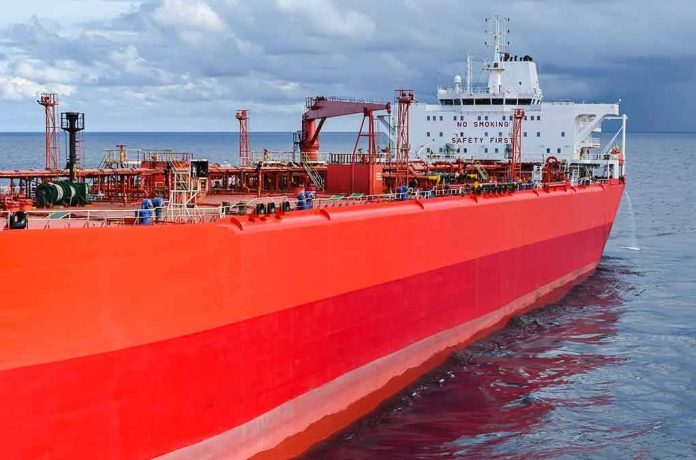
Energy policy in wartime is triage: every decision that adds a marginal barrel to the market also shifts leverage on the battlefield and in diplomacy. The controversy over President Trump’s Russian diesel waiver sits precisely on that hinge—sound in its immediate supply logic, contested in its strategic and moral arithmetic.
At a Glance
- Treasury issued a time-limited license that allows specified Russian diesel cargoes to move without U.S. sanctions exposure, making the policy more than rhetoric.
- Ukraine’s drone campaign has measurably impaired Russian refining, a driver of Moscow’s export curbs and regional fuel shortages—context for both the waiver and its critics.
- Announced volumes are modest relative to U.S. demand; any price relief is likely tactical, not transformative.
- Kyiv argues that easing sanctions without de-escalation funds Russia’s war and undercuts a core pressure track of its defense strategy.
What the waiver does—and what it doesn’t
The fulcrum of the policy is a Treasury action: a temporary license that suspends sanctions exposure for Russian diesel loaded by a stated deadline and, on paper, through a defined horizon. That specificity matters because it delineates eligible cargoes, counterparties’ risk, insurance, and payments channels—essential ingredients for traders to lift and place barrels rather than simply applaud a podium line. Public reporting places the license’s protection window into 2027, signaling a structured, time-bound pathway for limited flows rather than a wholesale sanctions rollback.
Against that legal scaffolding, the administration asserted volumes: 300,000 tons “immediately,” 500,000 tons in November, then tranches up to one million tons and a potential additional three million tons, subject to refinery conditions. By naming quantities, the White House created a falsifiable claim set—shipping logs, bills of lading, and customs entries can validate liftings and arrivals. But scale remains the constraint: independent analysis pegs the opening tranche at roughly six million barrels—about a day-and-a-half of U.S. diesel consumption—helpful on the margin, insufficient to anchor prices for a season, much less a year.
Why diesel, why now: the mechanism of tightness
Refined products markets buckle at the refinery, not the wellhead. When conversion units are down—whether from maintenance, accidents, or targeted strikes—the marginal gallon disappears quickly, and prices respond with disproportionate force. In Russia’s case, repeated Ukrainian drone attacks have taken primary and secondary units offline, pushing throughput and output lower, and prompting the Kremlin to intermittently restrict exports to stabilize domestic supply. Multiple independent outlets and the International Energy Agency (IEA) converge on the same pattern: diesel output down by roughly a third from prior-year levels; export curbs to protect internal markets; rationing and shortages in parts of Russia.
That is the market backdrop the waiver tries to offset: a global diesel pool thinned by Russian outages and policy curbs, with Europe still structurally short middle distillates post-2022 trade realignments. In such a setting, even modest new spot barrels can shave prompt spreads and temper panic bidding. The logic is orthodox commodity management. The controversy is everything around it.
The strategic countercase: pressure, targets, and proceeds
Kyiv’s objections are direct and, on the war’s terms, coherent. First, Ukrainian leadership frames refinery strikes as proportional retaliation for Russian attacks on Ukraine’s grid and as legitimate military targets that fuel and finance the invasion. The claim is not mere bravado; the observable production and export effects support that these strikes impose real costs on Russia’s war machine. Second, Zelenskyy warns that any sanctions easing absent a verifiable and durable de-escalation merely increases Moscow’s cash flow and staying power—a “gift to Putin,” in his formulation.
The IEA’s account of sustained output declines and Russia’s own export restrictions buttresses Kyiv’s strategic narrative: refinery pain is biting enough to change Moscow’s behavior at the margin, and keeping that pressure intact is a core Ukrainian interest. From this vantage, a U.S. license—even if narrow—risks blunting a pressure track that is finally working, while handing Russia cleaner routes to monetize molecules. That is the heart of the counterargument, and it is anchored in named, sourced evidence rather than conjecture.
Do the numbers justify the policy?
On pure market math, the announced flows are not large enough to reset the U.S. diesel balance. A few million barrels over weeks can calm a spike, narrow regional basis blowouts, or prevent localized shortages, but they will not drag a national average several dollars lower or inoculate harvesting season diesel from refinery outages elsewhere. That perspective matches independent coverage highlighting that the initial tranche amounts to roughly a day-and-a-half of U.S. demand—a stabilizer, not a solution.
Two further caveats shrink the promised upside. First, later tranches hinge on the state of Russian refineries—the same facilities repeatedly degraded by Ukrainian strikes and, per the IEA, operating at throughput levels roughly 30% below the prior year. Conditional supply from damaged capacity is not a bankable hedge. Second, Russia’s episodic export bans complicate forward availability. Even licensed cargoes require upstream policy permission to load and sail; Moscow has already proven willing to prioritize domestic stabilization over exports when inventories tighten.
Law, design, and the proceeds problem
The strongest defense of the waiver is that it is time-limited, circumscribed, and addresses an acute product-market tightness. The strongest critique is that it undercuts a sanctions regime built to constrain Russia’s hydrocarbon revenue while a hot war continues—and that the administration has not publicly articulated safeguards on payments, escrow, or end-use that would keep incremental proceeds out of the Kremlin’s war chest. Reporting confirms the license exists; it does not publish the counterparties, pricing terms, or revenue-routing conditions that would speak to the proceeds risk. In sanctions policy, design details are policy.
There is also the matter of coherence. Weeks before the waiver, the administration spotlighted tougher sanctions posture; now it is explaining a targeted release. Governments do both routinely in commodity crises. But absent a transparent theory of the case—how this license nests inside a broader pressure-and-price framework—critics can plausibly cast the move as ad hoc or politically timed. The evidence base includes that political angle, but its probative weight rests on perception more than documentable mechanism; the hard policy question remains the revenue channel and guardrails.
US President Donald Trump is facing criticism from lawmakers in both parties over a reported agreement with Russian President Vladimir Putin to import millions of tonnes of diesel as the war involving the US, Israel and Iran drives up energy prices. Trump said Russia would… pic.twitter.com/lCMe7xXBkk
— TMJ News Network (@tmjnewsnetwork) October 12, 2026
What would settle the dispute
Several verifiable disclosures would clarify substance over slogan. First, the complete Treasury authorization and guidance, including payment pathways and any escrow or humanitarian carve-outs, would reveal whether the license meaningfully increases unencumbered Russian revenue or simply regularizes cargoes already slipping through global gray routes. Second, shipping and customs data could confirm whether the initial 300,000 tons loaded, where it discharged, and who bought it—facts that resolve whether this is market-moving supply or theatrical accounting. Third, refinery-by-refinery production, outage, and repair data would test the physical plausibility of later tranches, instead of treating conditional promises as supply.
Bottom line: a narrow fix in a broad war
The case for the waiver is narrowly economic and near-term: put barrels in the pool while refineries are constrained, smooth price spikes, and buy time. The case against it is strategic and medium-term: don’t trade away sanctions leverage—and certainly don’t add clean revenue channels—without reciprocal, enforceable de-escalation. The evidence decisively supports two points. First, Ukrainian strikes have materially cut Russian refining, which has tightened diesel availability and justified, in market logic, emergency supply actions. Second, the waiver’s promised volumes are too small and too contingent to justify meaningful sanctions relief unless its financial plumbing rigorously starves the Kremlin of proceeds.
Sources:
youtube.com, apnews.com, bbc.com, cnbc.com, pbs.org, reuters.com