

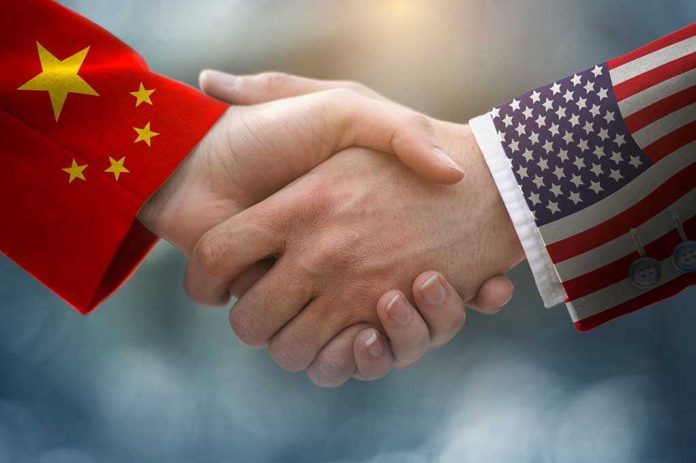
When a dispute over one small island can pull two nuclear powers toward confrontation, everyday Americans are right to wonder who is really steering the ship — elected leaders or entrenched elites playing global chess with other people’s lives.
Story Snapshot
- Taiwan has become the most dangerous flashpoint in United States–China relations, with both sides calling it the biggest risk to peace.
- President Trump has openly put United States arms sales to Taiwan on the table in talks with Chinese President Xi Jinping, while vowing not to change United States policy.[1][4]
- Beijing warns that support for Taiwan crosses a red line on Chinese sovereignty and could trigger conflict if Washington “plays the Taiwan card.”[1][4][5]
- Taiwan’s geography, chip industry, and defense buildup make it central to military strategy, global supply chains, and the balance of power in Asia.[2][3][4]
Why Taiwan Sits at the Center of United States–China Tensions
Chinese officials repeatedly describe Taiwan as the “biggest flashpoint” and “biggest risk” in relations with the United States, framing the island as a non‑negotiable issue of sovereignty and national unity.[1][4] After the Chinese Nationalists fled to Taiwan in 1949, Beijing has treated reunification as part of closing the chapter on civil war and foreign humiliation.[3][4] United States leaders, by contrast, treat Taiwan as a self‑governing democratic partner whose fate signals whether coercion or consent sets the rules in Asia.[3][4]
Washington’s position is anchored in the Taiwan Relations Act, which directs the United States to provide Taiwan with defensive capabilities, even as diplomats formally acknowledge the “One China” policy.[4] Over decades this has meant more than seventy billion dollars in arms sales and regular military cooperation, each round provoking sharp protests from Beijing.[4] Chinese leaders argue such sales violate their internal affairs; United States officials counter that abandoning Taiwan would shatter America’s security guarantees across the region and reward intimidation.[2][3][4]
Strategic Geography and Economic Power Raise the Stakes
Military planners on both sides see Taiwan as a piece of real estate with outsized strategic value. Analysts describe the island as a “giant aircraft carrier” off China’s coast and a key link in the “first island chain” that stretches through Japan, Korea, and the Philippines, where United States alliances constrain China’s navy.[2][3][4] If Beijing controlled Taiwan, it could punch through this barrier, push its defense perimeter deep into the Pacific, and threaten shipping routes that the United States and its allies rely on.[2][3]
The Taiwan Strait itself connects the South and East China Seas and sits between China’s two most important manufacturing regions, making it a “strategic thoroughfare” for trade and naval operations.[2] Taiwan also dominates advanced semiconductor production, benefiting as companies adopt “China plus one” supply chains to reduce dependence on factories on the mainland.[3] Taiwan’s economic growth even surpassed China’s in 2020, reinforcing its value to global markets and raising the cost if conflict or blockade ever cut it off from the world economy.[3]
Trump–Xi Summit: Arms Sales, Red Lines, and Political Theater
President Trump told reporters that United States arms sales to Taiwan would be on the agenda during his summit with Chinese President Xi Jinping in Beijing, placing one of the most sensitive issues directly on the negotiating table.[1] Trump acknowledged that Xi “would like us not to” sell weapons to Taiwan but said he would still discuss the matter and argued that the United States should continue those sales.[1][4] Summit coverage noted Taiwan was bundled with talks on the Iran war, trade, and artificial intelligence.[4][5]
Chinese spokespeople responded ahead of the summit by reiterating a “consistent and unequivocal” opposition to any United States military ties with Taiwan, calling the island an internal matter for the Chinese people.[5] Beijing’s warnings echo years of statements that any attempt to “play the Taiwan card” amounts to “playing with fire” and could trigger confrontation if the “One China” principle is undermined.[1][4] The result is a tense pattern: every United States move to reassure Taiwan prompts new Chinese military drills, air incursions, or blockade exercises around the island.[2][3][4]
Military Buildup and the Risk of a Crisis Nobody Wants
China’s defense spending reached roughly two hundred ninety‑six billion dollars in 2023, with rapid modernization focused heavily on a possible Taiwan operation, including advanced missiles, cyber units, and the world’s largest navy by number of ships.[4] The United States still spends far more—over eight hundred seventy billion dollars—but must project power across the Pacific instead of operating close to home waters.[4] Some United States assessments suggest Beijing wants to be ready for a Taiwan campaign by 2027, influencing planning in Washington and allied capitals.[4]
Taiwan watches Trump-Xi summit nervously, hoping island does not become “the surprise” in Beijing. Trump plans to discuss future US arms sales to Taiwan directly with Xi, raising fresh anxiety in Taipei over one of the most sensitive meetings in years. https://t.co/pw24pwQdK4
— Will Ripley (@willripleyCNN) May 14, 2026
Taiwan is not waiting on others. Reporting indicates the island has approved a special defense budget tied in part to United States arms purchases, signaling that Taipei expects help but is also trying to harden its own defenses.[2][3] Yet much of what happens between Washington and Beijing is shielded from the public by secrecy and spin. That opacity feeds the sense, shared by many Americans across the political spectrum, that global decisions risking war are being made far from democratic oversight, in closed rooms where regular citizens have no seat at the table.
Sources:
[1] YouTube – Trump Says He’ll Talk About Selling Arms to Taiwan at Xi Summit
[2] Web – Ahead of Trump-Xi summit, China warns on US arms sales to Taiwan
[3] YouTube – Trump in China to discuss Iran war, trade and arms sales …
[4] YouTube – Trump arrives in Beijing for talks with China’s Xi on Iran …
[5] Web – Trump puts Taiwan arms sales on table