
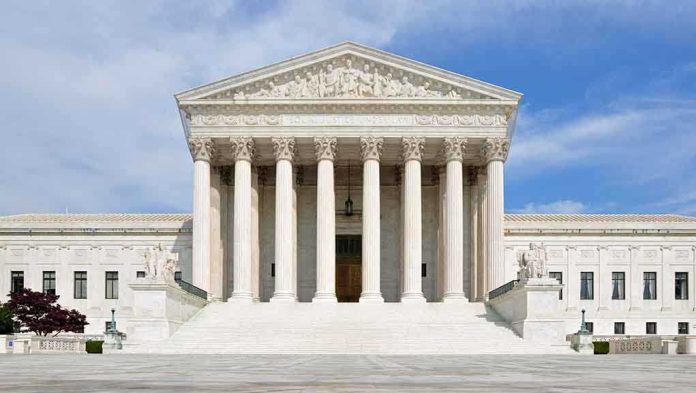
The Supreme Court just told Americans that prison officials who trash a court order and shave off a man’s religious hair cannot be sued for a dime.
Story Snapshot
- Supreme Court rules 6–3 that a Rastafarian ex‑inmate cannot sue guards who shaved his dreadlocks, even after a clear religious rights violation.
- Guards allegedly threw away a federal court ruling that protected his hair, then handcuffed him and shaved him bald anyway.[13]
- The Trump administration sided with the inmate, warning that without damages the religious‑freedom law has “little teeth.”[2]
- Conservative justices said Congress, not the Court, must clearly authorize personal lawsuits, leaving inmates with “rights” but almost no remedies.[10]
What Happened To Damon Landor Behind Bars
Damon Landor is a Rastafarian from Louisiana who spent more than twenty years growing knee‑length dreadlocks as part of a vow tied to his faith.[9] When he entered state prison to serve a short drug sentence, he brought proof that other prisons had honored his religious hair and even carried a federal appeals court ruling that said Rastafarian inmates must be allowed to keep their dreadlocks.[13] At a new facility, guards allegedly threw that ruling in the trash, handcuffed him to a chair, and shaved his head bald in one sitting.[13]
Landor later described the moment as having “decades” of religious practice stripped away in an instant.[13] A federal court of appeals had already held in an earlier case that Louisiana prisons had to accommodate dreadlocks under the Religious Land Use and Institutionalized Persons Act, a bipartisan law passed in 2000 to protect religious exercise in prisons.[15] Even so, the officers ignored that decision and the written ruling Landor showed them, then enforced a grooming rule that directly conflicted with his long‑standing religious vow.[13]
The Law At Issue: Rights On Paper, No Remedy In Practice
After his release, Landor sued the warden and guards under the Religious Land Use and Institutionalized Persons Act, claiming they placed a “substantial burden” on his religious exercise by forcing the haircut.[13][16] That law tells prisons that if they take federal money, they must not seriously burden an inmate’s sincere religious practice unless they have a truly compelling safety reason and use the least restrictive means.[15][17] The federal appeals court agreed his treatment was wrong but said its hands were tied because earlier precedent said the statute does not allow money damages against officials personally.[13][16]
Landor’s lawyers argued that the statute’s wording on “appropriate relief” matches language in the Religious Freedom Restoration Act, another federal law where the Supreme Court already allowed damages suits against individual federal officers.[13] They said the two “sister” laws should be read the same way, or else prison officials could violate religious rights with little fear of personal accountability.[13] The Trump administration supported Landor, telling the Court that Congress meant to “broadly protect individual religious exercise” and that money damages are often the only realistic way to enforce that promise inside prisons.[2][8]
How The Supreme Court Shut The Courthouse Door
On June 23, the Supreme Court ruled 6–3 that Landor cannot sue the guards for money, even if they clearly violated his religious rights.[1][9] Justice Neil Gorsuch wrote the opinion for the conservative majority, saying the statute was passed under Congress’s spending power and works like a contract between Washington and the states.[2][9] Because the individual officers never personally agreed with the federal government to be sued, he said, they cannot be held liable for damages under that law.[2][9]
Gorsuch stressed that lower federal courts had been unanimous for years that the statute does not authorize personal‑capacity damages, and he chose to stay with that consensus.[10] The majority said if Congress wants guards to face personal lawsuits over religious violations, it must speak much more clearly in the text.[10] In practical terms, that means inmates like Landor may win a statement that their rights were violated or force policy changes, but they cannot collect a dollar from the people who cut their hair or destroyed their religious items.
What This Means For Religious Freedom And Limited Government
This decision creates a stark tension that many conservatives will feel strongly. On one side, the Court is warning Congress that it cannot sneak personal liability onto individuals who never clearly agreed to it, which tracks with concerns about federal overreach and protecting people from surprise lawsuits.[9] On the other side, prison officials working for government took federal money, threw away a binding court ruling, and still face no personal cost when they crush a peaceful religious practice.[13]
Supreme Court rules Rastafarian ex-inmate can't sue prison officials for shaving dreadlockshttps://t.co/Y9rY4FstIz
— Space Cadet (@DogProtector23) June 23, 2026
Legal experts say the ruling now locks in a national rule: inmates have stronger religious rights on paper than under the First Amendment, but very weak tools to enforce those rights through damages.[12][16] Commentators have warned that this “rights without remedies” problem will make it much harder for prisoners of any faith to hold abusive officials to account unless Congress steps in and fixes the law.[1][10] For readers who care about both religious liberty and limited, accountable government, the message is clear: if Washington will not change the statute, state lawmakers and local voters must press their own prison systems to respect faith before the next pair of clippers comes out.
Sources:
[1] Web – Supreme Court rules against Louisiana prisoner’s lawsuit over shaved …
[2] Web – Landor v. Louisiana Department of Corrections – Oyez
[8] Web – Supreme Court to hear religious-freedom case that unites both sides …
[9] Web – Landor v. Louisiana Department of Corrections and Public Safety …
[10] Web – Landor v. Louisiana Department of Corrections and Public Safety
[12] Web – Landor v. Louisiana Department of Corrections | BJC Online
[13] Web – Search – Supreme Court of the United States
[15] Web – Court to consider prison inmate’s religious liberty claims
[16] Web – RLUIPA Archives – Becket Fund for Religious Liberty
[17] Web – [PDF] The Constitutional Status of the Religious Land Use and …