Power brokers are quietly testing a post-Trump order, and Marco Rubio’s sudden rise is forcing Republicans—and the country—to decide how much muscle abroad and consolidation at home they really want.
Story Snapshot
- Marco Rubio surges to second in a key conservative straw poll while JD Vance maintains a commanding lead [1].
- White House insiders and donors elevate Rubio as his foreign policy profile grows amid Iran and Venezuela crises [1][2].
- Rubio touts hard results—destroyed Iranian fast boats, protected ship transits, and punishing sanctions—fueling 2028 chatter [2][3].
- MAGA skeptics question Rubio’s America First credentials as succession talk intensifies without a fresh Trump signal [1][2].
What The CPAC Vote Actually Signals
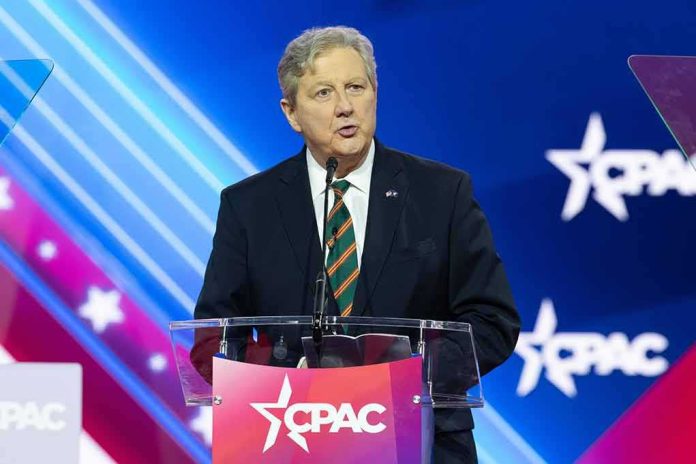
Conservative Political Action Conference attendees placed Vice President JD Vance first with 53 percent in a 2028 straw poll, with Secretary of State Marco Rubio second at 35 percent, a sharp jump from low single digits earlier, according to reporting on the event [1]. The spread underscores Vance’s frontrunner status while confirming Rubio’s momentum. Straw polls measure activist energy, not the broader electorate, but they shape donor attention and media coverage that can translate into money, staffing, and narrative advantage [1].
Fox News and other outlets framed Vance as the long-seen heir to President Donald Trump and his America First base, citing prior Trump comments calling Vance the “most likely” successor and even floating a Vance-Rubio ticket with Vance on top [1]. Rubio has publicly said that if Vance runs, Vance would be the nominee and Rubio would support him, reinforcing Vance’s pole position while giving Rubio space to rise if circumstances shift [1]. Absent a new 2026 endorsement from Trump, speculation remains fluid [1].
Why Rubio’s Portfolio Is Driving Momentum
Politico reports that senior White House officials credit Rubio’s expanded remit—spanning a United States operation in Venezuela and a month-long campaign of strikes against Iran—for his surge in visibility and perceived competence [2]. Rubio’s own briefings described strict engagement rules, the destruction of seven fast boats after warnings were ignored, and the successful transit of two United States-flagged merchant ships through the Strait of Hormuz under protection [2]. He has asserted sanctions are costing Iran up to five hundred million dollars daily and choking most trade, fueling severe inflation and currency collapse [2][3].
YouTube coverage amplified the connection between wartime leadership and political capital, highlighting how the Iran conflict has elevated Rubio’s standing amid 2028 speculation [3]. This dynamic fits a familiar pattern in Republican succession politics, where cabinet officials can spike in early attention by leveraging foreign crises to showcase command presence. That pattern benefits insiders with access to the global stage but can fade if outcomes deteriorate, costs mount, or voters tire of overseas commitments that feel disconnected from household economics [2][3].
The MAGA Test Rubio Still Has To Pass
Politico’s sources also flag lingering doubts within the populist right about Rubio’s alignment with America First priorities, citing perceptions that he is more hawkish on foreign policy, softer on immigration, and closer to traditional Republican orthodoxy than the base prefers [2]. Conservative activists who prize restraint abroad, immigration enforcement at home, and a combative stance against entrenched bureaucracies may view Rubio’s establishment-friendly profile warily. Those doubts will intensify if the Iran campaign or sanctions appear open-ended or economically costly [2].
Rubio’s standing also depends on outcomes he does not fully control. Politico characterizes his fortunes as tied to how the Iran war resolves and whether claimed successes endure without escalation or blowback [2]. Donor interest and insider praise can accelerate a rise, but the same forces can reverse if events shift. For many Americans—on the right and left—foreign ventures that seem to expand executive power while leaving border security, inflation, and public trust unresolved reinforce a belief that Washington protects its own first [2][3].
What This Means For Voters Tired Of D.C. Games
The Rubio-Vance storyline is more than inside baseball. It spotlights a federal government that too often rewards media narratives and elite conferences over measurable improvements in daily life. Activists see Rubio’s polished diplomacy and Vance’s populist brand and wonder which, if either, would prioritize secure borders, cheaper energy, and a fair economy over permanent crisis management. Until clear data verifies costs, results, and limits in Iran and Venezuela, skepticism about Washington’s accountability will remain justified [1][2][3].
🇺🇸 U.S. Secretary of State Marco Rubio said tensions between President Trump and Pope Léon XIV may continue, but won’t stop good relations.
Speaking on May 8, 2026, Rubio described his meeting with the Pope as “positive.”
Pope Léon XIV criticized America’s war in Iran. Trump… pic.twitter.com/L5pHXYtIU5
— Rwanda HD (@rwandahd) May 8, 2026
Next checkpoints are straightforward: independent verification of Rubio’s operational claims, additional straw and public polls showing momentum durable beyond CPAC activists, and an unambiguous 2026 statement from Trump clarifying succession preferences [1][2][3]. If Rubio converts wartime visibility into audited outcomes and grassroots trust, he moves from “rising” to “viable.” If not, Vance’s early lead and brand discipline keep him as the favorite—while voters on both sides keep asking why Washington keeps winning when families do not [1][2].
Sources:
[1] Rubio surges to 35% in CPAC 2028 straw poll as Vance leads at 53%
[2] White House insiders see Rubio on the rise as a potential 2028 pick