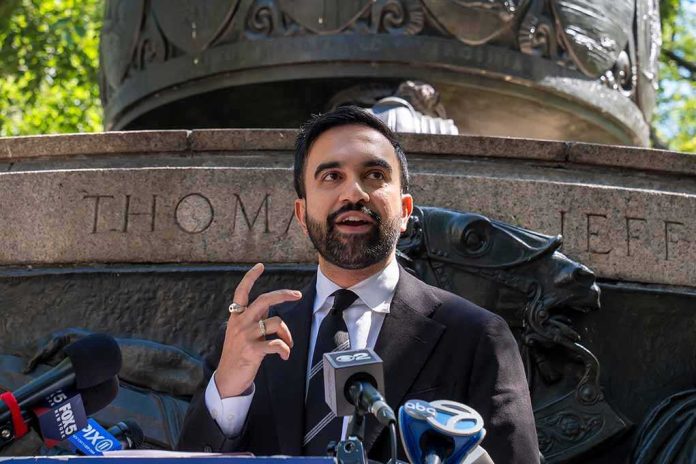
When cities move from regulating an old industry to prohibiting it, the courtroom stops being a venue for policy debate and becomes a test of legal first principles: equal treatment under the law and compensation when regulation extinguishes a lawful business. New York’s phaseout of Central Park’s horse‑drawn carriages will be decided on those terms, not on slogans about nostalgia or cruelty.
At a Glance
- The union and individual carriage operators filed a federal lawsuit immediately after the ban became law, putting constitutional and procedural claims before a judge rather than just the press.
- Plaintiffs argue the law singles out carriage tours while sparing other equine uses, and that it destroys medallion value without a guaranteed buyout.
- The City frames the law around horse welfare and public safety, with a mandated worker transition program and the possibility—not a promise—of compensation.
- A documented horse death from toxic vegetation fuels a parallel fight over responsibility and risk inside Central Park.
What the lawsuit actually contests
The Transport Workers Union, two owners, and a driver filed in the Southern District of New York the day the mayor signed the phaseout, alleging constitutional violations and procedural defects. Reported theories fall into three buckets: (1) unequal treatment—carriage tours are banned while horseback riding and racing continue; (2) takings—city-issued medallions and associated business assets allegedly lose their economic use without guaranteed compensation; and (3) process—the Council and administration purportedly cut corners enacting the law. While news coverage summarizes these claims, the docketed complaint—not yet surfaced in the record supplied here—will define the causes of action and requested relief, including any bid for a preliminary injunction.
The equal-treatment claim will hinge on whether the City can rationally distinguish carriage operations from other equine activities—on traffic exposure, public-safety externalities, animal-welfare risk, licensing structure, or congestion impacts. The takings theory will turn on what the medallion is in law: a transferable property interest or a revocable license; the Supreme Court’s takings jurisprudence treats total economic wipeouts differently from partial impacts, and compensation analysis starts with the nature of the interest, not its marketing price. The process claim lives or dies on the legislative record—calendars, committee transcripts, and rule compliance—rather than rhetoric.
How City Hall justifies a ban rather than more regulation
The administration states the law protects horse welfare and public safety while supporting roughly 200 affected workers through medallion buybacks, workforce development, job placement, and training, with a full transition plan expected by April 2027. The Council’s enactment materials describe a phased end by June 1, 2028, humane disposition requirements for horses, and a mandated workforce-transition program that includes referrals, counseling, placement, hiring events, and educational opportunities; on compensation, the law commits to consider a program for business, license, and equipment value, but it does not embed a payout formula in the statute. That difference—mandate versus consideration—is legally meaningful: courts read “shall” differently from “may,” and the plaintiffs’ takings narrative will point directly at that gap.
Beyond cash and jobs programs, the administration positioned electric carriages and pedal-assist options for future study, signaling that the City sees tourism value separable from animal use. That does not answer the constitutional questions, but it frames the policy choice: elimination of a risk deemed inherent, rather than mitigation through tighter rules.
The property question at the heart of the medallion fight
Medallions are the industry’s balance sheet—financed, traded, and treated as collateral. But the Fifth Amendment analysis is not an appraisal exercise; it asks whether government action has gone “too far” by appropriating or destroying a protected property interest. Two lines of doctrine matter. First, when a regulation deprives an owner of all economically beneficial use of a property interest, compensation is generally required; second, when government conditions or curtails a license in a highly regulated field, courts often treat the interest as limited and revocable, blunting takings claims. Which frame fits depends on statutory text, historical practice, and the specific incidents of the medallion—transferability, duration, renewal expectations, and whether the City induced reliance through past buybacks or assurances. Plaintiffs say medallions cost hundreds of thousands of dollars; the City counters with a transition architecture that includes potential—but not guaranteed—buyouts.
A practical note for readers: even when courts reject facial takings claims, they sometimes leave room for as‑applied compensation tied to individualized losses. If this case proceeds, expect expert valuations, evidence about financing and depreciation of equipment, and testimony on whether any continued use remains that preserves meaningful value.
Equal treatment and the comparators problem
The unequal-treatment claim asserts that the City targeted carriage tours while allowing other equine activities to proceed. Legally, the question is whether there is a rational basis for distinguishing carriages from horseback riding, mounted police operations, or racing. A rational-basis defense does not require the best or most consistent line-drawing—only a plausible one grounded in safety, congestion, enforcement practicality, or welfare risk differentials. The City’s legislative and administrative record points to horse welfare and public safety; the Council’s materials also emphasize humane disposition and structured worker transition. The plaintiffs will need a developed comparative record—routes, operating environments, incident data, veterinary oversight, insurance regimes—to argue that the City’s distinctions are arbitrary rather than reasoned.
This is where industry history matters. Urban animal-use controversies often migrate from rule tightening to prohibition when policymakers decide the risks are inherent—not manageable with better rules. Opponents reply that prohibition is a political choice masking regulatory failure, and that targeted fixes could mitigate risk without destroying livelihoods. New York’s carriage fight traces that well-worn path.
Safety, welfare, and the toxic-plant dispute inside the park
One recent event has become a proxy for the broader safety debate: a carriage horse’s death attributed by a Cornell necropsy to ingestion of Japanese yew, a plant lethal to equines in small quantities. Union leaders cite the report to argue the hazard was environmental and remediable—remove or mark toxic vegetation; warn drivers; and enforce a safety perimeter. The Central Park Conservancy responds that park rules forbid horses from eating any vegetation and that drivers are responsible for preventing grazing; it has also publicly supported ending the carriage industry on horse-safety grounds. The facts of the incident matter to the negligence narrative but do not, by themselves, resolve the legality of a citywide phaseout. What the incident does supply is a concrete example both sides use: operators to argue risks can be managed; advocates to argue that complex urban settings create unmanageable, ever-present dangers to prey animals.
JUST IN: Mayor Zohran Mamdani has signed a law banning horse-drawn carriages from city streets by June 1, 2028, ending a 150-year tradition.
“For 150 years, horse-drawn carriages have been a fixture of Central Park. Today, we are bringing that chapter to a close.”…
— The Rubin Report (@RubinReportShow) November 19, 2026
What to watch as the case moves forward
Three records will decide more than the press releases. First, the complaint and any early injunction motion will clarify whether plaintiffs proceed on federal takings, due process, or equal protection—and what remedy they seek. Second, the City’s legislative file will show whether the process claim has teeth or is a placeholder. Third, the transition plan due in 2027 will reveal whether compensation moves from “consideration” to commitment; if the City implements a robust buyback with enforceable rules, it will not moot the takings theory, but it could narrow the dispute to valuation rather than legality.
Beyond the courthouse, the practical politics are clear: the City has institutional control over the narrative and the implementation timeline, and it has framed the law as a historic animal-welfare win with structured support for workers. Plaintiffs counter with the language of constitutional constraint: government may change policy, but it must do so evenhandedly and, when it obliterates a vested business, with compensation.
Sources:
washingtontimes.com, usnews.com, bostonglobe.com, nydailynews.com, council.nyc.gov, nytimes.com, abc30.com, nbcnewyork.com