

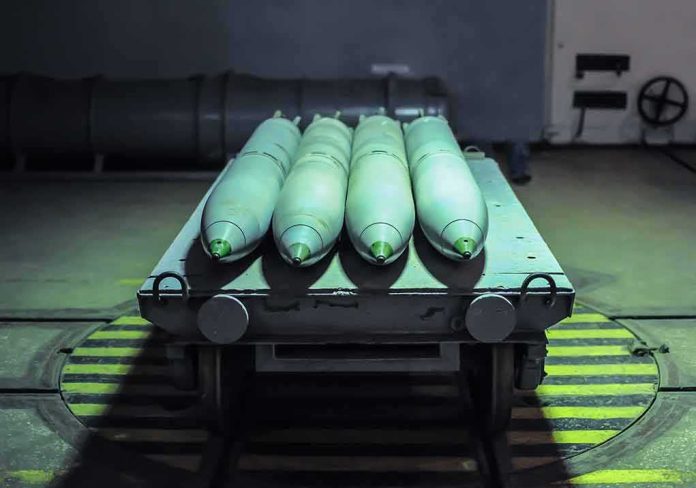
When a stockpile of unstable explosive collides with a legal clock, good governance is measured in hours, not months; Iowa’s disaster proclamation was the mechanism that fused federal hazardous-waste authority with on-the-ground coordination to manage a volatile lead-azide emergency at the Iowa Army Ammunition Plant.
At a Glance
- Iowa activated its disaster-response framework for three counties to coordinate around a federal emergency operation involving lead azide.
- The EPA issued an emergency permit authorizing the Army to store and treat a reactive, lead-toxic explosive; 68 drums at the Middletown site were identified.
- Courts briefly stayed the permit, creating schedule uncertainty even as state coordination continued.
- The move illustrates a recurring pattern: technical hazardous-waste problems shifting into emergency-management posture when risk becomes time-sensitive.
What Iowa’s disaster proclamation actually did
Governor Kim Reynolds’ proclamation activated the disaster response and recovery elements of Iowa’s emergency plans for the affected counties, placing state and local agencies on a unified footing for an operation centered at the Iowa Army Ammunition Plant in Middletown. In practice, this unlocks state-level coordination across public safety, public health, transportation, and communications functions; clarifies incident command with county partners; and positions resources and authorities in advance of a high-consequence task. Iowa’s Department of Homeland Security and Emergency Management characterized the action as triggering the Iowa Emergency Response Plan and relevant county annexes—procedural, yes, but consequential when minutes matter during an explosives operation.
This state posture complements, rather than duplicates, federal authorities. The EPA had already issued an Emergency Hazardous Waste Management Facility Permit to the Army specific to lead azide—an explosive that is both acutely reactive and a source of lead toxicity—authorizing storage and treatment actions necessary to abate an imminent and substantial endangerment. The state proclamation plugs Iowa’s interagency machinery into that federal framework so warnings, protective actions, and post-operation checks are not improvised.
Why this became an emergency: unstable lead azide, not routine waste
Lead azide is a primary explosive; small shocks can initiate detonation. According to court records, changes in storage conditions contributed to recrystallization in the Army’s stockpile—an effect that increases sensitivity to friction and impact—escalating the risk profile and narrowing the safe options for handling and disposal. EPA’s emergency permit formally recognized both the reactivity hazard and lead’s toxicity, and it authorized the Army to store and treat the material under emergency parameters rather than rely on standard, slower hazardous-waste processes. The operation identified a concrete scope: 68 drums at the Middletown plant. That specificity matters because emergency management aligns planning factors—blast safety arcs, air monitoring, traffic control, and public-health messaging—to exact inventories and locations.
The shift from routine permitting to emergency action follows a familiar arc in hazardous-materials governance. As material condition degrades or risk accelerates, the dominant hazard can flip: continued storage begins to look more dangerous than controlled treatment, even as treatment introduces its own externalities that must be managed. The state’s role is to prepare communities and synchronize protective measures around whichever technical course the federal lead agency executes.
The legal crosscurrents: operations planning amid a court stay
Even as Iowa stood up coordinated readiness, the federal permit’s path moved through litigation. Environmental organizations petitioned the Eighth Circuit to review EPA’s emergency authorization. The court issued a stay that paused the permit on a compressed timeline, and reporting described federal officials evaluating whether any separate legal authority could support proceeding during the pause. Those legal steps did not change the underlying risk calculus driving the state’s activation: an identified cache of sensitive explosive at a specific facility, with a federal plan to treat it under emergency parameters once legally executable. The state-level posture, therefore, aimed to be condition-ready rather than date-certain—prepared for execution windows and contingencies shaped by the court calendar as much as by weather and technical milestones.
For residents, the practical implication of the stay was timing uncertainty, not a recharacterization of the hazard. For responders, it underscored why advance alignment among county, state, and federal partners is prudent: once a legal green light emerges, the operational sequence—from site controls and air surveillance to public-information pushes—must be immediate and exacting.
Mechanics of coordination: how state activation fits with federal technical control
EPA’s emergency permit is the technical key: it authorizes the Army’s storage and treatment activities, prescribes controls, and frames environmental-protection conditions for the action. The Army owns the explosive-safety and engineering choreography on the installation. Iowa’s activation, meanwhile, is the connective tissue to the community. It standardizes incident command across jurisdictions, aligns county emergency managers and public health departments on protective-action guidance, and primes transportation and communications assets to manage perimeter traffic and public messaging. If air monitoring, sampling, or medical guidance are needed, those lines are already staffed. If a schedule shift or weather window opens, the state’s notification and coordination rhythm is in place, not built on the fly.
Because the hazard includes both blast risk and toxic potential, getting this division of labor right is not bureaucratic nicety—it is risk control. The installation manages detonation physics; the state manages human geography. Both must be synchronized to minimize exposure and confusion.
Why precision about “68 drums” matters
Emergency planning feeds on specificity. The Eighth Circuit record and EPA material converge on a clear unit count—68 drums—located at the Iowa Army Ammunition Plant, with EPA classifying the material as reactive and lead-toxic. With that denominator, modeling teams can bound worst-case and most-likely scenarios; public health can tailor advisories; agriculture and transportation can stage sensible, targeted measures rather than broad, blunt ones. Local outlets reported anticipated operational windows tied to those inventories, enabling counties to time staffing and alerts to credible expectations rather than rumor.
To a reader accustomed to environmental debates that trade in generalities, this level of technical anchoring is what distinguishes an emergency operation from a slogan. Inventory, condition, and location are the triad that responsible agencies must nail down; Iowa’s activation presupposed that triad and organized around it.
Iowa Governor Kim Reynolds Issues Disaster Emergency Proclamation for Three Counties as U.S. Army Prepares to Detonate 68 Barrels of Volatile Lead Azide Ahead of Thanksgiving
. https://t.co/8e35plLDRS— Larry Stoudt (@Live462) November 25, 2026
The broader pattern: two forms of precaution meeting in the middle
This episode illustrates a durable tension in hazardous-waste decisionmaking: one school of precaution prioritizes preventing an uncontrolled detonation of an increasingly unstable explosive; the other prioritizes preventing environmental dispersion from a controlled treatment action. EPA’s emergency-permit posture framed the material as an imminent endangerment that required emergency treatment authority; the court’s stay reflects the legal system’s gatekeeping over how swiftly such authority can be exercised and on what record. The state-level activation did not adjudicate that tension; it operationalized readiness for either outcome window. That is the unglamorous core of competent emergency management: synchronize people and systems so technical risk controls have a ready civic scaffold.
Sources:
thegatewaypundit.com, epa.gov, ecf.ca8.uscourts.gov, kttc.com, kwqc.com