

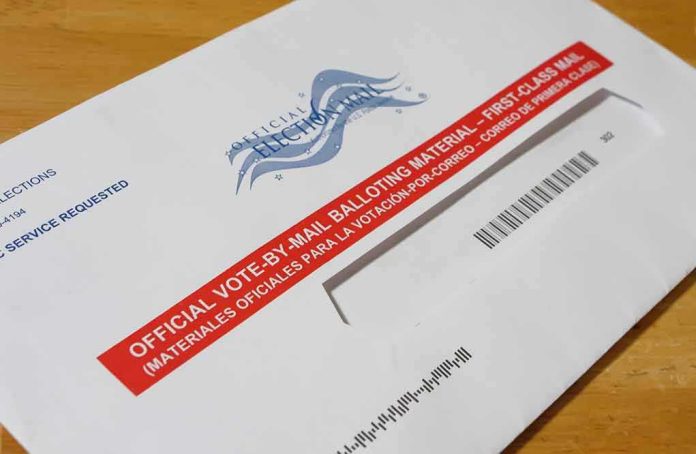
When election infrastructure changes collide with the calendar, process risk becomes voter risk; the Postal Service’s planned Federal Ballot Mail Portal sits squarely in that danger zone, with a detailed whistleblower disclosure alleging a rushed, untested build and courts already stepping in to slow or halt implementation.
The Short Version
- A USPS insider, through counsel, alleges the ballot mail portal and related IT were built in a “secretive, rushed, chaotic” manner with inadequate testing, elevating failure risk at scale.
- USPS counters that the portal is tightly scoped, not public-facing, and barred from inspecting ballot content or voter eligibility; it also says it will not implement the rule while injunctions stand.
- Courts and state litigants have already secured injunctions against aspects of the new regime, underscoring legal as well as operational uncertainty.
- Historically, USPS meets aggregate election-mail targets while localized process failures still threaten individual ballots—an uncomfortable but recurring pattern.
What the portal is, and what it is not
USPS’s final rule envisions a Federal Ballot Mail Portal as the sole data source used to verify outbound federal ballot mail before acceptance. States, through chief election officials or designees, would input limited information—principally mail piece characteristics, not birthdates or Social Security numbers—tied to unique barcodes. USPS presents the portal as closed to the public, firewalled between states, and supported by its Mailing and Shipping Solution Center. Crucially, the agency asserts the system neither authorizes inspection of ballot contents nor any review of voter eligibility or auditing of voter rolls. As litigation progressed, USPS further stated it would not take steps to implement the rule for the 2026 election unless courts lift current injunctions.
In design terms, the portal is a pre-acceptance validation and tracking adjunct—an IT front end layered onto existing mail-handling workflows, not a wholesale rearchitecture of USPS’s operational backbone. Its promise is standardization: uniform barcoding, predictable verification, and cleaner handoffs between election officials and postal operations. Its risk profile, however, hinges on how error-tolerant that verification logic is and how resilient the data flows are under national load.
The whistleblower’s allegation: speed over rigor
The counter-narrative is stark. An anonymous federal official represented by Whistleblower Aid told Senator Richard Blumenthal’s office that USPS leadership built “an entirely new and untested set of IT systems” for federal ballot mail—portal included—via a “secretive, rushed, chaotic, and fundamentally flawed” process. The letter asserts “direct knowledge” of significant concerns: compressed timelines, discarded best practices, and inadequate testing that could cascade into real-world ballot delays or rejections during peak election throughput.
Public reporting on the disclosure amplifies those specifics, describing a development sprint measured in weeks for software that, under normal governance, would run nine to twelve months from requirements to scaled deployment. The practical fear is failure mode: if verification relies on a strict barcode regime with little tolerance for batch anomalies, small errors could force repeat cycles or mass rejections, multiplying delay at the worst possible moment in the mail calendar.
Courts are defining the near-term reality
Even before the portal’s full operational debut, litigants secured emergency relief. A Massachusetts federal court temporarily blocked USPS from requiring state participation in the new portal and related pre-acceptance steps, finding a substantial question about authority and the risk of irreparable harm if rules shifted close to an election. A state attorney general’s office summarized the order as barring USPS from conditioning ballot acceptance on portal registration or federal design approvals, stabilizing practices while the merits are litigated.
This legal overlay matters. It slows implementation, compels clearer administrative records, and, in practice, forces USPS to operate the status quo during the pendency of injunctions. USPS’s own statement that it will not implement the new rule for the 2026 cycle absent relief from those injunctions confirms that, for now, courts—not code—govern the timeline.
Mechanism and failure modes: how a narrow tool can create wide effects
Pre-acceptance verification sounds benign: ensure the mailing conforms to standards before induction, then move volume. But two technical realities raise stakes. First, centralization: if the portal is the sole gate for acceptability, any outage, performance degradation, or data mismatch can stall entire outbound runs. Second, enforcement granularity: if the system treats a mixed ballot mailing as a single object, a single bad record or mis-encoded barcode can trigger a batch-level exception. The whistleblower’s warning converges on these mechanics—tight gates, low error tolerance, and national-scale load without burn-in testing translate to disproportionate disruption when the calendar cannot absorb retries.
An expert’s remedy set is straightforward but time-consuming: define failure domains to the smallest viable unit; build graceful degradation paths; rehearse with live-like volumes; and stand up parallel contingency workflows election officials can invoke without friction. That is the antithesis of a compressed, late-cycle rollout. The courts’ pause, whatever its politics, creates breathing room to build these guardrails if the policy survives.
How this fits the broader election-mail pattern
Election logistics in the United States routinely combine strong aggregate performance with pockets of procedural fragility. Independent oversight of the 2024 general election found USPS significantly exceeded service goals for Election and most Political Mail, yet still flagged deficiencies in ballot tracking and processes that pose risks of delays or non-counting at the edges. That duality—broad success with localized vulnerabilities—recurs across cycles and audits, and it is precisely where a brittle pre-acceptance tool can do outsized damage: not by collapsing the national network, but by creating avoidable choke points where volume and variance are highest.
Against that backdrop, introducing a mandatory, centralized verification layer late in the cycle is the classic way to turn known micro-risks into macro headlines. Stability in rules and interfaces is itself a safeguard; change management is part of election security.
A USPS whistleblower alleges the Postal Service rushed a new mail-ballot system in weeks — not the 9–12 months such a project usually takes — and that it could reject thousands of ballots.
Under the plan, USPS would check ballot barcodes against lists uploaded by states. One bad… https://t.co/T1OAdXYIZU
— The Digital Free Press (@tdfreepress) September 1, 2026
What to watch, and what matters long term
Three tests will tell whether the portal becomes a durable improvement or a cautionary tale. First, governance: are requirements, data schemas, and exception policies published, versioned, and co-designed with state users? Second, resilience: has the system passed load and failover testing at election-scale volumes with states piloting real workflows? Third, proportionality: do errors quarantine to the smallest unit—an individual mail piece—not entire trays or batches? USPS’s assurances about scope and privacy are necessary but not sufficient; reliability lives in error handling, not the happy path.
The legal posture ensures time to answer those questions. The operational posture demands the answers be demonstrated, not asserted. A portal that enforces barcode discipline, preserves privacy, and speeds induction could be a net win. A rushed gate that magnifies small mistakes into large delays is worse than doing nothing. The whistleblower’s disclosure, detailed and contemporaneous, justifies scrutiny on the latter risk; USPS’s commitments and the injunctions now provide the venue to resolve it on the facts.
Sources:
cbsnews.com, usnews.com, blumenthal.senate.gov, wrkf.org, uspsoig.gov, ag.ny.gov