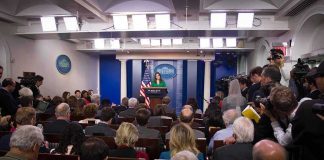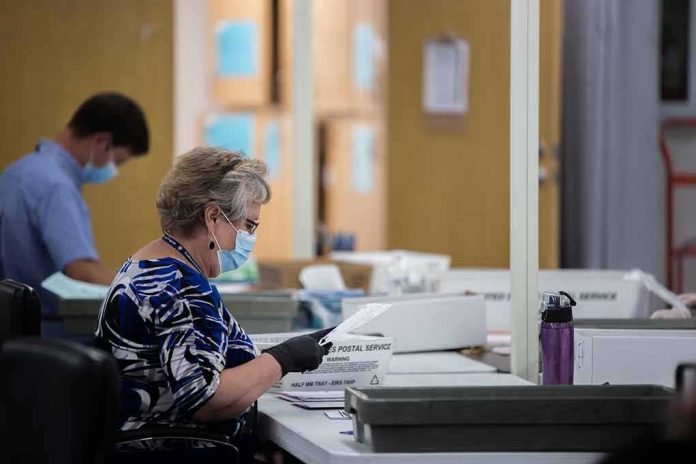
The fight over Trump’s mail-ballot executive order and the Postal Service’s new ballot-delivery rule is ultimately a fight over who runs American elections—and the courts are increasingly signaling that neither the president nor USPS can lawfully seize that role from the states.
At a Glance
- Trump’s Executive Order 14399 directs USPS to refuse transmission of mail ballots unless voters appear on state-provided lists tied to a federal citizenship database, effectively turning the Postal Service into a gatekeeper for ballot access.
- A Boston federal court has held that the president “has no specific powers over elections” and that USPS lacks statutory authority to control mail-in voting, declaring core parts of the order and rule unconstitutional and “legally void.”
- Two different federal courts have blocked the rule: one on constitutional grounds, another under a prior nationwide settlement with the NAACP that protects existing election-mail practices.
- A D.C. Circuit panel has now stayed part of that block, allowing USPS to keep writing and moving toward implementation in some states while appeals proceed, creating a patchwork of rules heading into the midterms.
How Trump’s Order Tries to Rewire Mail-In Voting
Executive Order 14399, titled “Ensuring Citizenship Verification and Integrity in Federal Elections,” is the legal foundation for the current dispute. Signed in March 2026, it does two structurally significant things. First, it instructs the Department of Homeland Security to assemble a “State Citizenship List” for every state using Social Security Administration records and the federal immigration database known as SAVE, then transmit those lists to election officials prior to each federal election. Second, it directs the United States Postal Service to adopt regulations under which USPS “shall not transmit” an absentee or mail ballot unless the intended recipient appears on a state-specific participation list that is supposed to reflect DHS’s citizenship data.
In practical terms, that moves USPS from being a neutral carrier of election mail to being a screening authority. The proposed ballot-mail rule developed to carry out the order would require states to furnish detailed voter manifests—names, addresses, and unique identifiers or barcodes—on a timeline ahead of ballot mailing, and USPS would check outgoing and returning ballots against these lists. Postmaster General David Steiner underscored the shift in role when he testified before the Senate Homeland Security Committee; asked whether USPS would deliver ballots to a state that refused to supply the required lists, he answered “We would tell the state that we need the manifest,” making clear that ballot delivery would be conditioned on state compliance.
The administration characterizes these moves as election integrity measures: documentary proof of citizenship, federal screening to prevent non-citizen voting, and tighter control over ballot chains of custody. But structurally, they amount to a federal executive attempt to dictate who receives a ballot and under what conditions—roles the Constitution assigns primarily to state governments and, in limited respects, to Congress.
The District Courts: Constitutional Limits and USPS’s Legal Authority
Litigation attacking the order and the USPS rule began almost immediately, led by Democratic attorneys general, civil-rights groups, and nonpartisan voting organizations. In a key Massachusetts case often referred to as California v. Trump, U.S. District Judge Indira Talwani issued a detailed opinion on June 25, 2026, that goes to the heart of the president’s claimed authority. Talwani stated bluntly that “The Constitution does not grant the President any specific powers over elections,” emphasizing that the Elections Clause places the regulation of the “Times, Places and Manner” of federal elections with state legislatures and Congress, not the executive branch.
On that basis, she held that Sections 2 and 3 of Executive Order 14399—which direct DHS to create federal citizenship voter lists and empower USPS to restrict ballot delivery to those appearing on approved state lists—are unconstitutional and ultra vires, i.e., actions taken beyond the president’s lawful powers. The court entered summary judgment for the plaintiff states and enjoined USPS from implementing the rule or enforcing those provisions within the suing jurisdictions.
Talwani’s opinion also addressed USPS’s own statutory authority. She concluded that “no law enacted by Congress delegates authority to control mail-in voting to USPS” and that USPS “lacks statutory authorization to promulgate any binding regulations on mail-in voting.” That point matters because even if Congress could empower a federal agency to regulate ballot delivery, it has not done so here. The Postal Service’s organic statute focuses on universal mail service and rate-setting, not election administration; using those powers to decide whose ballot is carried or rejected, the court reasoned, exceeds USPS’s remit.
A separate federal court in Washington, D.C., looked at the same rule through a different lens: a 2020 nationwide settlement in NAACP v. USPS that required the agency to maintain certain established election-mail practices. Judge Emmet Sullivan concluded that the proposed restrictions—conditioning ballot delivery on state voter lists and returning ballots that do not match those manifests—would violate that settlement agreement, and he extended an injunction nationwide to prevent USPS from implementing the rule in any state.
The Appeals Court Stay: A Narrow Win and a Patchwork Landscape
Despite these district-court setbacks, USPS and the administration proceeded to the appellate courts, arguing that they would suffer “irreparable harm” if blocked from implementing the rule in time for the 2026 midterms. Their argument is straightforward: elections are one-time events; if the executive’s preferred safeguards are not in place when ballots go out and are returned, there is no opportunity to redo the process later.
In NAACP v. USPS, a three-judge panel of the D.C. Circuit accepted enough of that reasoning to stay Sullivan’s injunction as it applied to the new rule-writing process. The panel found that USPS had made “a strong showing that they will likely succeed” on two points. First, that the proposed rule was not yet constitutionally or prudentially ripe for review because it was still being finalized—meaning that the underlying legal challenge might be premature. Second, that absent a stay, the injunction would render USPS unable to issue and implement a final rule in advance of the November 2026 general election, satisfying the irreparable-harm requirement for emergency relief.
Crucially, this stay does not overturn Talwani’s constitutional ruling in Massachusetts, nor does it definitively bless the rule’s legality. It allows USPS to continue the administrative process and, in states that were not parties to the Massachusetts suit, move toward applying the new standards, while separate appeals in the First Circuit and other circuits proceed. The result, as election-law commentators have noted, is a patchwork: the rule remains blocked in the roughly 23 Democratic-led states plus D.C. that sued, while in the other states USPS can continue down the path toward implementation unless and until further injunctions are issued.
For supporters of the rule, the D.C. Circuit’s stay is cast as a “big win”—a judicial signal that the agency’s position is at least plausible and that courts should not freeze election-related regulations months before they take effect. For opponents, it is a procedural setback rather than a substantive defeat; the underlying constitutional and statutory challenges remain unresolved, and the most detailed merits ruling to date still declares the core of the order and rule unlawful.
Executive Power, State Authority, and the “Election Integrity” Frame
To understand the stakes, it is useful to place this conflict within the broader pattern of Trump-era efforts to reshape election administration through executive action. Legal analyses from organizations such as Just Security and Protect Democracy have described a consistent strategy: spread unsubstantiated narratives of widespread fraud, install loyalists in key positions, use executive orders and agency rulemaking to override state election norms, and then challenge or discredit certification processes that do not produce favorable outcomes.
Executive Order 14399 fits that pattern. The administration frames it as a response to the risk of non-citizen voting and foreign influence, citing federal databases and national-security concerns. Yet the Brennan Center and other experts have repeatedly found no evidence of systemic non-citizen voting fraud sufficient to justify nationwide restrictions of this sort, and they emphasize that attempts to treat generic security rhetoric as a basis for federal takeover of election rules have no constitutional grounding.
From a structural standpoint, the key legal question is not whether citizenship verification is, in the abstract, a legitimate policy goal; it is who has authority to adopt and enforce such rules. The Constitution’s text and longstanding practice place decisions about voter eligibility and ballot procedures primarily in the hands of state legislatures, subject to congressional override—not the president, DHS, or USPS. Multiple analyses by constitutional scholars and advocacy groups converge on this point, stressing that “no president has the power to cancel or postpone federal elections, nor can the president abuse emergency powers to override the will of the voters.”
When a president directs a federal agency to withhold ballots from voters whom state officials would otherwise serve, he is not merely supplementing election integrity; he is supplanting state authority with unilateral executive preference. That is precisely the kind of “executive override” doctrine courts have been pushing back against in case after case involving election administration.
USPS Scores Big Win, As Fed Appeals Court Stays Order on Vote by Mail Ballots https://t.co/vnuSmrfPgk
— 🌺🌿kam🌿🌺 (@pjkate) July 18, 2026
Operational Risks: Universal Service vs. Targeted Ballot Denial
Separate from the constitutional debate, there is a practical question: what does it mean for USPS’s universal service obligation if the agency begins denying ballot delivery based on federal screening criteria? The Postal Service’s statutory mission under Title 39 is to provide prompt, reliable, and efficient mail service to all communities, treating users of the mail in a fair and equitable manner. The proposed ballot rule would carve out one category of mail—election ballots—and subject it to a gatekeeping process that does not apply to other time-sensitive items.
State attorneys general and multistate comment letters argue that this violates the basic premise of universal service, commandeering states into a federal data-collection and screening program that arbitrarily disenfranchises eligible voters whose information is missing or mismatched. In their view, requiring states to submit identifying information for all mail voters and then having USPS compile state-specific lists that dictate which voters may be delivered ballot mail effectively turns the agency into an election regulator without statutory authority or accountability.
These operational concerns connect directly to the courts’ analysis of harm. The administration invokes irreparable harm if it cannot implement the rule because “there can be no do-over” after the election. Opponents respond that the greater irreparable harm lies in wrongly denying eligible voters access to ballots, based on opaque federal data and untested screening processes, in a system where the president and his appointees have a direct stake in the outcome.
What Comes Next: Appeals, Supreme Court Timing, and Legislative Detours
Looking ahead, three trajectories matter. First, the appellate process. The First Circuit will review Talwani’s ruling on the president’s election authority and USPS’s statutory powers; the D.C. Circuit and possibly other circuits will confront the interplay between the NAACP settlement, ripeness doctrine, and the new ballot rule. Until those courts speak definitively, the legal status of Executive Order 14399 and the associated USPS regulation will remain uneven across states.
Second, parallel Supreme Court litigation could reshape the broader ecosystem of mail-in voting even apart from the USPS rule. The Watson v. Republican National Committee case—challenging whether ballots must be received by Election Day rather than simply postmarked—could impose a nationwide receipt-by-Election-Day requirement that would override more permissive state laws. That shift would tighten timelines for voters and election officials alike and magnify the impact of postal delays, making any change to USPS postmark practices or ballot-handling protocols more consequential.
Third, Congress remains a potential—though uncertain—venue for more durable change. The administration has backed legislation such as the Save America Act, which would require documentary proof of citizenship and photo ID to vote. Statutory reforms enacted by Congress would stand on firmer constitutional ground than unilateral executive orders; they would still face judicial review, but they would not suffer from the basic defect Talwani identified: the president acting in an area the Constitution reserves to states and Congress.
For voters and election officials, the practical takeaway is straightforward. Absent new legislation, the default constitutional arrangement continues to govern: states and Congress set the rules for federal elections; the president and federal agencies cannot unilaterally decide who receives a ballot or how states must design their mail-in systems. The current round of litigation over USPS’s ballot-delivery rule is another test of that boundary. The appeals court stay gives the Postal Service room to keep moving, but the deeper question—whether the executive branch can lawfully insert itself as a gatekeeper in the mechanics of voting—remains unresolved, and the most developed merits ruling so far answers no.
Sources:
redstate.com, whitehouse.gov, npr.org, cnn.com, aclu.org, brookings.edu, cortezmasto.senate.gov, washingtonpost.com, nonprofitvote.org, sos.wa.gov, aapd.com, oag.ca.gov, ag.ny.gov, reuters.com, justsecurity.org, brennancenter.org